This week, we remember the one and only Dolly Parton. Dolly used her musical success to help others. She started the Imagination Library, a free book program for children that included some of her favorites, like the "Little Engine that Could." And, Dolly’s kindness touched people from all walks of life.
Home » Stories » Tetanus a Public Health Concern After West Virginia Flooding
Published
Tetanus a Public Health Concern After West Virginia Flooding
Listen
Share this Article
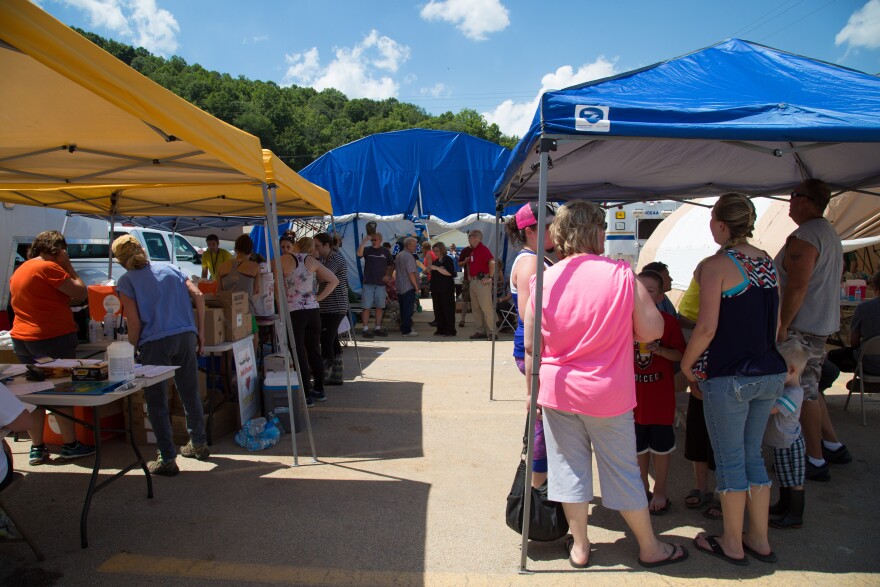
The two tents set up in a grocery store parking lot in Clendenin were overflowing with people waiting for tetanus vaccines Tuesday afternoon. A shipment of about 1,000 had been promised from out of state, but the FedEx truck holding them was held up in Memphis. Health Right, a free clinic based in Charleston, had about 50 to offer.
“I knew these people were out here waiting and so we do what we do best at free clinics,” said Angie Settle, executive director of Health Right. “We get our boots on the ground, we call people, [and] we tell them what the situation is. We have a good name in the community so people know our hearts are in the right place and they reach out for us.”
So by the time she pulled up to the makeshift hospital around 3 p.m., she had 250 doses with her from four Charleston-based donors – enough to cover that afternoon’s demand.
The vaccinations are part of a public health push to protect the people exposed to floodwater against bacterial disease, particularly tetanus.
Tetanus is a bacterial infection that affects the nervous system. It’s also known as “lockjaw” because it can cause your neck and jaw to lock, making it hard to open your mouth or swallow.
For the past 70 years, tetanus has been steadily declining in the U.S. due to the introduction of vaccines. But it’s still possible to get it through exposure to the bacteria in soil or contaminated water.
Credit Kara Lofton / WV Public Broadcasting
/
WV Public Broadcasting
The makeshift hospital in Clendenin, WV
Floodwater and residual mud like West Virginia experienced this past week are prime breeding grounds for the bacteria that causes tetanus because “there’s a mix of flood water and sewage that happens,” said commissioner of public health Rahul Gupta.
“The challenge with especially the sewage is the bacteria that can remain alive, and those bacteria can not only remain alive, but can actually grow,” he said.
So if you were a victim of the floods or a first responder or even a reporter who has been mucking around in a cocktail of floodwater, feces and unknown chemicals, you might be at risk.
The very best way to protect yourself against the tetanus bacteria is by using gloves, wearing rubber boots and properly cleaning any cuts. Tetanus bacteria enters the system through contact with the skin.
“So for contact, it really depends if they have any open wounds or abrasions,” said Gupta. “And oftentimes what would happen is you may not always be aware while you are cleaning [that] you have some skin breaks and may have some abrasions that may happen. And you may not feel those, so there can be contact with skin, but especially if it is not intact, and no matter how microscopic, those are bacteria can seep in.”
But vaccines are vitally important too – victims and first responders often did not have all the cleaning supplies they needed in the first few days following the flood.
Credit Kara Lofton / WV Public Broadcasting
/
WV Public Broadcasting
Angie Settle (left) holds tetanus vaccines at the makeshift hospital in Clendenin.
Fortunately almost everyone is vaccinated for tetanus as children these days. It is one of those vaccines required to enroll in school. But adults need a booster every 10 years to retain their immunity. However, boosters do take a couple weeks before they build full immunity.
Tamra Stall, a family practice doctor in Greenbrier County, said since tetanus has an incubation period of 3 to 21 days, boosters can still help protect people.
“The sooner after exposure they are inoculated, if they have not particularly had it before, the better prevention will be,” she said.
Stall’s office has given more than 1,000 doses of tetanus so far. Staff ran out of the vaccines Monday afternoon. By Monday evening, more than 100 people were on a waiting list. The office received 250 donated doses Tuesday and another 250 Wednesday. The state health department ordered several thousand new doses Monday to address the need for the vaccine across the state.
Appalachia Health News is a project of West Virginia Public Broadcasting, with support from the Benedum Foundation.
Add WVPB as a preferred source on Google to see more from our team
Scores of volunteers have poured into flood-worn north-central West Virginia, bringing cleanup supplies and food that residents need for the long recovery ahead.
Torrential rains flood the north-central part of the state, a state delegate faces 'disgusting' criminal charges, and scouts pour into W.Va. for the 2026 National Jamboree.