Alert (March 14, 2026): Due to recent high winds, our radio/TV tower in Bethany is not operational. Our engineers are working to resolve the issue. Alert (March 11, 2026): Our TV translator in Flatwoods is experiencing technical issues. Our engineers are troubleshooting the problem and expect it to be down for a couple days.
Thank you for your patience.
This week, we meet the woman behind the popular TikTok account “Appalachian Forager.” She makes jam from pawpaws and jewelry from coyote teeth. Also, we sit in on a master class in foraging for wild mushrooms. And, when a West Virginia pastor got assigned to a new church, folks tried to warn him.
Home » N.C. Artist Puts New Spin on Family's Legacy of Pottery
Published
N.C. Artist Puts New Spin on Family's Legacy of Pottery
Listen
Share this Article
Historically, the Catawba River Valley in North Carolina is pottery country. The Reinhardt family worked here for generations, making utilitarian pots for farmers. Now, Michael Gates is building on his ancestors’ work. Gates has always been creative, but it took him a while to find his calling as an artist.
Gates spent time in Australia, lived in California, and then, about five years ago, inspiration struck much closer to home.
In the 19th century, North Carolina’s Catawba River Valley region was a hotbed of pottery production. Dozens of artisans, many of them German, made ceramic jugs, the kind that people needed to store food, water, and essentials.
Gates’ ancestors were among those artisans. As late as the 1950s, members of his family were still making pots in the old, utilitarian style.
In an old farmhouse that’s been in the family for generations, Gates’ great-grandfather built his kiln, what they call a groundhog kiln, dug into the earth and enclosed by an arched brick roof.
For Gates, this place has always been a family monument. But now, it’s also a source of artistic vision.
In recent years, he’s been making regular visits to the Catawba Valley, and they’ve led him to completely rethink his own art.
“In my education and early on I enjoyed surrealism, and kind of went through phases and never really found a focus until I started looking closely at my own history and the region,” Gates said.
That’s when something clicked. When he got a bit of distance, Gates saw that the creative foundation he was looking for was already in place, back where he’d started.
“I guess you realize how unique it is,” he said. “All the things that you grow up seeing, you take for granted.”
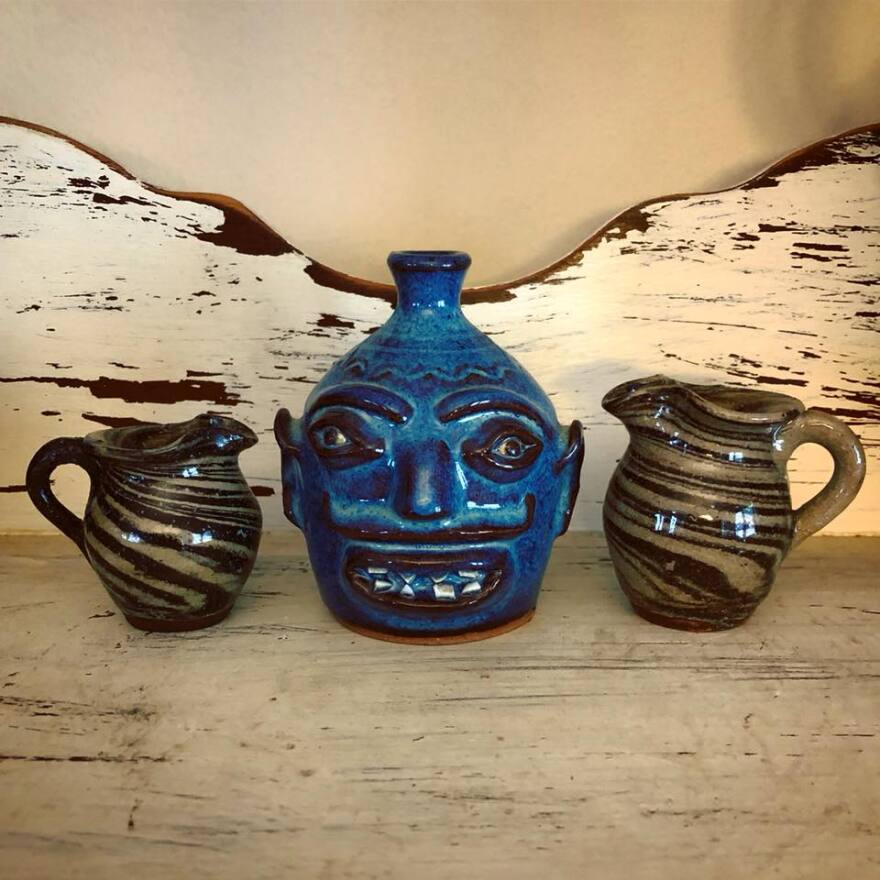
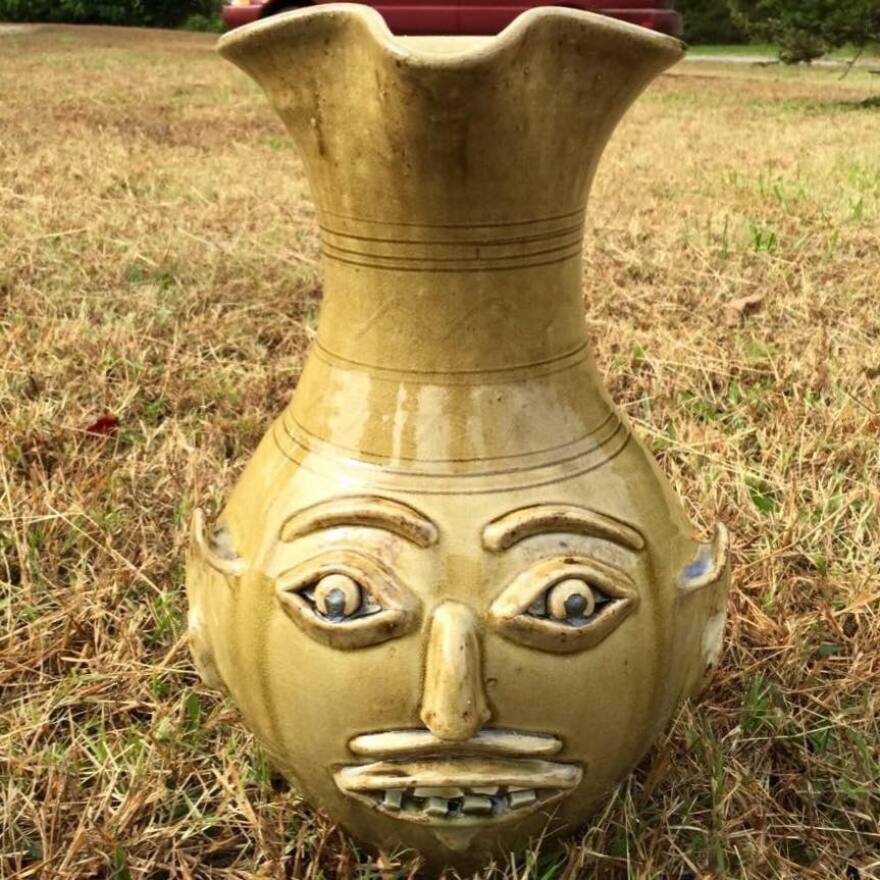
The story of Catawba Valley pottery has become the jumping off point for Gates’ own pottery. Of course, his pots aren’t quite the same utilitarian objects his ancestors made. They’re art. And sometimes, he even pushes the limits of what counts as pottery. Such as the time he made a more modern version of the face jug, one of the valley’s most iconic forms.
“I was taking pictures of my friends’ faces and putting them on jugs [and] just having fun with it,” he said.
Credit Joe O’Connell
/
Jugs made by Michael Gates
Years later, Gates still loves turning a historical style on its ear.
In 2017, he entered a juried exhibit at the North Carolina Pottery Center called “The Last Drop: Intoxicating Pottery, Past and Present.” For source material, Gates looked back all the way to a 17th century English piece–a slipware vessel in the form of an owl.
If drinking out of an owl sounds wild, drinking out of his reinterpretation would surely be even wilder. The owl’s face has what looks like a scornful, disapproving expression. Its ceramic body is densely adorned with underglaze decorations of hop vines and written phrases lifted from the American prohibition movement. It’s a clever, and masterfully-made piece.
Not surprisingly, it sold immediately.
“He does some things that just blow my mind,” said Gates’ father, Jim. “He’ll make face jugs and he’ll put decorations on them that look like henna tattoos, [and] sells them in Asheville. It would have blown my grandfather’s mind. I wished he could have lived to have seen some of Michael’s work.”
Credit Joe O’Connell
/
Enoch Reinhardt, Jim’s grandfather, left pottery behind before collectors really began to crave work from the Catawba Valley in the 1970s and 80s. Jim Gates appreciates that his son is making the leap into art pottery that his grandfather never could.
Gates wants his pottery to be a viable business, but the thing he lacks is a sizeable wood-fired kiln of his own, so he can boost his production.
That’s part of the reason why he and his father are turning their attention to their family’s old kiln. It’s going to take a lot of work and some help from neighbors to rebuild it, but if things go well, they’ll be able to fire it later this summer.
This story is part of an episode of Inside Appalachia about people who are working to preserve a part of American culture and traditions. Click here to listen to the full episode.
Add WVPB as a preferred source on Google to see more from our team
On this West Virginia Week, the state budget is headed to Gov. Patrick Morrisey, a statewide public camping ban bill moves forward, and Inside Appalachia visits Good Hot Fish.
Our program, Inside Appalachia, in December was tagged in an Instagram post by WVU Professor of Art Joseph Lupo. The post showcased four-color reductive relief prints made by WVU students — each one inspired by a story or episode they heard on the show.
On this West Virginia Week, another round of school consolidations in the state, the Republican caucus lays out plans for the upcoming legislative session and a Nashville poet and songwriter channels a connection to LIttle Jimmie Dickens.
...
On this West Virginia Week, the body of a missing miner was recovered, guaranteed median income comes to Mercer County, and with Halloween over and Thanksgiving a few weeks away, what can you do with those leftover pumpkins?