


'Haunted' Town Already Celebrating Spooky Season
Halloween is still several weeks away, but one West Virginia town is already celebrating the season.
Continue Reading Take Me to More NewsAlert (09/29/2026): Our Parkersburg TV transmitter is still undergoing maintenance and remains temporarily inoperative. We apologize for the inconvenience.
All our programming is available via our TV livestreams on our website and WVPB Passport. Thank you for your patience!




To Educate, Inform, and Inspire by Telling West Virginia's Story

Mountain Readers Week will be held Oct. 5-9, 2026! Celebrate and foster a love of reading in children across West Virginia.

Nominate an exceptional West Virginia K-12 teacher today!

On Demand

On Demand

Stream original productions from WVPB

Watch locally produced documentaries & more.

On Demand

On Demand






West Virginia Morning

Inside Appalachia

West Virginia Week

Mountain Stage

Us & Them

The Legislature Today

The Legislature This Week

Send us your comments and questions.

Stream our board meetings.

Check out the latest WVPB news.

Sign up for our newsletter and get weekly updates.

Meet the WVPB staff.

WV Educational Broadcasting Commission, the WVPB Foundation, and the Friends of WVPB.

Come work with us!

Read our annual report and learn how we educate, inform and inspire with your support.

Sponsor impactful and engaging media and entertainment.

Use your IRA to make a gift to WVPB.

Become a member with your gift of $1,000 or more.

Make WVPB part of your legacy.

Manage your membership account.

Learn how you can Protect and Sustain West Virginia Public Broadcasting.
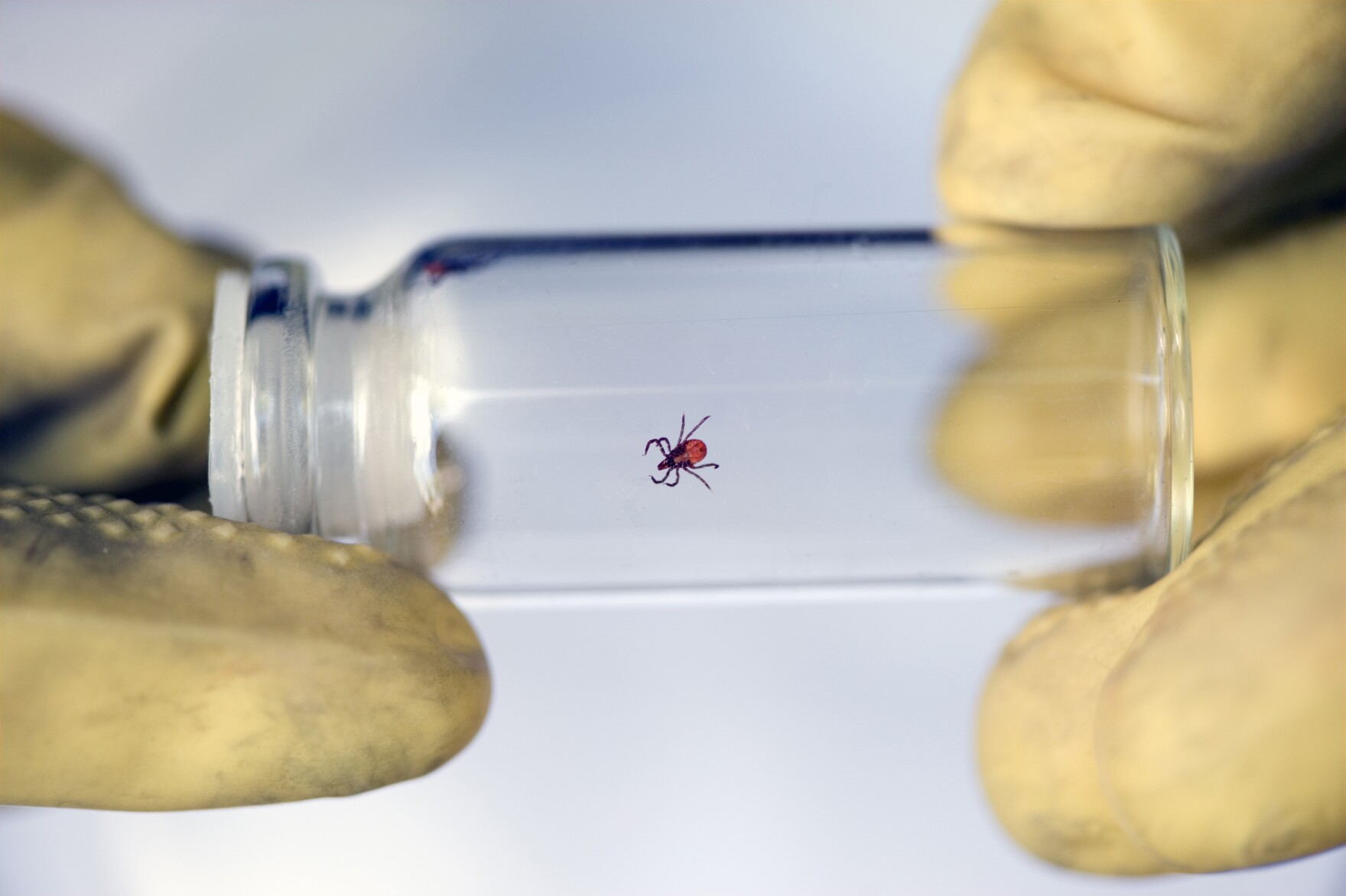
In June of 2007, Victoria Snyder, then age-nine, attended a week-long church camp. During the week she began to feel sick – muscle aches, lethargy, headaches. A doctor at the camp thought it might be the flu, but she didn’t get better. So after camp, her mother, Christine, took her to see a pediatrician.
“The pediatrician found a bullseye ring on her stomach,” said Christine. “I felt a lot of relief when they put her on antibiotics because with Lyme disease, we knew what we were dealing with.”
In 2007, there were only 84 confirmed cases of Lyme Disease in West Virginia – most of which were in the Snyder’s county, Berkeley. Seven years later, that number almost doubled to 136. The next year, 2015, it doubled again.
“The number of cases are increasing,” said West Virginia University pediatric infectious disease specialist Kathy Moffett. “It’s not that we haven’t diagnosed it before, it’s that it hasn’t been here before.”
Moffett said experts think that the mountains in eastern West Virginia have long been a barrier against the ticks (West Virginia’s border states of Maryland, Pennsylvania and Virginia all have high levels of Lyme).
Others disagree, saying Lyme has always been in West Virginia, it just wasn’t well diagnosed.
“I can tell you I don’t think there’s a great wall of West Virginia and all these ticks stop at these borders. It’s rampant in Virginia, it’s rampant in Pennsylvania, it’s rampant here,” said Doctor Erika Pallie, a West Virginia-based physician who used to work for WVU.
“The presumption is that for some reason West Virginia still doesn’t have Lyme disease,” she said. “I would propose this is a self-fulling fallacy. Doctors are told there’s no Lyme disease here, therefore they refuse to test people for it, therefore they don’t find it, therefore they don’t report it.”
Nationwide, the Centers for Disease Control and Prevention registers about 300,000 new cases of Lyme disease each year. More than 96 percent of those cases are being reported in 14 states. (West Virginia does not yet officially make that list, although if trends continue, it might in the coming years.)
The Lyme Controversy
Doctors Pallie and Moffett have both seen and treated Lyme in West Virginia. But they view the disease in very different ways.
Moffett adheres to the Infectious Disease Society of America’s recommended guidelines for Lyme, which basically state that Lyme is hard to get and easy to treat.
Pallie, who has personally had Lyme, believes that the IDSA’s definition of Lyme is too narrow. Rather, she follows guidelines from the International Lyme and Associated Diseases Society, which state there are more than 100 strains of the bacteria that cause Lyme in the United States. Therefore, a cocktail of antibiotics (rather than a single round of one) may be needed to treat Lyme.
The International Lyme Society’s research has also indicated that the official, primary, test used for the disease is only about 65 percent sensitive. So when possible, Pallie would order a different one. (Other, more sensitive tests are generally not covered by insurance as preliminary screening.)

But Moffett defends the IDSA’s guidelines saying, “[T]hese [guidelines] have been studied very closely and carefully to look at the science behind how accurate these tests are – are they valid and the science says they are valid. There are a minority of people who feel that their disease may not be accurately diagnosed who are looking for answers of symptoms that may have nothing to do with Lyme.”
For several years, those minority of patients flooded Pallie’s clinic in Morgantown.
“When you come down to it, I believe patients have the right to be informed of the risks of their alternative choices,” said Pallie. She said she told her patients “[L]ook this is the deal. This is what you have, this is the infectious disease standard of care and the ILADS standard of care, and these are the risks of this treatment.”
Pallie said eventually her supervisors at WVU asked her to stop diagnosing and treating Lyme or sending out any more specialty tests. Instead, Pallie says, she was instructed to send patients she suspected had Lyme to the infectious disease specialists at WVU.
Pallie says she understands that decision since she was hired as a family doctor, not a Lyme disease specialist. Nevertheless, she resigned from her position at WVU because she thought it was unethical not to treat patients she really did think have Lyme.
Still Sick? It Must Not Be Lyme
For one thing, many of the patients Pallie saw had stories like Victoria Snyder’s. Back in 2007, after her first round of antibiotics, Victoria didn’t get better. By November of that year, Christine took Victoria to an infectious disease specialist in Winchester, Virginia, who recommended that she be admitted to hospital and given six weeks of intravenous antibiotics.
“When she finished the IV antibiotics, she definitely had less of the cloudy thinking – we were just hoping that her energy would catch up,” said Christine.
It never did. Victoria is now 17 and a senior in high school. She tests negative for the bacteria that causes Lyme, but most days, it is all she can do to get out of bed and get through the school day.
Christine said the doctors she took Victoria to said “she was cured of Lyme disease and it was official. They weren’t willing to look into what other issues might be causing the fatigue.”
Christine also said her insurance refused to continue paying for treatments since Victoria no longer tested positive for Lyme. But she doesn’t see how the current health issues Victoria is having could not be related to Lyme. ”Victoria was a normal, high energy, 9-year-old kid. There was a change in her and it has never been the same since she got sick,” she said.
According to the Infectious Disease Society, there is no such thing as chronic Lyme disease. WVU’s Moffett said continuing to treat for Lyme when there’s no evidence of the disease may be masking the true problem. Also, she said, prescribing months of antibiotics may do more harm than good. But for patients like Victoria and doctors like Pallie, the question remains: If they are cured, why are they still sick?
Despite their differences, both Pallie and Moffett agree that Lyme disease is being diagnosed at a higher rate in West Virginia. They also both say that’s it’s preventable and that the best way to tackle Lyme disease is to take steps (such as wearing pants, checking for ticks during the warm months, and wearing bug spray) that keep that the bite from happening in the first place.

Appalachia Health News is a project of West Virginia Public Broadcasting, with support from the Benedum Foundation.
Add WVPB as a preferred source on Google to see more from our team

The $26.5 million grant from the U.S. Department of Agriculture will help construct the West Virginia State University Agriculture Complex that will house laboratory space for the university, as well as the state Department of Agriculture.
Continue Reading Take Me to More NewsWest Virginia has seen the largest population decline in the nation - nearly 1.5% - and many of those leaving are young people. In an episode that aired last month, Us & Them host Trey Kay heard from some young people who think they may stay in the state to launch their futures. This month, Kay talks with those who say living their dreams may well require moving away from the Mountain State. We listen to an excerpt from the latest Us & Them.
Continue Reading Take Me to More NewsLesions, sores and an itchy, red rash have affected more than 50 Wyoming County public school students.
Continue Reading Take Me to More NewsStories abound of people using large language models, colloquially referred to as artificial intelligence (AI), to write reports, only to discover that the computer used fake sources and made-up references. This interview explores the best way to use AI to get what you want – and not fabricated or false answers that seem real.
Continue Reading Take Me to More News