This week, a new generation is learning the story behind "Brown Hill," a song by influential bluegrass band The Lost and Found. Also, data centers are changing the landscape, and one project is planning to plow over an extremely rare stand of seed-producing American chestnut trees. And, small food producers embrace digital technology for the humble farm stand.
Home » Stories » From Miner to 'Manny'- Dave Hathaway's Struggle to Stay, Part Two
Published
From Miner to 'Manny'- Dave Hathaway's Struggle to Stay, Part Two
Listen
Share this Article
In our series, The Struggle to Stay, we’ve been following six people as they try to find a way to support themselves here in Appalachia, or elsewhere if they decide to leave.
Dave Hathaway is a former coal miner in the very southwestern corner of Pennsylvania. Back in 2015, he lost his job. Now, he and his wife Ashley have a new baby. And the job hunt isn’t going so well.
His wife, Ashley Hathaway, works at the same coal company (it’s had several names, including Alpha Natural Resources; it’s now called ‘Contura’) out of college.
She said when she first started, it was a good place to work, but the mood dampened when the mine started laying people off.
“Just seeing people leaving in the way they did it, it just didn’t seem like the same place as when I started,” she said.
It was tough at home, too, when Dave got laid off.
“I mean, we’ve survived,” she said. “But having a new baby–it was a blessing–but it’s hard. You have to think about the baby now and you’re spending more money because of that.”
Credit Reid Frazier
/
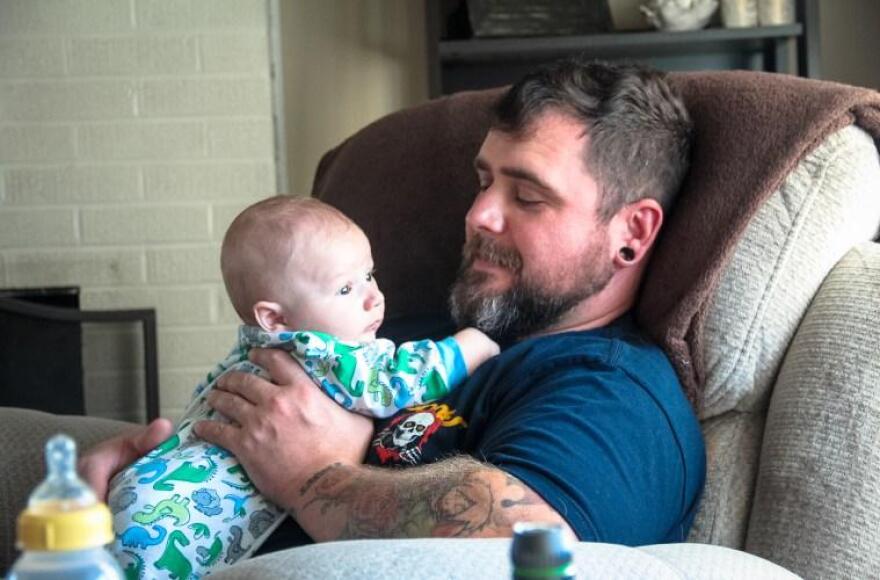
Dave Hathaway with his son, Deacon
As a union coal miner, Hathaway made around $33 an hour at Emerald mine. The yearly take home is around $75,000 a year, and it can get up into six figures with enough overtime.
"I think for the man of the house to not have a job, it's pretty disheartening. It's a hit to my ego, really. Ashley's the breadwinner. It's cool she has a job, but I need to chip in."- Dave Hathaway
While he was looking for a job, Hathaway only saw offers for low wage, low benefit work, like part-time positions at a Home Depot or Lowe’s. He wouldn’t take a job like that because he worried it would cause him to lose the health benefits he was still entitled to for the first year after his layoff.
He tried to get into an apprenticeship program with a carpenters’ union, but was turned down.
By late fall 2016, Hathaway’s unemployment ran out.
He started to get worried. It wasn’t just the money. It was also the feeling he wasn’t providing for his family. He felt that as a man, making money was his responsibility.
“I think for the man of the house to not have a job, it’s pretty disheartening. It’s a hit to my ego, really,” he said. “Ashley’s the breadwinner. It’s cool she has a job, but I need to chip in.”
Credit Reid Frazier/ The Allegheny Front
/
Ashley, Dave and Deacon Hathaway
He held out hope that he’d be re-hired by his old company. He was still a member of the United Mine Workers of America, so he was put on a waiting list to be re-hired at the nearby Cumberland mine. But he had no idea when, or if, that would happen.
After a year of looking for work, he’d burned through his savings and was getting anxious.
Dave had been at Emerald Mine for eight years, and by the time the mine closed down, he had secured an above ground job operating heavy equipment. To him, being above ground was better. It was safer, and he thought it was a higher status job.
He had plenty of gory stories of people getting injured by rock falls or close calls he had as underground coal miner, including one time when he thought he’d get electrocuted by a faulty wire in a pool of standing water.
He had plenty of gory stories of people getting injured by rock falls or close calls he had as underground coal miner, including one time when he thought he’d get electrocuted by a faulty wire in a pool of standing water.
But getting back underground was looking like a better and better option.
As the year wore on, he saw his number on the waitlist for work at the Cumberland Mine get smaller and smaller. And so, feeding an infant on his knee, he kept putting in applications, and wondering if the Cumberland mine would call. And they did. But more on that next time on The Struggle to Stay.
Music in the audio version of this story was provided by Marisa Anderson.
Add WVPB as a preferred source on Google to see more from our team
On this West Virginia Week, former governor and longtime U.S. senator Jay Rockefeller has died, West Virginia voted in the general election, and a new anthology explores science fiction and fantasy in Appalachia.
Bob Thompson’s annual holiday jazz celebration is back! Joining Thompson on stage is his long-time bandmates Timothy Courts on drums, Ryan Kennedy on guitar, John Inghram on bass, plus special guest vocalist Lena Seikaly with James Moore on trumpet. Buy your tickets today!
Appalachia is full of ancient cave systems. Some are so deep nobody’s sure where they begin or end. For Inside Appalachia, Folkways Reporter Andrea “river” Peterson explored a once-privately owned underground landscape that recently became a Pennsylvania State Park.
Across much of Appalachia, there’s a hidden world beneath your feet. The region is chock full of ancient cave systems. Some are just little caverns you can walk in and out of. Some are so deep, nobody’s sure where they begin or end. Folkways Reporter Andrea Peterson explored a once-privately owned underground landscape that recently became a Pennsylvania State Park.