Alert (09/10/2026): Our Parkersburg TV transmitter is undergoing maintenance for a few days and will not be operational. We apologize for any inconvenience.
All our programming is available via our TV livestreams on our website and WVPB Passport. Thank you for your patience!
On this week's premiere broadcast of Mountain Stage, host Kathy Mattea welcomes The Jayhawks, Tift Merritt, Tanasi, and Candi Jenkins to the Culture Center Theater in Charleston, WV.
A Look at Upper Big Branch's Safety Record Under Massey
Share this Article
As former Massey Energy CEO Don Blankenship stands trial in Charleston, federal prosecutors continue to present evidence that he conspired to violate federal mine safety standards leading up to the April 2010 explosion at the Upper Big Branch Mine.
Over the course of Massey’s ownership of the mine, the company amassed nearly 5,000 citations from the federal Mine Safety & Health Administration. Of those, many were designated as “significant and substantial” by MSHA standards.
According to MSHA, a violation designated as significant and substantial, often referred to as an “s and s violation” in the industry, indicates “that based upon the particular facts surrounding the violation there exists a reasonable likelihood the hazard contributed to will result in an injury or illness of a reasonably serious nature.”
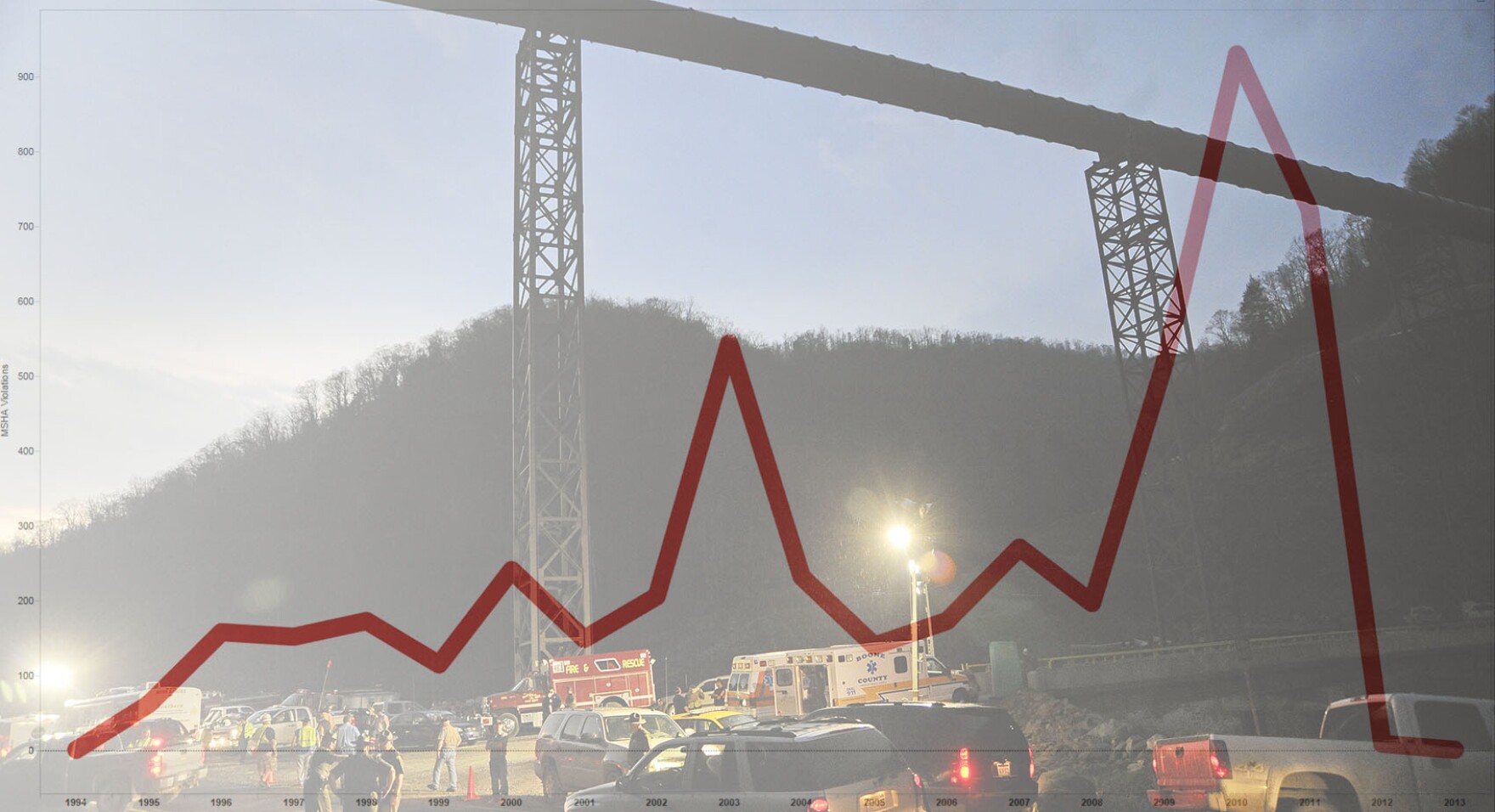
In 2010 alone, MSHA officials slapped mine operator Performance Coal Company--a subsidiary of Massey--with 930 citations. The company oversaw the Upper Big Branch mine.
Blankenship’s defense filed a motion to prevent the MSHA citations from being admitted as evidence, calling the hundreds of citation issued during the indictment period (from January 1, 2008 to April 9, 2010) hearsay. On October 6, Judge Irene Berger ruled the citations could be used by the prosecution, noting:
“[T]he citations are not being offered for the truth of the matter asserted in them or, in other words, to prove violations of safety standards but are being offered as evidence of the defendant’s knowledge, intent, and/or willfulness as well as notice. That being the case, the documents are not hearsay and are admissible in my opinion given the allegations in the counts of the indictment. I further anticipate, if the documents are offered, giving the jury a limiting instruction that they cannot consider those citations for the truth of what’s contained in them but they can be considered for the fact that they were issued and, thus, can be used by them in their consideration of notice and the defendant’s knowledge, intent, and/or willfulness."
MSHA safety citations have long been a problem at the Upper Big Branch mine--long before the indictment period.
Here’s a look at the citations issued to the company by year of date issued during the time that Performance Coal Company operated the mine:
Most Frequent Citations at Upper Big Branch Under Massey
Performance Coal Company was issued citations stemming from violations of a wide range of MSHA standards--everything from failing to create a roof control plan, issues with rock dusting and the accumulation of combustible materials.
The interactive graphic below breaks down each of the company’s citations by MSHA standard, with the largest circles representing standards with the highest frequency of citations.
§75.400 Accumulation of combustible materials.– Coal dust, including float coal dust deposited on rock-dusted surfaces, loose coal, and other combustible materials, shall be cleaned up and not be permitted to accumulate in active workings, or on diesel-powered and electric equipment therein. (526 citations issued.)
§75.202 (a) Protection from falls of roof, face and ribs.– The roof, face and ribs of areas where persons work or travel shall be supported or otherwise controlled to protect persons from hazards related to falls of the roof, face or ribs and coal or rock bursts. (378 citations issued.)
§75.370 (a)(1) Mine ventilation plan; submission and approval.– The operator shall develop and follow a ventilation plan approved by the district manager. The plan shall be designed to control methane and respirable dust and shall be suitable to the conditions and mining system at the mine. The ventilation plan shall consist of two parts, the plan content as prescribed in §75.371 and the ventilation map with information as prescribed in §75.372. Only that portion of the map which contains information required under §75.371 will be subject to approval by the district manager. (241 citations issued.)
§75.503 Permissible electric face equipment; maintenance. – The operator of each coal mine shall maintain in permissible condition all electric face equipment required by §§75.500, 75.501, 75.504 to be permissible which is taken into or used inby the last open crosscut of any such mine. (217 citations issued.)
§75.220 (a)(1) Roof control plan. – Each mine operator shall develop and follow a roof control plan, approved by the District Manager, that is suitable to the prevailing geological conditions, and the mining system to be used at the mine. Additional measures shall be taken to protect persons if unusual hazards are encountered. (121 citations issued.)
A full listing of MSHA standards can be accessed through the agency’s website.
Editor’s Note: West Virginia State University graduate student and West Virginia Public Broadcasting Media Diversity Fellow Ikram Benaicha contributed to this report.
Add WVPB as a preferred source on Google to see more from our team
In the runup to the midterm elections, it’s time for a new Us & Them dinner party. Host Trey Kay brings West Virginians together from a range of political perspectives to share some family dishes, as well as their thoughts. This time around, the conversation included some new topics as well as some of the familiar issues that divide us. We listen to an excerpt.
With the midterm elections approaching, Us & Them is taking the Dinner Party on the road to a trio of communities across West Virginia. In the first of our three gatherings this fall, host Trey Kay is back in Charleston bringing together conservative and liberal West Virginians to share a potluck meal, talk politics and see whether conversation across the divide can uncover some common ground.
The votes are in – more than 3,200 of them – and the winner of the inaugural Coolest Thing Made In West Virginia competition will be announced next week. It’s down to the final five. Assistant News Director Maria Young caught up with Bill Bissett, president of the West Virginia Manufacturers Association, which is hosting the contest, to find out more about the finalists.
At the core of the case is who in government has final authority over policy and rulemaking for the state's public schools: the Board of Education or the Legislature.