Maria Young Published

Green Bank Observatory Offers Behind-The-Scenes SETI Tours 

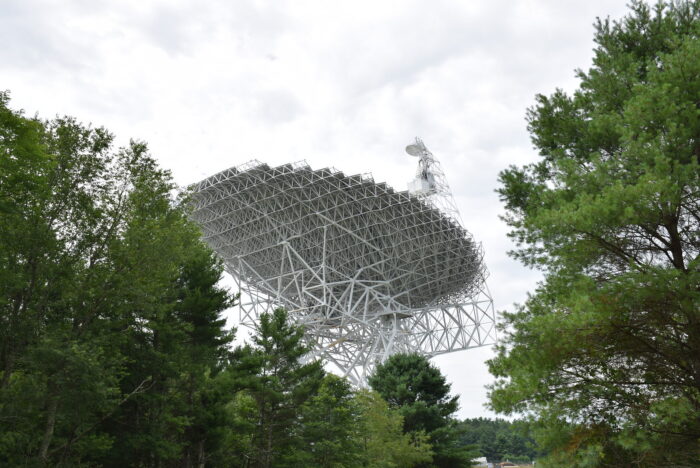
A large white satellite dish towers over green trees against a cloudy sky. Its white scaffolding juts out at various angles.
The Robert C. Byrd Green Bank Telescope, located at the Green Bank Observatory in Pocahontas County, is the largest fully steerable telescope in the world.
Jill Malusky/Green Bank Observatory
Listen

The Green Bank Observatory in Pocahontas County is offering a limited chance to go behind the scenes to check out its Search for Extra Terrestrial Intelligence.   

SETI tours are offered to small groups – ages 12 and up – several times a month through October.   

Maria Young caught up with the observatory’s news manager, Jill Malusky, to find out more about the tours – and what, exactly, scientists there are looking for.  

This interview has been lightly edited for clarity.      

Young: Let’s start off by explaining. What is the SETI tour? It’s Search for Extra Terrestrial Intelligence, but tell me kind of what that involves. 

Malusky: So the search for extraterrestrial intelligence, or SETI, people who are interested in that sort of thing, it may be familiar to them. It’s been around for quite a while, but they may not know that it actually started in Green Bank not long after the observatory first opened in the 1960s by a scientist named Frank Drake.  

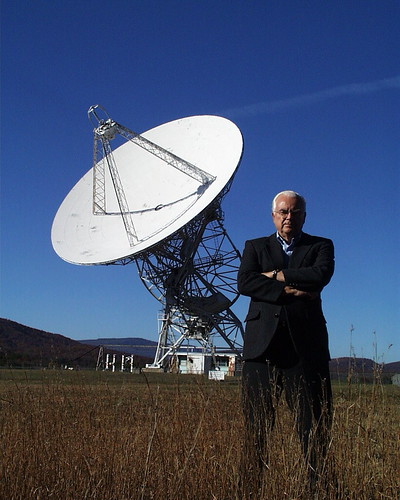
Some people might recognize that name because he created the Drake equation, which is a scientific formula that tries to deduce the chance that there’s extraterrestrial life out there, looking at what we know about the universe, how many planets are out there, and just the likelihood, what are the odds, that one day, will be able to find communication for them or make contact with them. So he came up with that formula and that idea when he was a scientist at Green Bank back in the 60s, and he used one of our first telescopes on site. It’s still there. You get to see it as part of the SETI tour to actually search for signals from extraterrestrials. And when he started this project, it was called Project Ozma, after the book “The Wizard of Oz,” so, kind of fun.  

Frank Drake in front of the 85-foot telescope he used  to conduct Project Ozma.

Photo courtesy of Green Bank Observatory

When you come to site for a SETI tour, you get to go in that first telescope that he used. It’s more of a historic artifact. Nowadays we don’t use it to observe anymore or to try to look for anything in space, but we still have it there preserved.  

So you get to go inside the control room, and then you get to learn about other telescopes that we have on site that have been used and are used today in a search for extraterrestrial intelligence. Today, we call it Breakthrough Listen, and that project actually uses the huge Green Bank Telescope that we have on campus that some people may be familiar with. 

Young: When you say Breakthrough Listen, help me better understand what that means. 

Malusky: They use the Green Bank Telescope to search, to observe different parts of the universe that we can see with the telescope, and just be there, recording, taking in all the data, so that computers and scientists can go through it after, like looking for a needle in a haystack. And try to see, are there any tiny signals in there that may have been created by extraterrestrial life. With the earth broadcasting information on radio or television or streaming services or our phones, all those signals that we make are going out into the universe, and they could be seen or observed by other extraterrestrial life. So we turn around and try to look out in the universe and see if anybody else out there is broadcasting anything that could connect us with them or tell us more about them. 

Young: Wow, that’s really intriguing.  

Malusky: It’s pretty wild. We’re putting a lot of stuff out there, and we’re trying to see if anybody else is putting stuff out there, if we can pick anything up. 

Young:  I’m imagining that any kind of a search for extraterrestrial intelligence would involve looking for the right environment to accommodate life. At least for our form of life, you would have to have oxygen, water, some source of food, the right temperature. Those things may not necessarily be the case for other forms of life, but I’m imagining that there are some characteristics that would support life or not support life. Is that part of what the search is for? 

Malusky: Not this one. There are other scientists who are out there looking for the organic elements you’re talking about. You know, ‘Is there water?’ ‘Is there ice?’ ‘Can we see other organic elements that could be the building blocks of life?’  

So that science is different than this science. It all kind of goes together. Different people are looking for life in different ways. But what SETI is actually looking for is called techno signatures. So, stuff that’s not organic, stuff that could only be created by other life forms with higher intelligence. 

Young: You know, there’s kind of a saying that says, ‘Be careful what you ask for, because you might just get it.’ I’m wondering, what would you all do if you did pick up some indications of potential extraterrestrial intelligence out there in the universe. What would be the next step? 

Malusky: The first thing is, is what we found actually real and true? And then we’d probably have to go a couple pay grades up, you know, to a higher level the federal government, make them aware. And then plug into their bigger system. How do we share this news without causing panic, you know, without causing worry? 

Add WVPB as a preferred source on Google to see more from our team

Google Preferred Source Badge