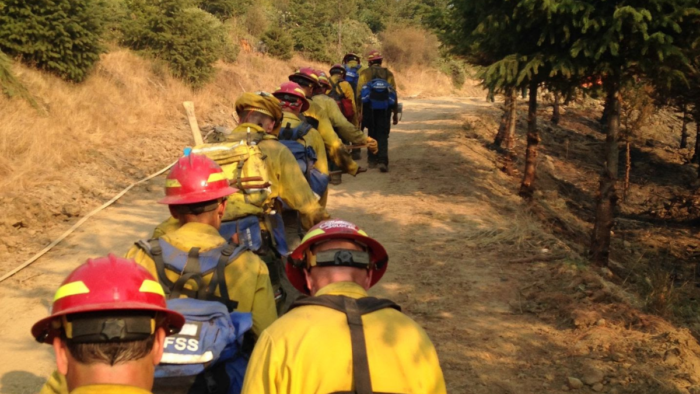
West Virginia’s spring fire season, which runs through May 31, allows outdoor burning after 5 p.m. – when winds typically die down. But state fire officials say the weather at least through April 14 is expected to be so warm and dry that there’s a greater risk campfires and debris burning will get out of control.
“Basically 36% of our fires this spring is being caused by people burning brush and allowing the fire to escape,” said Eric Jarrell, fire supervisor with the state’s Division of Forestry.
He said there have been an estimated 475 fires that have burned more than 3,000 acres across the state since the first of the year. The next five days are particularly precarious.
“Even if you want to wait till after five o’clock but the winds are still blowing and the conditions aren’t favorable, I would recommend waiting to do it during the safer time,” Jarrell said.
Even folks who burn during allowable times can be cited and held responsible for any damage or expense from a fire that gets out of control.
“Even if they’re doing everything right, but just say the wind picks up and blows embers across their safety strip and sets the woods on fire, they’re still in violation of our fire laws by allowing the fire to escape,” Jarrell said. “So whatever we have to pay to come out and help with fire suppression and stuff, then, by law, we can try to recover those costs from whoever started that fire.”
The Forestry Division General Burning Guidelines include:
- All fires must have a ring or safety strip.
- The safety strip itself must be cleared of burnable material and be at least 10 feet wide, fully encompassing the debris pile.
- Fire must be attended until completely extinguished.
- Only vegetative materials such as leaves, brush and yard clippings are permitted to be burnt.
- Fines for forest fires due to negligence range from $100 to $1,000 with additional civil penalty of $200.
- If operating spark-throwing machinery such as power shovels or sawmills on land subject to fire, machinery must contain an adequate spark arrestor.
- Inflammable waste disposal areas must annually remove all grass, brush, debris and other inflammable material adjacent to disposal areas to provide adequate protection, preventing the escape of fire to adjacent lands.
- A landowner must take all practicable means to suppress any fire on his property.
- To burn during prohibited periods for commercial burning, a permit must be obtained from the Division of Forestry.
Add WVPB as a preferred source on Google to see more from our team