Alert (09/10/2026): Our Parkersburg TV transmitter is undergoing maintenance for a few days and will not be operational. We apologize for any inconvenience.
All our programming is available via our TV livestreams on our website and WVPB Passport. Thank you for your patience!
This week, one thing about Appalachians: we can get competitive. We’re proud of our local food. Love a good hunt. And enjoy competition with friends. We learn the rules and celebrate our victories. You'll hear these stories and more this week, Inside Appalachia.
CDC Begins Appalachian Fact Finding Mission In West Virginia
CDC's Dr. Leslie Dauphin talks with Huntington Mayor Steve Williams and Marshal Health CEO, Dr. Kevin Yingling.Randy Yohe/West Virginia Public Broadcasting
Listen
Share this Article
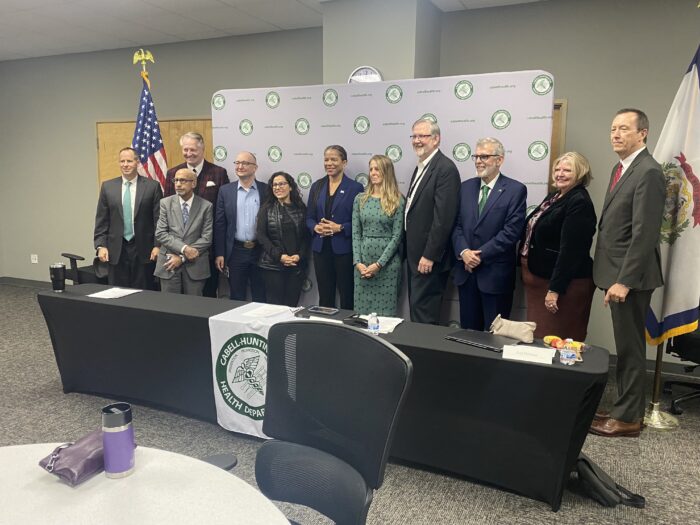
Public and private health care leaders and community stakeholders gathered at the Cabell Huntington Health Department on Tuesday to meet with leaders from the U.S. Centers for Disease Control and Prevention (CDC). The session was intended to showcase what’s working locally and to address the challenges of rural health care delivery.
CDC Health Care visit the Cabell-Huntington Health Department.
Randy Yohe/ West Virginia Public Broadcasting
Dr. Leslie Dauphin, CDC Director of Public Health Infrastructure, said this mission started here after learning about the successes of local community based partnerships.
“This was recommended as a place to start because of their accredited health departments,” Dauphin said. “That, and the way that the public-private partnerships work together with the health system to protect people.”
Dauphin said that due to a federal flexible funding program, the Cabell-Huntington Health Department has been able to hire staff. She said her concern was what will they do when that funding runs out.
“In order to get the work done to protect the health of communities, we must have a sustained growth,” Dauphin said. “We know that with their workforce, we’re here to learn what’s working, how they’re using the funding that they’ve received, to hire, recruit, retain a workforce, and what we can do to help them sustain.”
Cabell-Huntington Health Department CEO Dr. Michael Kilkenny said the CDC infrastructure director needed to know the state’s continuing broadband access challenges relate directly to health care.
“Telemedicine is showing a growing importance, Kilkenny said.” One of the ways to break down some of the transportation difficulties that we hear time and time again from the public is being able to come into your living room no matter where you’re at.”
Dauphin said the CDC is here to learn more about infrastructure, workforce issues, community partnerships and data modernization. She said the results must be federal health care policies made to bring the most benefits to those with the greatest need.
Add WVPB as a preferred source on Google to see more from our team
Kianoosh Nawai, an eighth grader at the West Virginia Virtual Academy, was the only West Virginia student chosen from close to 2,000 entrants from across the country for a national science competition.
News Director Eric Douglas sat down in a classroom studio with Marshall's Chuck Bailey, the student news director Emma Johnson, and the Director of the Marshall School of Journalism and Mass Communications Rob Quicke, to learn more.
The funding will help the West Virginia State Police increase the number of eligible DNA samples analyzed for entry into a federal database and will also help reduce turnaround times for forensic cases involving DNA evidence and prevent backlogs of forensic and DNA database samples.
West Virginia received $199 million in the first year of the Rural Health Transformation Program. Dr. Arvin Singh, secretary of the West Virginia Department of Health, told lawmakers he expects the state's level of funding to remain the same next year.