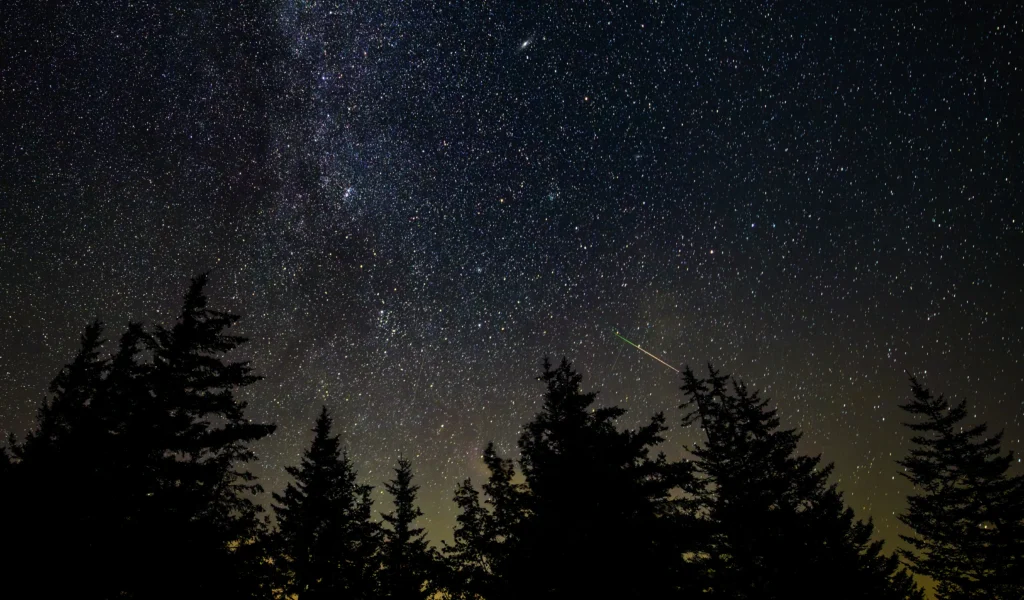
It’s the best time of the year for fans of shooting stars and meteors as one of the night sky’s most dazzling displays is peaking on the night of Aug. 12.
The Perseids meteor shower can be seen from mid-July into September, but the show peaks in mid-August.
Shannon Silverman, planetarium and science educator at the Clay Center for the Arts & Sciences of West Virginia, said with swift and bright meteors, the Perseids is considered the most spectacular meteor shower of the year.
“Unfortunately, we had the full moon just two days ago so we still have a very bright moon,” Silverman said. “That said, the Perseids are the best meteor shower to have to deal with a bright moon because they are so bright. So you won’t see as many meteors, because the smaller, fainter ones will kind of be drowned out by the moon, but there should still be large enough meteors to spot, as long as you’re patient.”
Silverman is also the host of the “Almost Heavens” show, West Virginia Public Broadcasting’s guide through the cosmos above the Mountain State. She said patience is key, but those unwilling to deal with the bright moon can wait until the moon has waned a little more into next week. Silverman also said that facing north, generally away from the Moon’s path across the sky, can help to get a better view of the meteors.
“Best viewing is going to be when it’s really dark outside, of course, late at night, early morning,” she said. “Perseus isn’t right next to the moon or anything, so you can kind of turn away and maybe you’ll get some more bright meteors. But the main advice is to just be patient and keep looking at the sky, because there’s nothing less fun than staring at the sky for five minutes, looking away and then your friends saying, ‘Oh, you missed this huge fireball.’”
The Perseids are an annual event, part of Earth’s interaction with another celestial body on a cosmic scale.
“They happen when the Earth passes through the remains of Comet Swift-Tuttle’s tail,” Silverman said. “Comet Swift-Tuttle goes through every 133 years or so, and as it gets close to the sun, it starts to melt. This causes a big hail to come off of it, and some particles start to come off, and it leaves this trail that the earth then passes through every year.”
As particles from the comet pass through Earth’s atmosphere, they leave long “wakes” of light and color behind them with about 50 to 100 meteors visible per hour.
“These are technically cometary or comet fragments, instead of asteroid or small asteroids or asteroid fragments, which are what we typically think of as meteors and meteorites,” Silverman said. “Meteorites are when something has reached the surface. They’re the things that you find on Earth when you go meteorite hunting. Meteors are when something enters the Earth’s atmosphere and burns up.”