Alert (09/29/2026): Our Parkersburg TV transmitter is still undergoing maintenance and remains temporarily inoperative. We apologize for the inconvenience.
All our programming is available via our TV livestreams on our website and WVPB Passport. Thank you for your patience!
Inside Appalachia Host Mason Adams met with author Barbara Kingsolver at her home outside Abingdon, Virginia, a couple weeks before her new novel "Partita" was set to publish.
W.Va. Poised To Benefit From Future Aerospace Investments
Vertx Partners is invested in bringing Appalachian innovators and businesses together to transform the future of Advanced Air Mobility (AAM).Courtesy Vertx Partners
Listen
Share this Article
The aerospace industry looks extremely promising for West Virginia according to panelists who were part of a robust industry discussion at the Culture Center Monday.
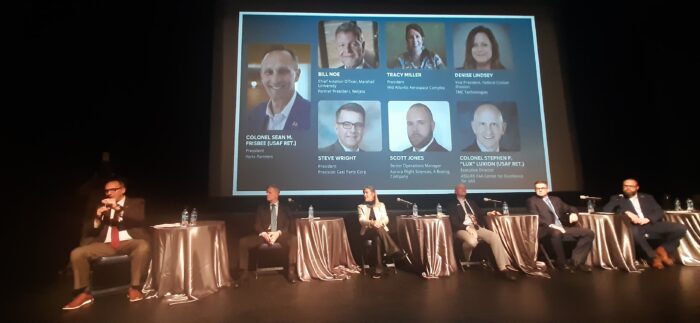
The diverse group of aerospace experts included representatives from Vertx Partners, Aurora Flight Sciences – A Boeing Company, Marshall University, Mid-Atlantic Aerospace Complex, TMC Technologies and ASSURE – the FAA’s Center of Excellence for UAS Research.
Moderator Col. Sean Frisbee (USAF Ret.) is the president of Vertx Partners. He said the state is positioned to become a powerhouse for the state as well as the national defense.
“It’s an exciting industry, it’s booming and we want to make sure West Virginia stays on the leading edge of the industry,” Frisbee said. “A lot of people don’t realize it but aerospace literally touches everybody.”
Frisbee talked about technologies commonly used by people in their everyday lives which stem from the aerospace industry.
“GPS for example, how could we possibly live without our Google maps, Waze and so forth,” Frisbee said. “But also the cameras that you have on your phones, the technology to make that camera as good as it is and as small as it is comes from aerospace.”
“How many of you use memory foam mattresses? The technology was developed by NASA as a safety measure as well as a comfort measure for astronauts,” he said. “Earbuds, headphones and even baby food can look at its origin back to developing food for astronauts.”
A newer technology Frisbee said holds huge promise is a silent leaf blower.
“It is incredible, you are holding a leaf blower, and there is literally no noise coming out of it,” he said. “And that technology is being developed for drones in order to reduce the acoustics of these drones that fly around.”
West Virginia’s aerospace industry is worth an estimated $1.35 billion a year, which Frisbee said contributes $486 million to the state’s GDP and more than $24 million in state and local taxes.
“But what we see globally is just an incredible growth of this industry,” he said. “From the commercial systems in defense, the emerging space economy and sustainability initiatives, battery development as well as alternative fuels to reduce carbon emissions which could be an important role here in West Virginia.”
Panelists discussing the future of aerospace technology at the WV Division of Culture and History.
Caroline MacGregor/West Virginia Public Broadcasting
Tracy Miller is the president of the Bridgeport based Mid-Atlantic Aerospace Complex which specializes in aviation and aerospace component manufacturing. She said the future for the industry in the state offers boundless opportunities for West Virginians.
“You’re adding value to the existing aerospace industry that we’ve had and you’re saying, folks, there’s ways to redefine it,” Miller said. “We’re in the flow of a new definition of aviation and I think it’s up to all of us to put your aerospace hat on, we can be the brainpower behind anything we want to be in aviation.”
The panel lauded the idea of investments in airports and education and working with schools like Marshall University to develop the state as an innovative hub to secure space assets from potential cyber-attacks.
Marshall University Chief Aviation Officer Bill Noe said the future for aerospace technology is limitless.
“This aviation space right now, it’s not even a big pond, it’s an ocean and there’s room for so many fish to swim in it, it’s ridiculous,” he said.
Noe said Marshall University has strategically employed momentum to grow the state’s aerospace industry and expose more people to aviation.
“It goes into the air traffic control training, it goes into dispatch training, flight attendant training, it goes into the airlines, creating this area of space that will interest people, inspire people and really create a delightful outlook on their futures that we can really provide,” he said.
Denise Lindsey, is the vice president for TMC Technologies Federal Civilian Division. She said supporting educational opportunities for school kids is key.
“The K- through 12 is super important from a space perspective as well,” she said. “They grow up, they read books, they learn about their planets but to actually be engaged in a curriculum or activity that involves space is a game changer.”
Lindsey said space camps would also be a great investment for the state.
“If you really want to get the kids involved in space in our region, start up a space camp,” she said. “That could be in anyone’s district, I think it would be a great idea.”
The focus of discussion also centered heavily around Advanced Air Mobility systems – drones that can be used to move people and cargo. The idea is being embraced in West Virginia as a way to transport goods and medicines to the state’s difficult to reach and underserved rural Appalachian communities.
“The thing that excites me about this is, we’ve got a lot of technology, but we’ve got a lot of people in this state who would directly benefit,” Noe said. “We can get there with this technology. We can take pain points and smooth those out, and we’re going to be not only training it and researching it and figuring it out, but it’s going to be done right here and it’s just one of the strong pillars of opportunity we can have.”
Executive Director of ASSURE Col. Stephen Lux Luxion (USAF Ret.) said while there’s a lot of talk and money surrounding urban mobility, the greatest generation where drones can help the most are in remote communities where medical inaccessibility and below-average health outcomes exist. Rural Advanced Air Mobility offers the potential to redefine healthcare in the state.
“In a rural world you’re sending out a drone over what would be a long drive over Appalachia,” Luxion said. “A drone can fly that thing; it reaches out to those families that are in need within your state whom you have a responsibility to take care of.”
Add WVPB as a preferred source on Google to see more from our team
West Virginia has seen the largest population decline in the nation - nearly 1.5% - and many of those leaving are young people. In an episode that aired last month, Us & Them host Trey Kay heard from some young people who think they may stay in the state to launch their futures. This month, Kay talks with those who say living their dreams may well require moving away from the Mountain State. We listen to an excerpt from the latest Us & Them.
This week, ballroom culture offers LBGTQ folks a chance to be as fabulous as they want to be. Also, national media reports on the deaths of notable people, but small, hometown papers add a more personal touch. And, alpha-gal syndrome takes red meat off the menu, but what about ostrich?
Across the Appalachian Mid-South, local law enforcement is doing more to support U.S. Immigration and Customs Enforcement (ICE) in detaining people. Morgan Watkins with the Kentucky Center for Investigative Reporting analyzed the latest data on ICE arrests in Kentucky, Tennessee and West Virginia. Louisville Public Media's Bill Burton spoke with her about what she learned.
In the runup to the midterm elections, it’s time for a new Us & Them dinner party. Host Trey Kay brings West Virginians together from a range of political perspectives to share some family dishes, as well as their thoughts. This time around, the conversation included some new topics as well as some of the familiar issues that divide us. We listen to an excerpt.