Alert (March 11, 2026): Our TV translator in Flatwoods is experiencing technical issues. Our engineers are troubleshooting the problem. Thank you for your patience.
This week, "Our Common Nature" is a new podcast from WNYC. It features cellist Yo-Yo Ma and producer Ana González, as they explore America and talk to folks like West Virginia coal miners. We follow Yo-Yo and his team as they venture into Appalachia. And we talk with González about meeting people where they are.
Ready To Vote? Remember These Rules For Conduct At W.Va. Polls
Pleasant View Elementary School in Morgan County served as a polling location for West Virginia's 2024 primary election.Jack Walker/West Virginia Public Broadcasting
Listen
Share this Article
Residents are already heading to their local polling stations to vote in the leadup to this year’s Nov. 5 general election.
To protect the integrity of the electoral process, certain forms of conduct are allowed and disallowed at the polls, according to Mike Queen, deputy chief of staff to West Virginia Secretary of State Mac Warner.
West Virginia Public Broadcasting has compiled a summary of laws and policies voters must follow on Election Day.
Voter Identification
Since 2018, West Virginia has enforced a voter identification law, where voters must present some form of identification to cast their ballots “if the poll worker doesn’t recognize you,” Queen said.
Acceptable forms of identification include a driver’s license; passport; military, government or student identification card; birth certificate; Medicare, social security or state benefits card; concealed carry permit; health insurance card; or bank statement issued within six months of Nov. 5, this year’s Election Day.
The law does not apply to absentee voters who cast their votes by mail.
Voters unable to provide identification at the polls can still cast a provisional ballot, which will be counted by election workers if their identity and voter registration can be verified.
Campaign Paraphernalia
Rules regarding conduct at the polls generally apply within a 100-foot radius of voting sites. Some polling locations have signs on site to denote how far this 100-foot boundary extends, and where “electioneering” is deemed a crime under state law.
According to the West Virginia State Code, “electioneering” refers to “the displaying of signs or other campaign paraphernalia, the distribution of campaign literature, cards or handbills, the soliciting of signatures to any petition, or the solicitation of votes for or against any bona fide candidate or ballot question.”
Beyond actively campaigning for a candidate, this means wearing political paraphernalia is forbidden.
“There’s no stickers, there’s no hats, there are no buttons that can be worn in a polling place,” Queen said.
The Morgan County Courthouse served as a polling location for West Virginia’s 2024 primary election.
Photo Credit: Jack Walker/West Virginia Public Broadcasting
In West Virginia, electioneering at a polling location is a misdemeanor punishable by a fine up to $1,000 or a year of jail time.
Some polls are located in multipurpose locations like shopping areas, where enforcement of this policy “gets a little bit nuanced,” Queen said. According to Queen, local officials work harder at multipurpose locations to ensure electioneering does not occur on site.
Photography On Site
Within 100 feet of polls, taking photographs of voters or election officials is also prohibited, Queen said.
Taking pictures of the exterior of a polling location is permitted, but Queen said residents cannot take pictures of voters or polls because it can be disruptive to the voting process.
“No person may enter a voting booth with any recording or electronic device in order to record or interfere with the voting process,” reads a section of the West Virginia Code regarding elections.
Violating the policy can result in fines up to $1,000 or a year of jail time.
Queen added that the secretary of state’s office works with members of the press to ensure they are able to collect media without infringing upon the electoral process.
Behavior Toward Election Workers
Under state law, it is also illegal to prevent election workers from completing their duties “by force, menace, fraud or intimidation.” This can range from disrupting the voting process to threatening poll workers.
Individuals who violate this law can be charged fines up to $1,000, or imprisoned up to one year.
Queen said that residents tend to be respectful of polling location rules and staff members. As of Friday, he said the state had received “zero complaints” from election workers during early voting, which began Oct. 23.
“We have really no complaints with our poll workers,” he said. “Everybody’s very respectful.”
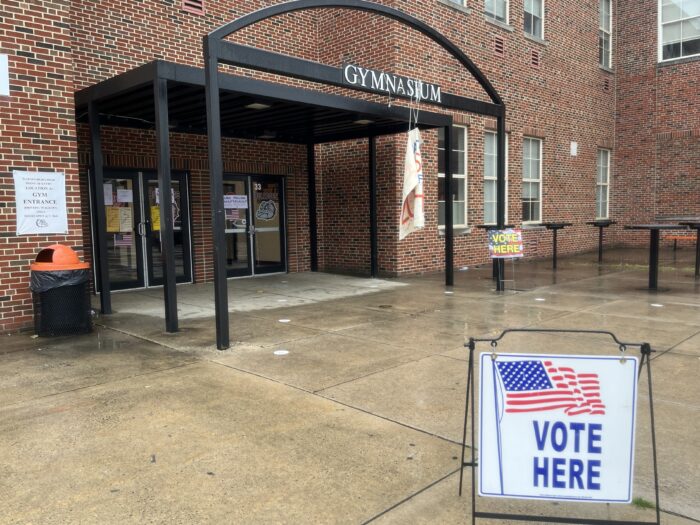
A sign outside Martinsburg High School denotes the school gymnasium as a polling location for West Virginia’s 2024 primary election.
Photo Credit: Jack Walker/West Virginia Public Broadcasting
Policy Enforcement
Polling locations do not have police officers or security on site, because it can be “intimidating” to voters, Queen said. But on Election Day, a number of agencies are on standby and ready to respond to any incidents that may occur.
These range from energy and utility companies that can address electricity issues to the state police, Federal Bureau of Investigation, West Virginia National Guard and secretary of state’s office itself for matters of election security.
There are 169 polling locations in West Virginia, and Queen said each one has back-up plans in case anything goes wrong. For example, when flooding was reported at a polling location during a previous election, officials were able to move to a new site, Queen said.
“The secretary of state’s office has 18 investigators alone, just our office, deployed throughout the state on Election Day,” he said. “So we can be just about anywhere within a half hour or so if there are any problems.”
Each polling location is led by a head clerk, “usually the most experienced, most tenured poll worker,” Queen said.
Queen said county clerks provide poll workers training for how to report any issues, and can provide information as needed to voters at the polls.
“Everybody is all hands on deck on Election Day,” he said. “If there are any problems, we can address them very, very quickly.”
For more information on voting in this year’s Nov. 5 general election, visit the West Virginia secretary of state’s voter dashboard at GoVoteWV.com.
Add WVPB as a preferred source on Google to see more from our team
On this West Virginia Week, the state supreme court decides on vaccine requirements, the office of miners health and safety releases its findings about recent accidents and money talks on Planet Money.
...
The high court agreed to review the case last December after blocking a lower court order that stopped the creation of new charter schools without voter approval.
Federal judges ruled that West Virginia's vaccination requirement are legitimate because of its protection of the health and well-being of school children.
An Us & Them episode honored by the Virginias Associated Press Broadcasters for Best Podcast examines the hidden side of homeownership in Appalachia. While West Virginia has the nation’s highest homeownership rate, aging housing stock and low incomes leave many residents living in deteriorating conditions. Reporting from western Virginia, this episode explores what happens when owning a home doesn’t mean building wealth.