On this West Virginia Morning, a Marshall University historian discusses documenting previously unknown underground railroad sites throughout the region.
One month after the incident, Jack Walker caught up with Skaff about what happened, and the status of his recovery.
This interview has been edited for length and clarity.
Walker: Doug, can you walk us through your visit to Boone County and what led up to your snake bite?
Skaff: [The] day after Election Day, May 15, just like I do every year, I go around and start taking my campaign signs down. I ran for secretary of state, so this year I had signs all around the state. I had a lot of signs out. I take pride in putting them up myself with other people. And also I take pride in taking them down as fast as we can every year. But this is the first time I ran outside of Kanawha County. So I had some signs down Route 119 in Boone County and Danville. … I was with my eight year old son, and he was just going around taking some signs down with me wherever we could. He was out there at school that afternoon.
Walker: And that’s where you encountered the copperhead, right? What happened next?
Skaff: I go up, I grab this sign and I pull one side out. It’s a two-foot by four-foot sign, a little bigger than normal. And long story short, I felt like I tagged my shoe on some barbed wire or some glass, or just something sharp, like a nail or something. And it ripped the top of my shoe on my right baby toe of my shoe. And I didn’t see anything. I just thought I snagged it, but it kind of stung for a minute. It kind of stung and it wouldn’t go away. I was like, man, maybe I cut it on something, but then it wouldn’t go away. And then about 15 seconds I take the other side of the sign down like, “Oh man! I jammed it on some barbed wire again!” And I look down, and this time it wasn’t barbed wire of course. I see this snake, which now I know to be a copperhead. I didn’t at first know what type of snake it was because it all happened so fast, but it was a good size snake, about three inches round in diameter.
Walker: Once you realized you had been bitten by a snake, how did you react?
Skaff: So it latched on. What I did was I swung my leg around. I remember grabbing my quad, swinging my leg around and banging that snake against the shrub right there, trying to get it to fall off my leg. And so it finally did and I hobbled down about eight feet back down on the ground. I kind of scoot myself on my butt over towards my car and I lean my head back and bang on the car. My son had just gotten back in the car and he gets out. He’s eight years old. I give him my phone. I was like, “I need some help buddy, snakes, snakes!” And I said, “Don’t go over there.” He was pretty cool and collected, so he’s getting my phone from the front seat, so we call 911.
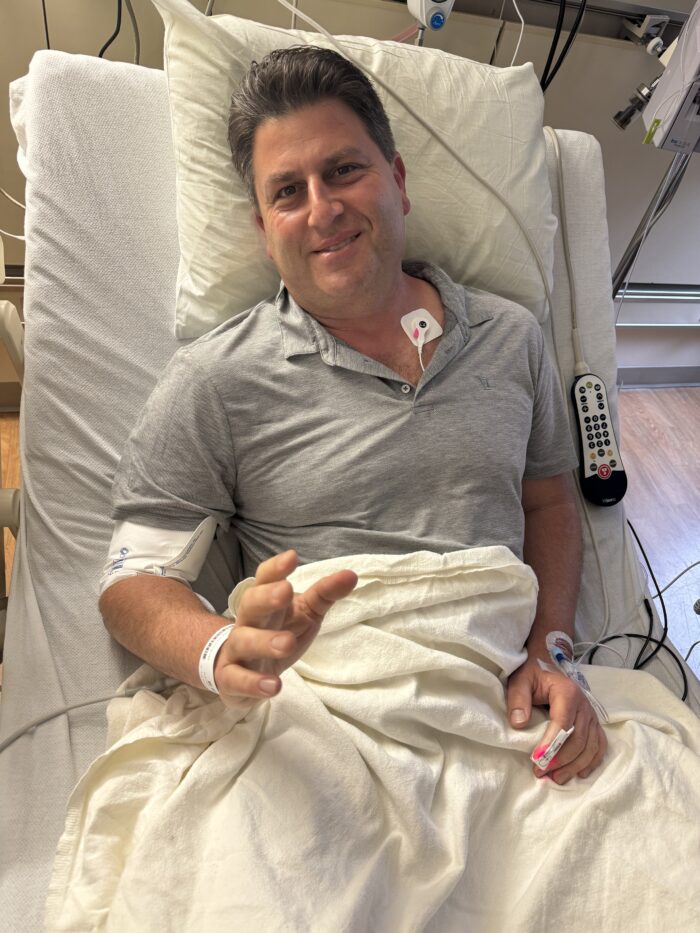
Former House Minority Leader Doug Skaff was hospitalized for seven consecutive days in May over a series of four copperhead bites.
Photo Courtesy of Doug Skaff
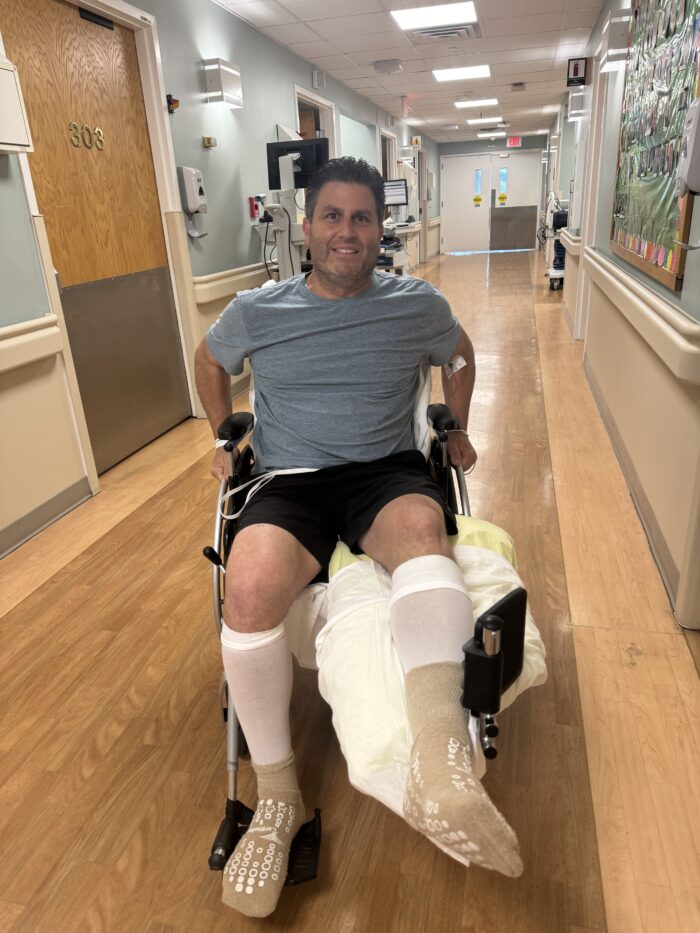
After being discharged from the hospital, Skaff was told to use a wheelchair or walker to manage his muscle pain.
Photo Courtesy of Doug Skaff
Walker: What did the first responders do when they got you into an ambulance?
Skaff: Within probably 25 minutes I think, we got to the ER. Then there, they quickly tried to service me and get me this anti-venom stuff. [I] forgot what it’s called, CroFab or something. I don’t remember, some anti-venom stuff. And what that does is it’s supposed to stop the spreading.
Walker: Did that work?
Skaff: It did stop the spreading that first day OK. But the morning I woke up, and it started spreading again. It started going up my knee, up my leg, through my thighs, through my quads, all the way up to my waist. Same discoloration, same burning sensation. It was the worst feeling I’ve ever felt in my life.
Walker: So how did they get the spreading under control?
Skaff: They ended up giving me six more doses of that stuff, so I had ten vials of the anti-venom.
Walker: What has your recovery process been like since then?
Skaff: This is week four, and what does it feel like now? So I’m still taking pain medicine and all that. I’ve been pushing it and walking, standing up on it, hobbling around. I’m still supposed to use a walker and wheelchair when I go long distances, but I’ve really pushed it trying to get my strength back. But it still hurts. I’m not gonna lie. I mean, my ankle is really hard right now. My muscle feels weird. And I don’t know, the top of my foot — it just feels like it swells up and goes down and swells up, and the bottom of my foot is still bruised. But they say my muscle, it can take a long time before my muscle gets back to normal, if it ever gets back to normal.
Walker: This sounds like a really difficult experience. I’m wondering if there’s anything you’ve taken away from this that you want to share with our listeners?
Skaff: Well, it’s just funny because I wasn’t even thinking. [There are] so many campaign signs you saw out there, and people just stepping in the same grass I did and they don’t even think. Think about how many people are cutting your grass this summer, doing the weed whacker or hitting a golf ball. And the thing I really want to stress is, anything you can do to help people, the kids. Please tell your kids to be careful when they’re out there playing in the yard and in the grass. I mean, if my eight-year-old would’ve got hit four times, I don’t know if he could have survived it.
Add WVPB as a preferred source on Google to see more from our team
Every week, more than two newspapers close in the United States, leaving whole communities without local coverage. On this encore Us & Them, Trey Kay visits West Virginia communities trying to hold onto local journalism — from the long-running Hurricane Breeze in Putnam County to The Real WV, a relatively new digital news outlet with roots in Greenbrier County. What happens to a place when the news that helps a community see itself begins to disappear?
As many as 400 children in West Virginia's foster care system have been placed out of state for treatment not available in state. The state plans to renovate facilities to bring those children back.
Appalachian Power will spend $17 billion to construct three new natural gas-fired power plants across the state, and $7.5 billion to upgrade its West Virginia coal-fired power plants.
Google announced plans Thursday to send $10 million from the Energy Impact Program to the West Virginia Office of Energy to help lower energy bills by making homes and community buildings more energy efficient.