Alert (09/29/2026): Our Parkersburg TV transmitter is still undergoing maintenance and remains temporarily inoperative. We apologize for the inconvenience.
All our programming is available via our TV livestreams on our website and WVPB Passport. Thank you for your patience!
Our premiere fall broadcast season of Mountain Stage continues this week when host Kathy Mattea welcomes Tony Trischka’s EarlJam featuring Michael Daves, Buffalo Wabs & The Price Hill Hustle, Jack Barksdale, and Sarah Borges.
House Reviews Numerous Amendments To Proposed DEI Ban
Ending diversity, equity and inclusion programs is a focal point for the Republican Party nationally, and a major objective for Gov. Patrick Morrisey during his first legislative session.Perry Bennett/WV Legislative Photography
The West Virginia House of Delegates is now reviewing Senate Bill 474, which would eliminate diversity, equity and inclusion (DEI) initiatives across the state government — plus entities it funds, like public universities.
Abolishing DEI is a central administrative priority for Gov. Patrick Morrisey, and an objective he shares with President Donald Trump and the Republican Party at large. But the bill has been a wide source of contention among Democratic lawmakers, and has even garnered pushback from the governor’s own party.
That debate manifested on the House floor Saturday, where delegates set forth a total of 24 amendments to the controversial bill from members of both parties.
Updated on Saturday, April 12, 2025 at 10:35 p.m.
When the House began discussing Senate Bill 474, it set a one-hour cap on floor discussions over amendments to the bill. Lawmakers passed that threshold, which meant only those who sponsored each amendment were eligible to speak in the last stages of discussion.
The House rejected a handful of final tweaks to the bill.
That included amendments from Del. Kayla Young, D-Kanawha, that would have added political ideology to the identity groups unable to be considered in the hiring, admissions and promotion processes; shielded private and parochial schools from certain restrictions in the bill; and added language protecting “free, robust and uninhibited debate” at institutions of higher education.
Another rejected amendment came from House Minority Leader Del. Sean Hornbuckle, D-Cabell, which aimed to ensure that employees and contractors at colleges and universities have free speech protections and means to appeal “imposed discipline” over alleged violations of the state’s DEI repeal.
The House has moved to debating the full text of Senate Bill 474.
Updated on Saturday, April 12, 2025 at 10:13 p.m.
While some early revisions to the anti-DEI bill found consensus from the House, a whole lot more have been rejected.
As the debate over DEI stretches into the final hours of this year’s legislative session, the House has already rejected 13 of the 24 amendments originally proposed for Senate Bill 474.
Several of the rejected proposals came from House Minority Leader Del. Sean Hornbuckle, D-Cabell.
Among them: an amendment giving colleges an extra year to report back on how they are complying with new DEI restrictions; an amendment to let colleges highlight how they support “underserved” identity groups in grant applications; and an amendment adding explicit language that colleges will not be prevented from providing financial aid to specific identity groups.
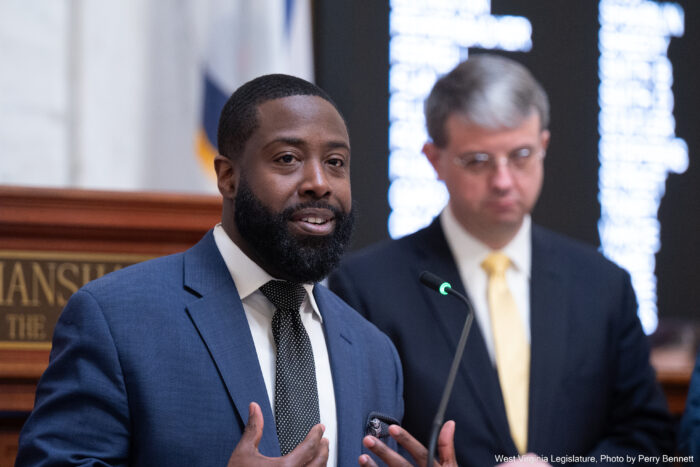
Del. Sean Hornbuckle, D-Cabell, introduced numerous amendments to Senate Bill 474, a proposed ban on diversity, equity and inclusion programs in the state. He is pictured here in January 2025.
Photo Credit: Perry Bennett/WV Legislative Photography
Del. Kayla Young, D-Kanawha, introduced a total of 12 amendments to the full House chamber, the majority of which were also rejected.
These amendments included an assurance that “preferences granted to veterans” in state law are not affected by DEI cuts, protections for the content in university libraries and purported clarifications on access to college scholarships and visa eligibility for international students.
Throughout floor discussion, Del. Brandon Steele, R-Raleigh, routinely characterized Democrats’ amendments as efforts to circumvent restrictions on DEI at large and find ways to weaken its core intent.
Another unsuccessful amendment from Young would have ensured the bill would not impact “department, division, agency, or board of this state” in their ability to access “community programs” or partake in “private sector” partnerships.
“It’s not a back door. It’s an open front door,” Steele said of the amendment. “We might have put a fence outside, but it’s an open front door.”
Young also proposed an amendment to remove references to “color blind” processes from the bill, arguing it was an outdated term. Ultimately, it was rejected.
Meanwhile, Democrats argued that their amendments provided crucial modifications to a bill that could have unintended consequences.
Discussion on the bill was still active as of 10:13 p.m.
Original Story: House Votes Down First Spate Of DEI Amendments; Some Pass
Published Saturday, April 12, 2025 at 8:54 p.m.
Del. Bill Flanigan, R-Ohio — who has vocally opposed the bill — sponsored an amendment that would have clarified restrictions on DEI in public schools “shall not be based on isolated comments, classroom discussion or misunderstandings.” His amendment was shot down by a verbal majority vote.
Two amendments from Del. Anitra Hamilton, D-Monongalia, were rejected by the chamber. One would have made all provisions of the bill consistent among identity groups; currently, some parts of the bill apply to race, ethnicity and national origin as categories, but not gender.
Del. Brandon Steele, R-Raleigh, argued that amendment could have made it hard to protect “female sports.” Hamilton disagreed, but ultimately did not secure support from a majority of the House.
Another amendment from Hamilton would have included language to protect residents from discrimination on the basis of hair type.
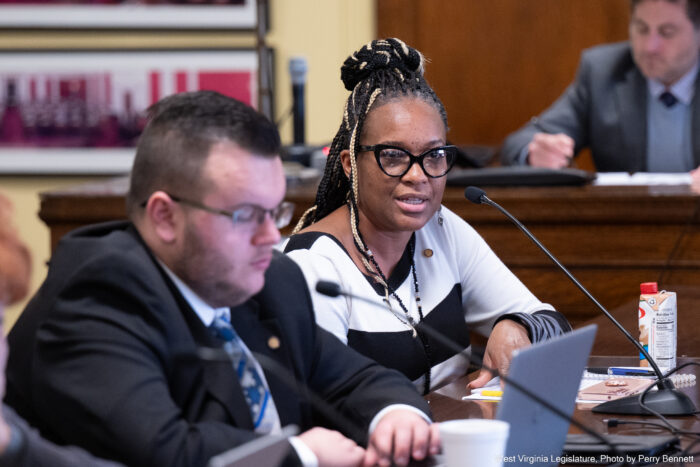
Del. Anitra Hamilton, D-Monongalia, introduced amendments to Senate Bill 474 to make its text consistent across identity groups and add protections from discrimination on the basis of hair type.
Photo Credit: Perry Bennett/WV Legislative Photography
Steele likened the amendment to the CROWN Act, a bill passed by several states nationwide to protect against hair type discrimination, but which he said the House floor had not considered in full. He also argued forms of hair type discrimination would already fall under non-discrimination protections based around “national, origin or religion.”
“We do need to have a conversation,” Hamilton said. “There are specific barriers in place that are preventing certain classes of people, specifically African Americans, from being hired because of their hairstyle and their hair texture.”
That amendment was also voted down by the House.
Successful amendments
The House did adopt an amendment from House Minority Leader Sean Hornbuckle, D-Cabell, that explicitly states nothing in the bill’s text can be used to curtail West Virginia Human Rights Act, which extends residents “equal opportunity” to employment and public resources.
The House also passed an amendment from Del. Kayla Young, D-Kanawha, which would affirm that the bill could not restrict universities in ways which would prevent them from meeting “accreditation standards.”
Add WVPB as a preferred source on Google to see more from our team
West Virginia has seen the largest population decline in the nation - nearly 1.5% - and many of those leaving are young people. In an episode that aired last month, Us & Them host Trey Kay heard from some young people who think they may stay in the state to launch their futures. This month, Kay talks with those who say living their dreams may well require moving away from the Mountain State. We listen to an excerpt from the latest Us & Them.
State lawmakers have warned surveillance company Flock Safety they may compel company officials to testify if they don't respond by Friday to questions stemming from an August interim meeting.