This week, some of the stories on our show inspired college student art — including a vivid image of a bear smashing a clarinet. Also, a Hare Krishna community in West Virginia serves vegetarian food made in three sacred kitchens. And, COVID-19 exposed the contempt society has for marginalized people. One author says, these folks are anything but passive.
House Democrats Say Republicans Overlooked Laundry List Of Key Issues This Session
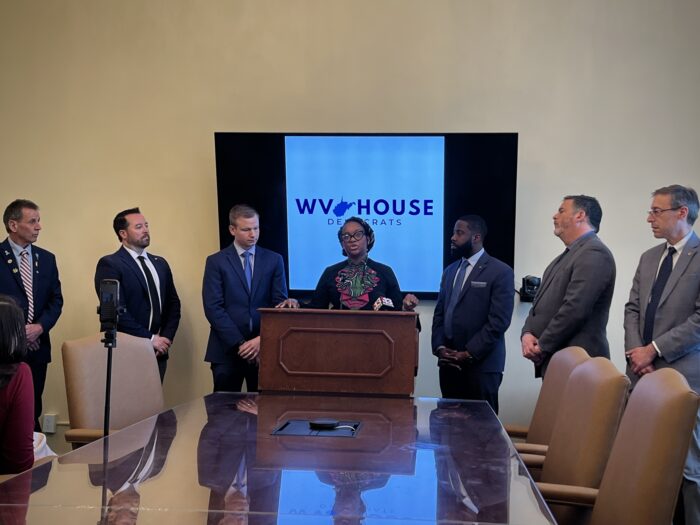
Del. Anitra Hamilton, D-Monongalia, discusses this year's legislative session at a press event for Democrats in the West Virginia House of Delegates Wednesday afternoon.Jack Walker/West Virginia Public Broadcasting
Listen
Share this Article
Just days remain in this year’s legislative session, but Democratic members of the West Virginia House of Delegates say the wider legislature has insufficiently addressed key issues affecting residents across the state.
House Democrats expressed disappointment over the Republican supermajority’s approach to things like child care, workforce development and benefits for state employees during a press conference at the West Virginia State Capitol Wednesday afternoon.
House Minority Leader Del. Sean Hornbuckle, D-Cabell, called these “kitchen-table issues” that had been at the top of his party’s agenda throughout the session.
“Unfortunately, we have seen this session again — I stand here on Day 57 — is a waste of time,” he said.
Del. Anitra Hamilton, D-Monongalia, pointed to Senate Bill 474 as an example of a misplaced priority from lawmakers on the right. The bill would eliminate diversity, equity and inclusion programs across state government.
Hamilton described the bill as “divisive and discriminatory.” She noted that some of its provisions allow for identity-specific initiatives on the basis of sex, but prohibit them on the basis of race and ethnicity.
Hamilton introduced an amendment to make provisions in the bill more uniform among these identity categories. It was approved by the House Education Committee but later walked back by the House Judiciary Committee, where she does not serve as a member.
“This is not a problem in West Virginia,” Hamilton said. “It does nothing to improve West Virginia. It only divides us.”
Del. Mike Pushkin, D-Kanawha, said Republicans in the state legislature have focused on “campaign-mode,” “rhetoric-type” bills like these instead of things that would boost benefits for state employees or recruit more workers into the state’s overburdened foster care and correctional systems.
“This legislature and this governor [have] made the problem worse by failing to address the Public Employee Insurance Agency, failing to address that their health care keeps going up without giving adequate pay raises,” he said. “They need to be less concerned about ending DEI and more concerned about fixing PEIA.”
Del. Anitra Hamilton, D-Monongalia, speaks at the House Human Services Subcommittee on Feb. 17.
Photo Credit: Perry Bennett/WV Legislative Photography
Del. Mike Pushkin, D-Kanawha, attends a House Health and Human Resources Committee meeting on Feb. 24.
Photo Credit: Perry Bennett/WV Legislative Photography
Del. Evan Hansen, D-Monongalia, argued Republican lawmakers have introduced “harmful” bills this session. He specifically pointed to Senate Bill 592, which would loosen inspection requirements for oil, gas and coal tanks near water supplies.
The inspections were mandated by the state legislature after a devastating chemical leak into the Elk River from an above-ground storage tank contaminated drinking water for residents of nine counties in 2014.
House Democrats also criticized last-minute efforts to expand vaccine exemptions for West Virginia students after similar pushes failed earlier in the session; plus a bill that would authorize data centers to create their own microgrid energy supplies without paying energy rates or procuring local approval.
After the event, Cole Snyder, communications director for the House’s Republican caucus, pushed back against some of the concerns raised by members of the chamber’s Democratic caucus in an email to members of the media.
“House Democrats claim that the legislature is getting nothing done, but this is simply a lie,” Snyder wrote. “Quality bills are moving through the House of Delegates, oftentimes with their support.”
Snyder cited House Bill 2014 — the microgrid bill — plus House Bill 2389 and Senate Bill 458 as examples of Republican-led efforts to foster job growth in the state. The latter two bills would facilitate licensure processes in the state for dieticians and other professionals.
“They simply choose to forget those bills when it comes time to play politics,” he added.
March 12 is the final day of this year’s legislative session, and bills have a March 10 deadline to be taken up for first reading on the floor of either legislative chamber. By then, House Democrats expressed doubt that the state legislature would address their overarching concerns.
“Session is almost over,” said House Minority Whip Del. Shawn Fluharty, D-Ohio. “That’s some good news for West Virginians.”
On this West Virginia Week, ICE arrests in West Virginia include 650 people, some lawmakers consider changing how residents vote, and rock climbers embrace the cold to scale a frozen waterfall.
On The Legislature This Week, House Finance leaders provide us with some insight into the state budget process. We also hear about lawmakers’ ideas to change local elections, as well as a bill restricting abortion medication in the Senate.
While the West Virginia Legislature may consider hundreds of bills during the 60-day session, there is only one thing they are required by the state constitution to do and that is to pass a balanced budget. The state is not allowed to operate in a deficit. News Director Eric Douglas spoke with House Finance Committee Chair Vernon Criss, R-Wood, and Minority Chair of House Finance Del. John Williams, D-Monongalia, to discuss the process for creating the state budget.
Thursday’s decision came following a two-day hearing held in December at the DEP headquarters in Charleston where the citizen groups argued for the release of all redacted information in the site’s air quality permit application.