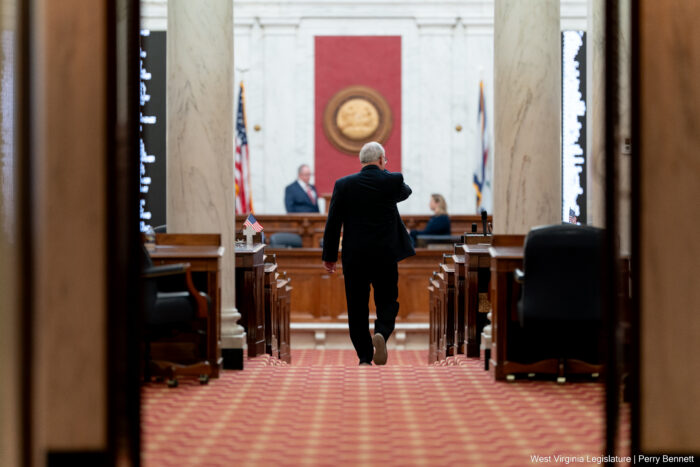
The West Virginia House of Delegates had a busy Tuesday, sustaining lengthy debate on several bills ranging from elections to employment and electric bills.
As part of a floor session that exceeded four hours, delegates debated House Bill 4600, which would make the closing of polls on election day the deadline for all ballots.
Code currently allows absentee ballots that have been postmarked by election day to be counted if they arrive by the day of the official election canvas, which usually takes place a week or more after the election.
Most of the opposition to the bill throughout the legislative process has come from Democrats, who introduced four separate amendments Monday to try and carve out exceptions to the new deadline for the elderly and other groups reliant on absentee ballots.
They were joined Tuesday by Del. Keith Marple, R-Harrison, who at 82, is the oldest delegate in the House. Much of the debate has centered around issues with the postal service and not being able to reliably predict when someone will need to mail their ballot for it to arrive by election day.
“I urge that you vote this bill down. You preserve the dignity of the elections in West Virginia, and you allow people who mail their ballots on the day before election and have it postmarked,” Marple said. “They’ll never know it wasn’t counted, because nobody’s going to notify them, ‘Sorry, your vote came in too late. We didn’t count it.’”
Del. Tristan Leavitt, R-Kanawha, reiterated the argument that more than 20 other states already have similar requirements.
“I understand there are policy disagreements that people may not like this as a deadline, and I understand that whatever we do, we want to educate our people about,” he said. “But I do think it’s a little disingenuous to claim that we are disregarding votes or that we are trying to disenfranchise anybody. This is something that is done in almost half of the states in the nation, including by very liberal states, and it has never posed an issue.”
House Bill 4600 was approved 79-17 with three delegates absent, and now goes to the Senate for its consideration.
Employment Verification
Delegates also hotly debated House Bill 4198, which would require all businesses in West Virginia to electronically verify their workers’ employment authorization.
Supporters like House Majority Leader Del. Pat McGeehan,R-Hancock, argued the requirements protected jobs for West Virginians over undocumented workers. He warned about the influx of what he called illegal immigrants into the country.
“We have a problem, a massive problem, on our hands. We need to preserve our state, our culture. Fortunately, it’s not as bad here as it is in other states,” he said. “But it’s not about this not being compassionate. It’s not about this interfering with businesses. It’s a free website for crying out loud. It’s really about our state’s working people, our state’s working people that are the backbone of this state. It’s we need to also preserve and keep and hold our communities intact. That’s what this is really about.”
But those like Del. Bob Fehrenbacher, R-Wood, who sought to amend the bill and create exceptions for small businesses, argued the requirement represented an undue burden on businesses in a state with the nation’s worst broadband.
“This state is going to get a billion dollars for internet service, because it’s estimated that about 10% of our population has no internet service,” he said. “I guess those businesses in those locations that don’t have internet service are going to move to where they get a signal. Well and hope that their third party provider or their cell phone service is going to allow them to perform this E-verify check because I-9s are not satisfactory.”
HB 4198 passed 69 to 24 and now heads to the Senate for its consideration.
Foster Child Bill of Rights
The House also passed House Bill 4749, which adds three articles to the Foster Child Bill of Rights that would give children in foster care aged 13 and older the right to proper notice of a hearing where the outcome may affect them, the option to attend the hearing and the right to have the outcome explained to them.
Del. J.B. Akers, R-Kanawha, and Del. Evan Worrell, R-Cabell, both stood to commend the bill’s author Katana Curry, an 18-year-old resident of Turning Point, a long-term residential care program serving older youth who are currently wards of the state. She wrote the bill when she was still 17.
“She spoke to the committee at the podium,” Akers said. “She was a great advocate for herself and her peers in the foster care system, and she was their voice that day. So thank you for doing that.”
House Bill 4749 passed with the unanimous support of all 97 delegates present, with three absent, and now heads to the Senate for its consideration.