Alert (09/10/2026): Our Parkersburg TV transmitter is undergoing maintenance for a few days and will not be operational. We apologize for any inconvenience.
All our programming is available via our TV livestreams on our website and WVPB Passport. Thank you for your patience!
This week, one thing about Appalachians: we can get competitive. We’re proud of our local food. Love a good hunt. And enjoy competition with friends. We learn the rules and celebrate our victories. You'll hear these stories and more this week, Inside Appalachia.
Bill Prohibiting Ranked Choice Voting Passes Both Chambers
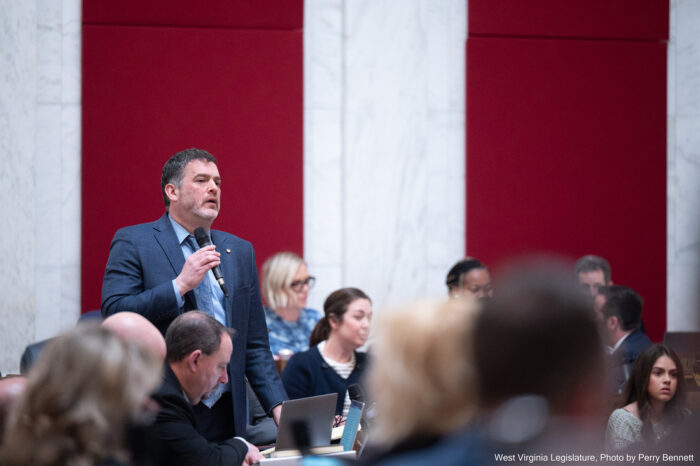
Del. J.B. Akers, R-Kanawha, addresses his fellow lawmakers on the floor of the West Virginia House of Delegates on Friday.Perry Bennett/WV Legislative Photo
Listen
Share this Article
In recent years, some political organizations and public interest groups have pointed to ranked choice voting as a means of improving elections nationwide and better representing the wants of voters. The practice allows voters to rank their candidates by preference, instead of voting for just one.
But the process has become a point of bipartisan contention, with several Republican-led state legislatures advancing bills that would prohibit the process within their jurisdictions. That debate has spilled over into the West Virginia Legislature in the shape of Senate Bill 490.
The West Virginia House of Delegates on Friday passed Senate Bill 490, which would codify in the West Virginia Code that ranked choice voting is prohibited, and that efforts to adopt the process on the state or local level are void.
The bill had already passed the West Virginia Senate on Tuesday, where it was originally proposed by Sen. Jack Woodrum, R-Summers.
Del. Mike Pushkin, D-Kanawha, speaks against the potential prohibition of ranked choice voting in West Virginia on the House floor Friday.
Photo Credit: Perry Bennett/WV Legislative Photo
Ranked choice voting is already not practiced in the state. Proponents of the bill, like Del. J.B. Akers, R-Kanawha, describe it as a “proactive” effort to uphold the integrity of elections in West Virginia.
“We often pass legislation in this body proactively,” Akers said on the House floor Friday. “If we see a problem somewhere else, we try to address it before it’s in West Virginia.”
But opponents of the bill say banning a practice not in place has little effect. Del. Mike Pushkin, D-Kanawha, argued that the bill would prohibit a practice that “promotes civility in politics,” and is already used to select committee chairs in the state legislature itself.
“If you’re running against somebody [and] you think that y’all are pretty close there, you want [to be] their voters’ second choice,” Pushkin said on the House floor Friday. “So you’re not going to attack them, because you want their folks to give you their second choice.”
Despite the pushback from Democratic lawmakers, Senate Bill 490 passed the House by a vote of 87-9 on Friday. It now returns to the state’s Senate for a final review, before heading to the governor’s office for approval to become law.
Add WVPB as a preferred source on Google to see more from our team
U.S. Secretary of Education Linda McMahon told media in Cabell County she wants to transition federal education funding to a block grant model and eliminate the U.S. Department of Education completely.
U.S. Sen. Shelley Moore Capito is a co-sponsor of legislation she said would help protect athletes and bring college athletics back to what they were meant to be.