Alert (09/10/2026): Our Parkersburg TV transmitter is undergoing maintenance for a few days and will not be operational. We apologize for any inconvenience.
All our programming is available via our TV livestreams on our website and WVPB Passport. Thank you for your patience!
Appalachians have always made use of the region’s wide variety of plants. A new book, called Appalachian Plants: In the Garden, In the Yard, and In the Wild, explores some of the history and lore of regional staples. It’s written by Linda Hager Pack and illustrated by Pat Banks. Inside Appalachia Host Mason Adams spoke with them.
To Keep Industry Abuzz, W.Va. Beekeepers Want More State Protection
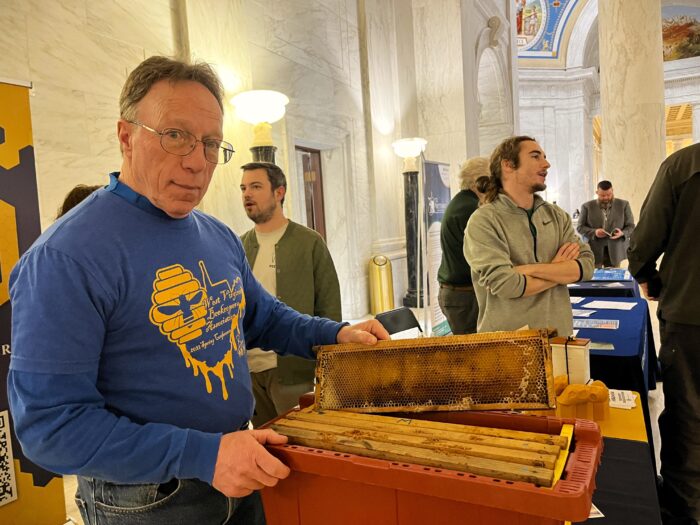
Rick Forre is president of both the South Eastern Beekeepers and the Fayette County Beekeepers. He displayed racks from a beehive at the State Capitol Thursday.Jack Walker/West Virginia Public Broadcasting
Listen
Share this Article
West Virginia is home to roughly 16,000 honeybee colonies, which produce at least 250,000 pounds of honey per year, according to the West Virginia Department of Agriculture (WVDA). Across the United States, agriculturists estimate that honeybee-pollinated crops make up one-third of the food we eat.
But beekeepers in the Mountain State say overly restrictive local ordinances can make it hard to maintain colonies. Concerns like these have spilled over into the courtroom; and, this week, shown up at the State Capitol.
In 2023, South Charleston resident Alex Urban sought a permit to keep bees on his property, but was rejected by the city. South Charleston went on to ban keeping domesticated animals like bees within its limits, so Urban filed a lawsuit in the Kanawha County Circuit Court in August 2023.
Ultimately, the circuit court ruled in favor of Urban and the WVDA, affirming that the WVDA has authority over beekeeping regulations in the state.
“Beekeeping is a crucial component of agriculture and environmental sustainability, and we are committed to protecting those who contribute to our state’s food systems,” said West Virginia Commissioner of Agriculture Kent Leonhardt in the press release. “We worked diligently to ensure that the law remains clear and fair for all West Virginia farmers and beekeepers.”
While the circuit court case has been put to rest, beekeepers across the state want stronger protection to ensure local policies do not infringe upon their right to maintain colonies. Several visited the State Capitol Thursday for “Agriculture Day,” an annual event that aims to familiarize lawmakers and residents with issues affecting the state’s agriculture industry.
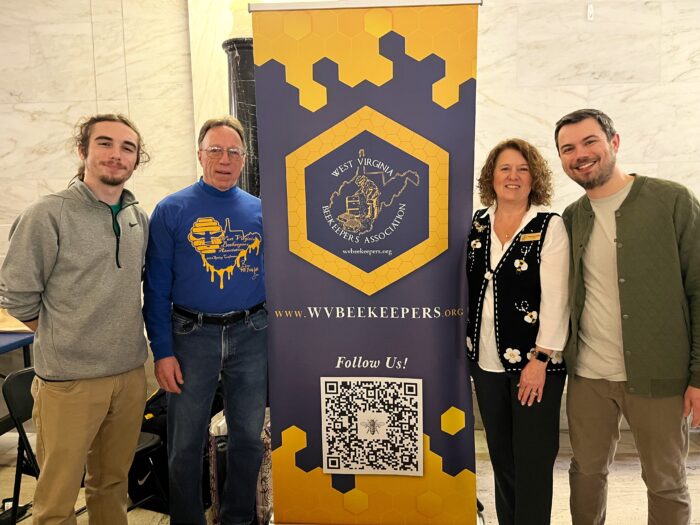
From left: Paxton Coby, West Virginia Beekeepers Association; Rick Forre, Fayette County Beekeepers; Louisa Householder, WVBA; and Mike Lamp, Monongalia County Beekeepers.
Photo Credit: Jack Walker/West Virginia Public Broadcasting
Louisa Householder is president of the West Virginia Beekeepers Association (WVBA), which offers education, mentorship and advocacy to 25 regional beekeeping clubs across the Mountain State.
To prevent future conflicts on the local level, she said her organization is advocating for the West Virginia Legislature to pass House Bill 2454, which would clarify in the West Virginia Code that authority over apiary policies rests solely in the WVDA.
The bill was proposed in the West Virginia House of Delegates by Del. Mike Hornby, R-Berkeley, on Feb. 17. It has not yet been taken up for a reading on the House floor.
“No town, city, municipality or political subdivision may prohibit urban agriculture or agricultural residential land or cause a permit or license to be issued or obtained to engage in the practice of urban agriculture,” the bill reads.
“It strengthens the apiary law that we already have,” Householder said, adding that supporting beekeeping rights “is extremely important for food security.”
Mike Lamp serves as the president of the Monongalia County Beekeepers Association, part of the WVBA network. He said the value of pollinators like honeybees reaches beyond food production.
“Pollinators not only help with cultivating crops, but wild species of plants as well,” he said.
Like Householder, Lamp said reinforcing protections is a simple way to ensure an important animal species keeps strong numbers across the state.
“The beekeeping industry in West Virginia is not necessarily a small one. It’s a relatively sizable industry with a lot of people who are affected by ordinances like these,” Lamp said. “That’s what makes this bill all the more important.”
Add WVPB as a preferred source on Google to see more from our team
On this West Virginia Week, the state signs a memorandum of understanding about nuclear energy, the Public Service Commission disputes need for a transmission line, and 9/11 is remembered.
A staff engineer testified that there is little evidence of the project’s benefit to West Virginians and the most likely outcome of the MARL project not being built is the energizing of fewer data centers in Virginia.
Economic growth in West Virginia ranks close to the bottom in national rankings. It’s not just losing jobs, it’s also losing young people. In the first of two new Us & Them episodes, host Trey Kay talks with several young adults from the Mountain State asking whether they will stay put or find their future elsewhere.