Alert (09/10/2026): Our Parkersburg TV transmitter is undergoing maintenance for a few days and will not be operational. We apologize for any inconvenience.
All our programming is available via our TV livestreams on our website and WVPB Passport. Thank you for your patience!
Hockey is still finding fans and players in central Appalachia, but just because it’s an emerging sport in this region doesn’t mean we don’t have hockey heroes. Inside Appalachia’s Abby Neff met with Gwyneth Phillips, a goalie for the gold-medal winning U.S. Olympics Women’s team, to learn more.
Martinsburg Forum Connects Region’s Farmers With State, Federal Aid
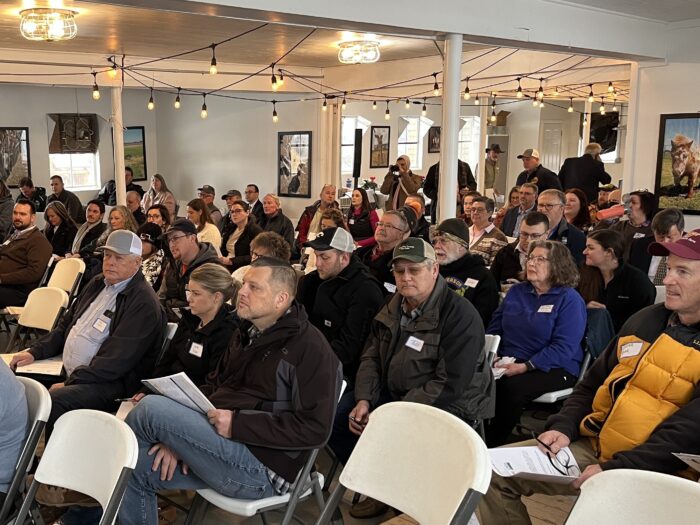
Dozens of farmers and community members attended an Appalachian regional food systems meeting in Martinsburg on Thursday, January 16, 2025.Jack Walker/West Virginia Public Broadcasting
Listen
Share this Article
Dozens of people packed into a farmhouse at a Martinsburg apple orchard Thursday for a regional forum on food business, and the federal and state financial support available to food entrepreneurs in the Appalachian region.
The tri-state food systems meeting was hosted by the United States Department of Agriculture (USDA) Agricultural Marketing Service, the USDA Regional Food Business Centers Program and the FarmLink Project, a nonprofit that helps growers redistribute their excess produce.
The meeting aimed to introduce residents of Maryland, Virginia and West Virginia to business development grants and resources, and to solicit feedback from farmers regarding regional experiences in the food and farming industries.
The meeting paid particular focus to the region’s apple industry, which has in recent years been plagued with market and demand issues.
This has affected commercial orchards that grow apples for food processing most acutely. Some farmer advocates say the importation of apple ingredients from foreign countries with lower labor costs have reduced domestic sales, and placed the future of the U.S. apple industry at risk.
Sophia Adelle, head of policy and advocacy for FarmLink, said this makes helping farmers access support and business resources more urgent.
“These apple growers have seen a moment of surplus due to the complete and total loss of their processing markets,” she said. “FarmLink really stepped in, patchworking together both state and federal support.”
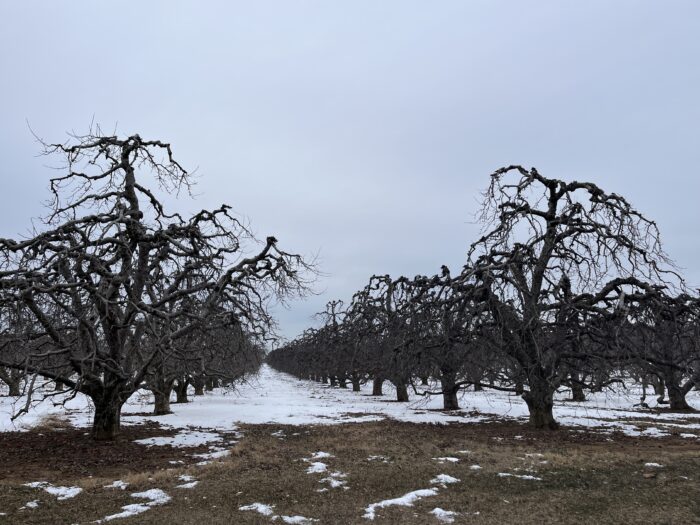
Thursday’s forum was held at Orr’s Farm Market, an apple orchard and produce business with locations in Martinsburg, pictured here, and Shenandoah Junction.
Photo Credit: Jack Walker/West Virginia Public Broadcasting
Adelle said many grants and loans exist on the federal and state levels for agriculture businesses, but that the application process for these programs can place a burden on farmers.
“That’s really difficult for a lot of farmers in this country who are just trying to make ends meet,” she said. “They don’t have the time or the resources to apply for those grants and those loans. So we’re seeing a lot of challenges with our agricultural trade, and a lot of imports coming in.”
Adelle said introducing Appalachian farmers and entrepreneurs to the resources out there makes the process easier.
Kim Watt runs an apple growing business that spans Hampshire County as well as Frederick County, Virginia. She said FarmLink has already helped her business sell excess produce, but that Thursday’s forum showed her how many more resources are available.
“We have actually not applied for grants in the past. So today has been a very enlightening experience for me to even know what is out there,” she said. “I think sometimes that’s your biggest obstacle. You don’t know where to start or what’s available.”
For Watt, an added perk of the meeting was being in the same room as several other people in the industry, as well as individuals who run programs that support farmers. This created connections that stretch beyond any one meeting, she said.
“I’ve met some incredible folks through USDA, and they all work in different capacities, but they are just a huge advocate for us,” she said. “I just want to thank everybody for taking the time to meet with us farmers and growers.
“I mean, 2% of America, that’s it — we’re the farmers,” Watt continued. “But we’re responsible for feeding all of America.”
This story was distributed by the Appalachia + Mid-South Newsroom, a collaboration between West Virginia Public Broadcasting, WPLN and WUOT in Tennessee, LPM, WEKU, WKMS and WKYU in Kentucky and NPR.
Add WVPB as a preferred source on Google to see more from our team
Hockey is still finding fans and players in central Appalachia, but just because it’s an emerging sport in this region doesn’t mean we don’t have hockey heroes. Inside Appalachia’s Abby Neff met with Gwyneth Phillips, a goalie for the gold-medal winning U.S. Olympics Women’s team, to learn more.
The Black Diamond Power Company and Appalachian Power have until next week to file a schedule with the Public Service Commission of West Virginia (PSC) for a proposed purchase agreement.
A series of storm systems moved across West Virginia earlier this week, bringing repeated periods of heavy rainfall and thunderstorms, overwhelming streams, creeks, drainage systems, and low-water crossings.
Two federally important facilities located in West Virginia require a strict limit on radio frequency interference. But for decades – increasingly as communication systems have become more advanced – those limits have made it difficult for emergency crews and first responders in Pendleton and Pocahontas counties to do their jobs as safely and effectively as possible. Now the results of a lengthy federal study show exactly how precarious the situation is. We caught up with Pendleton County Emergency Management’s Rick Gillespie to find out what the study shows and what happens next.