Alert (09/29/2026): Our Parkersburg TV transmitter is still undergoing maintenance and remains temporarily inoperative. We apologize for the inconvenience.
All our programming is available via our TV livestreams on our website and WVPB Passport. Thank you for your patience!
This week's premiere broadcast of Mountain Stage honors the lives of artists who we lost over the past few years. On this "In Memoriam" episode, you will hear archived performances by Jill Sobule, Todd Snider, Chip Taylor, Justin Townes Earle, and more.
Data Center Threatens Rare American Chestnut Orchard In W.Va.
The former Clements State Tree Nursery in Mason County hosts the only known sexually mature orchard of American chestnuts in West Virginia and one of only a handful nationwide.
Andrea "river" Peterson
Listen
Share this Article
The former Clements State Tree Nursery in Mason County hosts the only known sexually mature orchard of American chestnuts in West Virginia and one of only a handful nationwide.
But the Nscale Monarch Computing Campus is set to be built on top of the orchard.
The Nscale data center development is one of several projects across West Virginia approved under a state program that exempts developments from some local permit and zoning regulations. Many locals are angry that the fate of these trees was decided largely in secret.
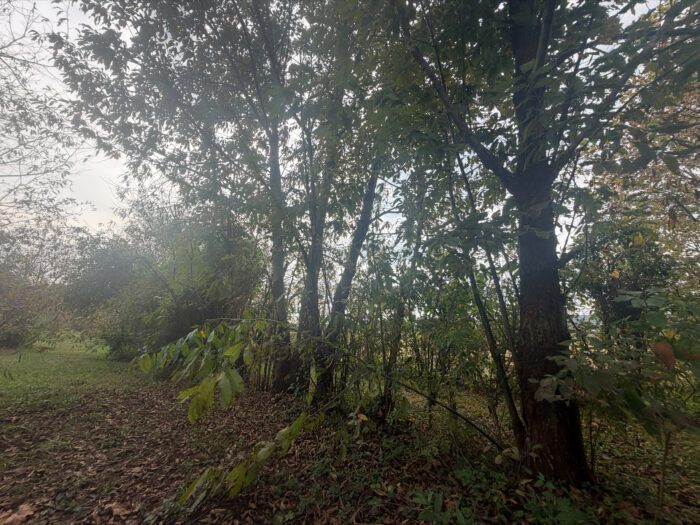
Alex Cole, a local community organizer who also runs a small native tree nursery, recently visited Clements. The facility closed in 2021 but the land is still owned by the state and publicly accessible. Rows of American chestnuts grow here, with a handful rising as high as 60 feet.
“It’s like being around a white rhino or something,” he said.
American Chestnuts growing at the former Clements State Tree Nursery in Mason County.
Photo by Andrea “river” Peterson
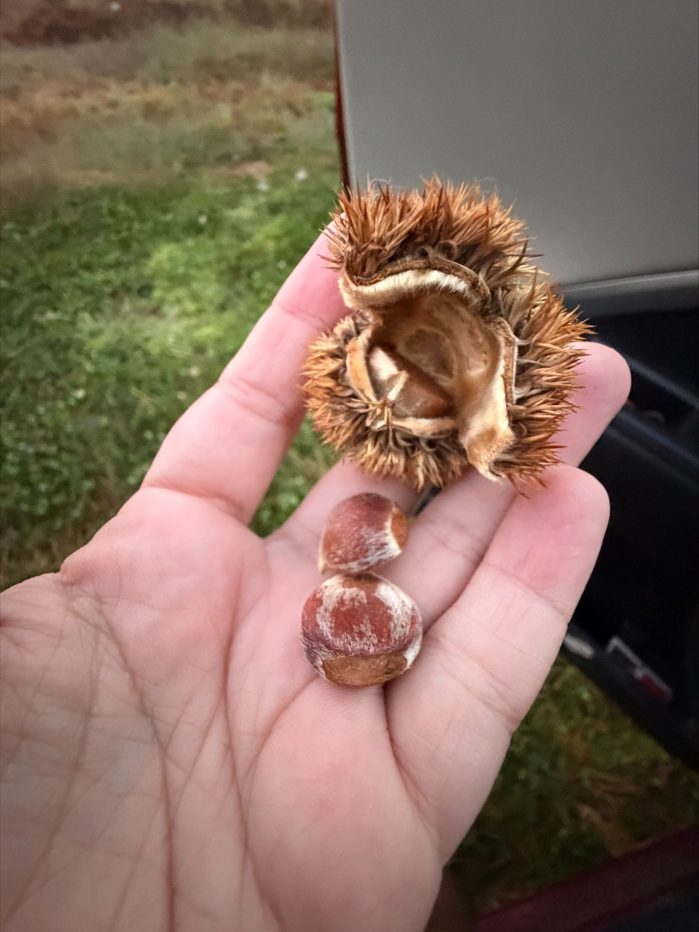
But Cole is surrounded by burrs – the spiny shells that protect the nuts and are a product of mature pollinating trees.
“It’s this thing that shouldn’t exist and here it does, right here in West Virginia – and on state land,” he added.
Marshall University natural resource and recreation management professor Casey Moran said the lack of public engagement over the orchard is especially upsetting for many.
“This is a part of Appalachian heritage,” she said. “Not having a public comment period on the plan that engaged the community and asked for their opinion – I think that to me is the biggest issue.”
American chestnut trees once grew across Appalachia, serving as an important human and animal food source.
In the early 1900s, blight was imported into the eastern United States with Chinese chestnut trees.
“The fungus found a cousin to Chinese chestnuts that had absolutely no resistance. So over the course of about 50 years, we lost four billion trees,” said Mark Double, a retired researcher at West Virginia University who works with the state chapter of The American Chestnut Foundation.
But there are rare survivors.
In the 1970s, researchers harvested nuts from those trees and planted just over a thousand of them at the Clements site.
“This is the repository of Appalachian genetics for the American chestnut tree. Period. That’s why it was planted – that’s why it exists,” Cole said.
Most of the seeded trees died. But half a dozen trees from the original planting and another 15 to 20 mature trees from a planting in the mid-1990s now bear chestnuts every year.
The orchard has the blight, but decoding what allows these trees to reach maturity and reproduce even while infected could help scientists figure out how to reintroduce American chestnuts to the wild.
“It’s highly valuable,” Double said .
In fact, nuts from the orchard are the primary source for American chestnut seedlings that the West Virginia Chapter of The American Chestnut Foundation distributes to its members for their own local plantings and in research use.
Harvests continued after the nursery was officially closed. The trees are harvested in February and September every year. This year, the group collected roughly 900 nuts.
But the organization struggled for years to get answers on the fate of the trees as data center developments took interest in Mason County. No specific plan for the orchard was publicly shared by Nscale, or its predecessor Fidelis, after they struck a purchase agreement for the land in 2023.
Now, as construction on the first stage of Nscale’s data center campus is underway nearby, online pressure from Cole and others has prompted Nscale and Gov. Patrick Morrisey to share a plan for the trees. As of now it is to move them during the winter of 2027, at Nscale’s expense.
“There’s never been a plan to and there will never be a plan to bulldoze or cut down the trees,” Nscale Senior Vice President Pete Hollis said in an interview with West Virginia Public Broadcasting.
But locals and tree experts are skeptical that the trees can survive a move with existing blight damage. Cole said it’ll be impossible to even dig their roots up without significant destruction.
“Do you see how close together they are?” Cole said, pointing to a series of chestnut trees with trunks more than a foot wide, now growing within two feet of other similarly sized, mature trees.
After the closure of the nursery operations, state workers from Ohio continued to perform basic maintenance. Double confirmed Ohio Division of Forestry has been mowing the orchard and harvesting nuts from the site in recent years.
The governor’s office cited a report, which it has not yet released to the public, but that has been seen by West Virginia Public Broadcasting, as motivation for the decision to move the trees in an emailed statement. The report notes there are mortality risks related to moving the trees. It also described their current health as impacted by lack of maintenance and the blight.
“The assessment concluded that while some mortality may occur during relocation, improved growing conditions and proper maintenance may improve the health of the surviving trees,” wrote Lars Daleside, communications director for the West Virginia Office of the Governor. “Relocating them offers an opportunity to give these trees a better chance at long-term survival than they have under current conditions.”
The report was produced after a viral online outcry about the future of the trees raised concerns they could be at risk as soon as Nov. 1.
Cole said he hopes the developers will consider leaving the trees in place as they learn more about the importance of their genetics – especially because they are on a small, 1.2-acre parcel near the edge of the 2,250-acre stretch associated with the Nscale development.
Nscale’s Hollis said the company is still finalizing plans for the trees and will take the advice of experts, but ruled out leaving the trees in place.
“We will announce what the plans are for the relocation of the trees, whether it be on-site or off-site. We will be transparent with the public as to what those plans are once they are finalized,” he said.
The company has not announced any community engagement opportunities related to the trees, but Hollis said they are in development.
The American Chestnut Foundation confirmed they received their first outreach from the company about the trees on Oct. 14. Anthropic, which is set to lease computing power from the computing campus, did not respond to a request for comment about the trees.
In the emailed statement, the governor’s office said “input from Mark Double of the West Virginia chapter of The American Chestnut Foundation was significant in generating the plan” to move the trees.
Double said he was not consulted by the governor’s office. He described plans to move the trees as a “ludicrous” proposal that would not result in the trees’ preservation or allow for their continued use in restoration efforts, but was instead almost certain to kill them.
“The governor is trying to placate both sides,” Double said.
The sale of the land has not yet closed, and neither the state nor Nscale has provided a date the company expects to take possession.
To Moran, the Marshall University professor, the plans to effectively destroy the orchard at Clements are another symbol of environmental exploitation in Appalachia, like the mining of coal and cutting of timber.
“We’ve all lost something through no fault of our own, you know, that we can never get back,” she said. “And that for me is really what the chestnut resonates with. It is grief and it’s grief that an entire community can feel together.”
Add WVPB as a preferred source on Google to see more from our team
The analysis places the total tax income from the two projects at over $231 million annually, a fraction of the roughly $77 billion the companies plan to invest developing the data centers.
In Mason County, West Virginia, new data center developments are changing local landscapes and communities. One of the computing campuses is also threatening a special stand of trees. Reporter Andrea “River” Peterson reports.
The West Virginia Board of Education got its first look Wednesday at a proposal to update school funding in West Virginia, and voted that that the current funding formula does not provide a thorough and efficient education to public school students.
The developer Valley Link will hold nine meetings in West Virginia next month, as well as three other meetings in Maryland and Virginia, so community members can learn more about the project, review potential routes and share feedback with the project team.