


‘Coolest Thing’ Contest Is Down To The Final Five
After more than 3,200 votes cast, the “Coolest Thing Made In WV” competition is down to five finalists.
Continue Reading Take Me to More NewsAlert (09/10/2026): Our Parkersburg TV transmitter is undergoing maintenance for a few days and will not be operational. We apologize for any inconvenience.
All our programming is available via our TV livestreams on our website and WVPB Passport. Thank you for your patience!




To Educate, Inform, and Inspire by Telling West Virginia's Story
Mountain Readers Week will be held Oct. 5-9, 2026! Sign up to read in your community!

Learn more about Be My Neighbor Day! And check out our recap from last year.

On Demand

On Demand

Stream original productions from WVPB

Watch locally produced documentaries & more.

On Demand

On Demand






West Virginia Morning

Inside Appalachia

West Virginia Week

Mountain Stage

Us & Them

The Legislature Today

The Legislature This Week

Send us your comments and questions.

Stream our board meetings.

Check out the latest WVPB news.

Sign up for our newsletter and get weekly updates.

Meet the WVPB staff.

WV Educational Broadcasting Commission, the WVPB Foundation, and the Friends of WVPB.

Come work with us!

Read our annual report and learn how we educate, inform and inspire with your support.

Sponsor impactful and engaging media and entertainment.

Use your IRA to make a gift to WVPB.

Become a member with your gift of $1,000 or more.

Make WVPB part of your legacy.

Manage your membership account.

Learn how you can Protect and Sustain West Virginia Public Broadcasting.
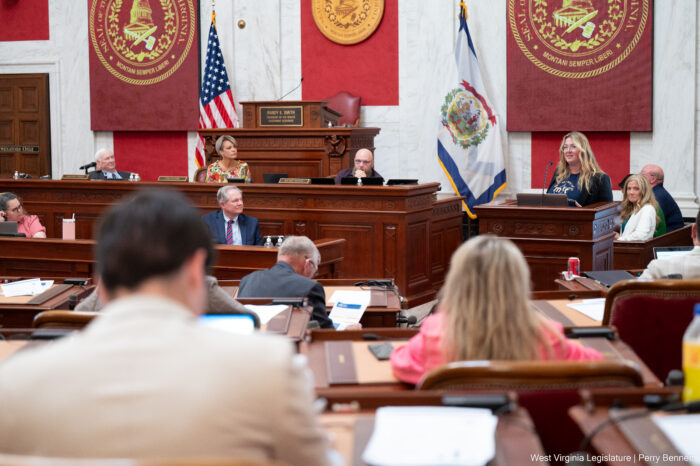
Lawmakers have said school funding reform is a top priority in next year’s legislative session. During a Joint Standing Committee on Education Sunday, they got a glimpse of the governor’s perspective on the issue.
Curtis Capehart presented the Governor’s Principles and Objectives for Education Reform. Capehart wears many hats in Gov. Patrick Morrisey’s administration including acting Secretary of Tourism. He told lawmakers his presentation would relate the governor’s fundamental principles for reform rather than particular statutes, rules, or policies.
“It has been said that principles are the things that help you stay grounded when confronted with difficult decisions or issues of significant import. They can even help to resolve or avoid dilemmas in thorny areas,” Capehart said. “And with that said, the principles that follow now are what the office will have in mind when we are looking at proposed education reforms, and the governor hopes that this is helpful information for you all to know as we all move forward.”
The governor’s principles for education reform generally included:
“When it comes to education, newer is not always better. West Virginia should adopt reliable tools that demonstrably improve learning and outcomes, while eschewing approaches that feel modern merely for the sake of novelty,” Capehart said. “We should also identify technologies that can help to reduce the administrative and bureaucratic burden on teachers, so they can focus on educational time with their students.”
On school funding reform, the governor’s principles were:
“West Virginia ranks near the national average in terms of per pupil spending, but our education results do not. Many states spend substantially less per pupil than West Virginia does, but nonetheless have significantly better outcomes,” Capehart said. “This demonstrates that injecting more money into the system, simply spending more, is not the answer. Instead, we should devote our time and energy to ensuring that funds are being allocated in the most effective and efficient manner and places possible.”
After the presentation, Del. Mike Pushkin, D-Kanawha, asked Capehart how the governor’s principles squared with the administration of the Hope Scholarship.
“The money that goes into the Hope Scholarship, there are no guardrails to that. I see advertising all the time, ‘You can use that money for dance lessons, for horseback riding lessons, for whatever the family wants to use it for.’” Pushkin said. “How is that illustrating its principle of accountability?”
Capehart replied he was not there to speak about the Hope Scholarship but rather to simply present the governor’s areas of focus.
After the meeting, Pushkin expressed frustration with what he felt was an unserious, unprepared presentation that added no information to the discussion on education reform.
“We have a serious crisis going on in our state due to the underfunding of public education with money being drained out of it to put into this unregulated voucher program, and this is the type of report we get in front of Joint Education today,” he said. “Yes, we are renewing our calls to the governor to take this issue seriously. We are in a crisis in public education, and we need to update the funding formula.”
Pushkin and other Democrats from the House of Delegates publicly requested Morrisey call a special session to deal with school funding immediately during a press conference Monday morning.
Add WVPB as a preferred source on Google to see more from our team

In the past 10 to 15 years, schools have seen an increased need to address the social, emotional, and mental health needs of students. The conference will allow support professionals to learn from one another and collaborate.
Continue Reading Take Me to More NewsAn award of more than $290,000 is expected to support training for roughly 100 more nursing students from rural counties in West Virginia.
Continue Reading Take Me to More NewsWest Virginia’s tourism economy has brought in $9.4 billion in economic impact over the past year.
Continue Reading Take Me to More NewsIn recent years, physicians across the country have monitored surges of a condition known as Alpha-Gal Syndrome, which can cause allergic reactions to red meat. Hannah Saad with Appalachia + Mid-South Newsroom member station WKMS reports that, now, farmers, restaurateurs and the afflicted are flocking to a new source of protein.
Continue Reading Take Me to More News