


'Haunted' Town Already Celebrating Spooky Season
Halloween is still several weeks away, but one West Virginia town is already celebrating the season.
Continue Reading Take Me to More NewsAlert (09/29/2026): Our Parkersburg TV transmitter is still undergoing maintenance and remains temporarily inoperative. We apologize for the inconvenience.
All our programming is available via our TV livestreams on our website and WVPB Passport. Thank you for your patience!




To Educate, Inform, and Inspire by Telling West Virginia's Story
Mountain Readers Week will be held Oct. 5-9, 2026! Celebrate and foster a love of reading in children across West Virginia.
Nominate an exceptional West Virginia K-12 teacher today!

On Demand

On Demand

Stream original productions from WVPB

Watch locally produced documentaries & more.

On Demand

On Demand






West Virginia Morning

Inside Appalachia

West Virginia Week

Mountain Stage

Us & Them

The Legislature Today

The Legislature This Week

Send us your comments and questions.

Stream our board meetings.

Check out the latest WVPB news.

Sign up for our newsletter and get weekly updates.

Meet the WVPB staff.

WV Educational Broadcasting Commission, the WVPB Foundation, and the Friends of WVPB.

Come work with us!

Read our annual report and learn how we educate, inform and inspire with your support.

Sponsor impactful and engaging media and entertainment.

Use your IRA to make a gift to WVPB.

Become a member with your gift of $1,000 or more.

Make WVPB part of your legacy.

Manage your membership account.

Learn how you can Protect and Sustain West Virginia Public Broadcasting.
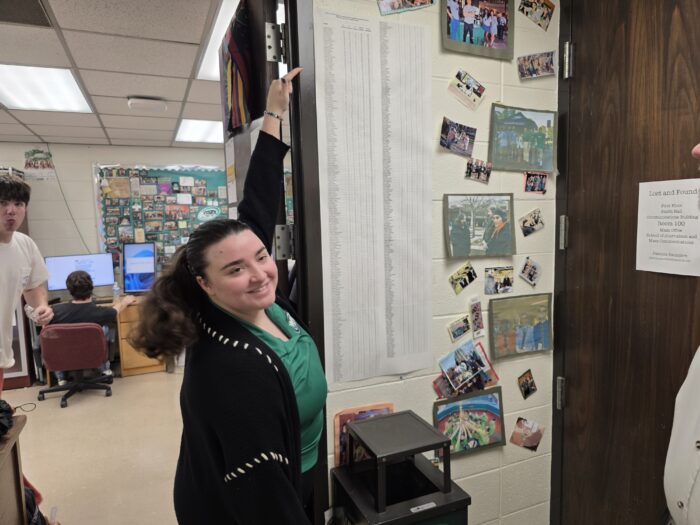
The student-led team that produces the news for WMUL radio at Marshall University learned in August that they won a collegiate Edward R. Murrow award for Outstanding Newscast for the second year in a row.
One of the big reasons students and staff alike list for the overall success of the program is Chuck Bailey, who is entering his 42nd year on faculty. Over that time, WMUL has won more than 2,700 awards.
News Director Eric Douglas, a Marshall journalism alumnus, but not in the radio program, sat down in a classroom studio with Bailey, the student news director Emma Johnson, and the Director of the Marshall School of Journalism and Mass Communications Rob Quicke, to learn more.
This interview has been lightly edited for clarity.
Douglas: What’s the secret sauce, Dr. Bailey? I mean, what do you do? What is it about this college radio station that is beating commercial stations?
Bailey: Well, first I’d say it’s student empowerment. But my philosophy, Eric, if you want to know, I say when students are motivated to learn, afforded adequate training, and delivered concise instruction and provide them with an obtainable set of goals, their success is anticipated result, not a surprising development. Most people come here and don’t think they can do these things. And we have to tell them, “Why not you?”
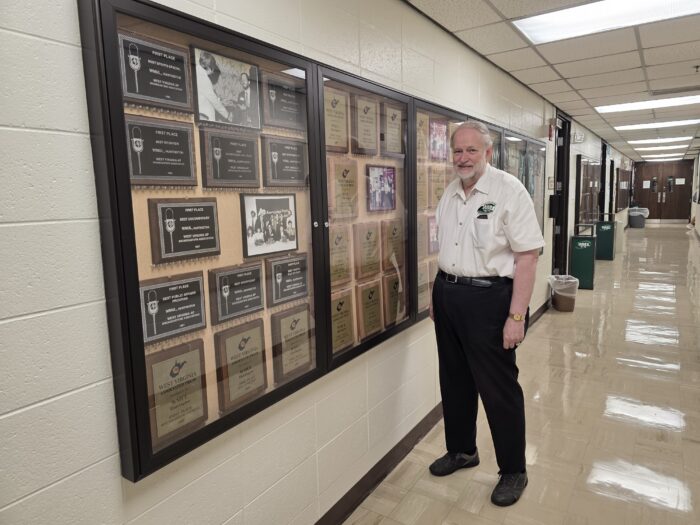
I was telling you when you walked by all the awards, we put those out there to say, “Why can’t you be successful? Look at how much success other students have had.”
And I would say the third thing besides that is, once you’ve created quality work, students get to hear it and they know what’s expected. And it’s not like, “Oh, I hope this wins.” You can ask Emma, we listen to some things and go, “That doesn’t stand a chance. And you need to go back and work on that.” But they don’t take it like, “Oh, you’re putting me down personally. You want me to be successful.” Like I said, if you empower them, I think that’s the secret sauce.
Douglas: Emma, what’s it like being a student in this system?
Johnson: First, let me say it’s great being a student here. We are one of the few programs out of the entire Marshall program list where you can do things hands-on your first semester in school. A lot of other programs, you’ve got to take these prerequisites and then you can do the classes, your junior, senior year. But you can get started literally as a freshman, your first semester here. And so one of my favorite things is when I bring in these new students to produce the news or show them how to do something and I’ll produce the first block of news and then I pass it off to them. And they’re like, “Oh, I get to press the buttons immediately?” And it’s always cool watching them kind of navigate that and see what works for them, what doesn’t work for them. And I think that something else is where we run news five days a week and everyone kind of gets in a rotation.
Almost everyone can produce, anchor, do weather, do sports, do a package. And so you can kind of rotate in and out and figure out who’s the best at what. And I think that’s something that helps everyone as well.
Once everybody gets over the initial nerves of being here at WMUL and realizing they’re not going to mess up the equipment so bad that it can’t be fixed or they actually don’t sound like, my favorite is they don’t sound like cornbread on the air. After they kind of get over those nerves, they realize that while there are high stakes here, it’s not like, “Oh my God, my job’s on the line if I mess up.”
And so I think that helps students get more comfortable and confident with what they’re doing. And it makes them want to have fun. I mean, there are so many students here that are on news, on sports, but then they run a podcast, just like a random, funny little podcast that they want to do on their own time. And while it really doesn’t benefit them anything journalism-wise, they’re building their editing skills, their script writing skills, interviewing skills. So I think it helps in all jobs here.
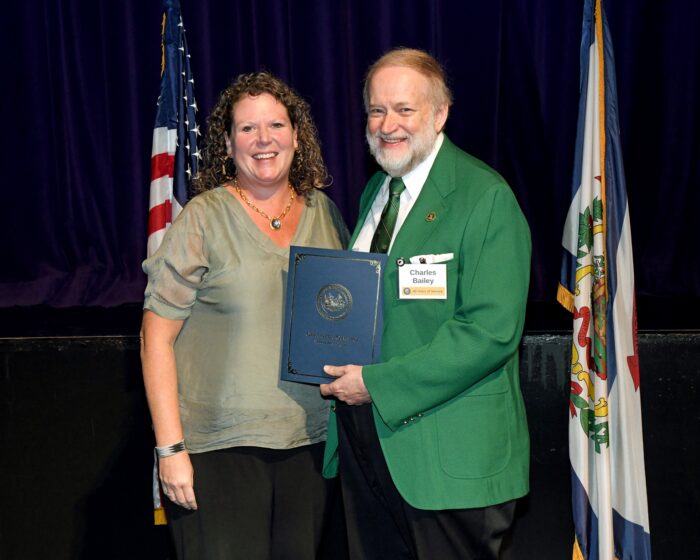
Bailey: Let me add to that. The veterans here sit in with the new people. It’s not they throw them in the deep end, sink or swim. The thing I’ve noticed over the years is that after they’re taught and they know what I expect, I don’t have to sit and tell that to everybody who comes in the door. It’s a given. I can walk into the hallway and I hear them saying what I would say to them. And that’s gratifying in every sense.
Douglas: Dr. Quicke, as the director of the school, how does this move the school forward? Are these students getting jobs?
Quicke: Long before I came to Marshall to work here, I knew about this radio station because my station up in New Jersey and many others kept losing to WMUL. And we’re like, “What the Dickens is going on in West Virginia? What’s going on with this station, WMUL? They keep winning everything.”
I think that’s what’s going on here is that when the students do so well and the station does so well, people don’t just know about the station here in the state, in the region, they hear about it nationally. When you look at the record of Dr. Bailey I don’t think anyone has achieved as much as he has during his time as faculty advisor for the station. I mean, his 41 years here, I don’t think anyone has ever achieved as much in college radio as he has.
So for me, if you ask me what’s the secret sauce, I’d say squarely and honestly and obviously, I’m looking at him right now, Dr. Charles Bailey, because he has created a culture of excellence. a place where students can flourish and thrive and where they can believe.
Douglas: Dr. Bailey, you just won for the second year in a row, a Murrow award, granted, collegiate but not to take anything away from it. That’s truly one of the most reputable, top awards that anybody can win.
Quicke: And then back-to-back as well.
Bailey: In the same category.
Quicke: It almost sounds unbelievable in a way, doesn’t it? Particularly because there are going to be people not at this year’s ceremony who had last year’s ceremony who obviously didn’t win. So yeah, it’s quite amazing, isn’t it, Dr. Bailey.
Bailey: Eric, if you ask most people, they’d say, “Yeah, you might be accredited out of the 104 schools, but you’re way down the list.” Well, in the Hearst Awards, we finished in the top 10 of the 104. And the only three schools returning to New York City for a Murrow are Syracuse, North Carolina, Chapel Hill, and Marshall. Well, most people would not say that.
I think if you ask Emma, I’ve never given them the impression they cannot compete. It is, “Why not us?” We have the same equipment, we have the same things. We do a 30-minute newscast. Most people are amazed when they talk to my sports people, they go, “You get 5 minutes of sports?” And yes, you get 5 minutes, and we want 5 minutes. We don’t want 3 minutes of sports. Dr. Quicke will tell you, you can come up here in the afternoons at 4 o’clock and the staff room’s full because you’re getting ready to do the news at 5. You go anywhere else around here and you can’t find a student.
Johnson: Five days a week, Monday through Friday, starts at 5, ends at 5:30, and we run it through the summer too. We do 15 minutes through the summer though.
Quicke: I’m not just saying this. The proof is in the pudding in terms of what our students are doing here and what they’re achieving. It’s very difficult for us to, pound for pound, dollar for dollar, to go up against some of these big schools. It’s difficult to compete against them in terms of resources, because we just don’t have as many faculty or the big dollar budgets that they have, like the Syracuses or the Columbias. But where we compete and where we win is in the marketplace of ideas and in terms of the things that we’re doing are really, really exciting and cool.
And then what we can do, because we are a smaller school, is that we definitely spend more time with our students one-on-one individually to really give them that individual attention, that coaching. And I believe it pays off. I believe our students can go toe-to-toe with anyone from any program in the country. I really believe that. And of course we can go beyond that. We can actually beat these programs. So I believe this is a huge success story because if you look at what the students have achieved and what they’re doing and then they are getting jobs after graduation, I think that’s the greatest evidence and proof of it all when the students (are) actually going on into the industry. And so for me, enormously proud just to have been here for the last three years into my 4th year to seeing this, but it’s an amazing success story, a remarkable success story.
Bailey: Ask him about our working with the BBC.
Quicke: Yeah, so the BBC approached me because I founded College Radio Day, which is a big national event, and WMUL always was involved with that. But they said, “We’re think of developing a college radio show for the BBC, which would be a first. And so we did the pilot here. And then this last summer, they said, “You know, gosh, we really want to do a show in the summer, but there’s no one around.” I said, “No, at Marshall, we always have students around.” So we did the first ever national college radio show for the BBC done in the summer.
And we did a live session for it here too. It was a huge amount of work, but the BBC sent over all their branding, all their audio imaging and stuff. It sounds very, very strange when listening to it because you got the stuff produced, all this audio from the BBC. And then you’ve got our Marshall students hosting the show. And it’s one of those moments where these weird, very far away worlds collide into something really beautiful.
Douglas: Dr. Bailey, I’ll give you the last word.
Bailey: Eric, if somebody had told me when I started, your people will win several Hearst Awards, which are the big deal in college broadcasting, we won three or four of those, that you would win this many outstanding news operation awards, this many outstanding sports operation awards from the AP, two Murrow awards. I would have thought they were out of their mind. I wanted to create one of the best college stations in the country, but it’s Huntington, it’s Marshall.
But there have been presidents who were really impressed and they gave me the budget to do it. Now in these lean times, the budget’s not there to do what we’ve done in the past.
I got hired by Dottie Johnson, who was Boz Johnson’s wife, and she just said, make things relevant. And I think I’ve done that for the students. And I don’t think there’s anything that we do here that’s beyond the pale, but I think most people don’t expect it. And then when judges hear it, they’re amazed. And I think that amazement is what enables us to compete because they don’t expect it.
Add WVPB as a preferred source on Google to see more from our team

The $26.5 million grant from the U.S. Department of Agriculture will help construct the West Virginia State University Agriculture Complex that will house laboratory space for the university, as well as the state Department of Agriculture.
Continue Reading Take Me to More NewsHalloween is still several weeks away, but one West Virginia town is already celebrating the season.
Continue Reading Take Me to More NewsThey love West Virginia, but love alone may not be enough to keep them here. In the second of two Us & Them episodes, Trey Kay talks with young West Virginians who say they may need to leave in search of careers, community and a place where they can imagine their futures. Their decisions reveal what the Mountain State risks losing when young people cannot see a place for themselves at home.
Continue Reading Take Me to More NewsLast week, we aired the first part of an interview with a WVSU professor about what is AI. In the second part of that interview, we explore the best way to use AI to get what you want – while avoiding fabricated or false answers that seem real.
Continue Reading Take Me to More News