This week, ballads tell stories about all kinds of real-life events, but after Hurricane Helene, one group of ballad singers felt some topics were still too raw. Also, the author of a new book on ancient Ohio credits a former grad student with introducing him to the region’s mysterious earthworks. And, the legacy of Affrilachian poet Norman Jordan includes a summer camp for teens to study their heritage.
Spot The Difference: Baby Dog Shows Up In Capitol Murals
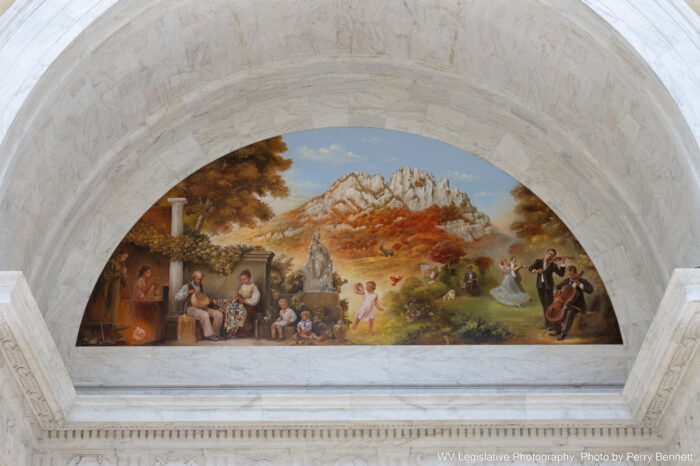
A BabyDog look-alike sits left of center next to a man playing a musical instrument. Perry Bennett/WV Legislative Photography
Listen
Share this Article
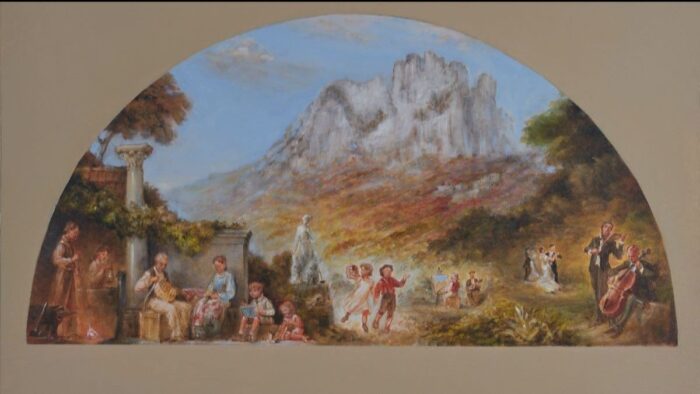
Last week the governor unveiled a series of murals in the capitol’s rotunda. Onlookers noticed multiple changes in the murals from when they were previewed in April, most notably the addition of a painting of a dog that resembles the governors pet.
Gov. Jim Justice’s English Bulldog, Baby Dog, has been a common political prop, appearing in official campaign photos and also being present at many of the governor’s speeches. Baby Dog’s likeness was portrayed in one of the murals unveiled on Thursday.
The mural that was previewed to the public in April.
Courtesy of the Governor’s Office
Critics say that immortalizing Baby Dog’s likeness in the state murals is a misuse of taxpayer dollars. The total cost of the project is $350,000.
Any substantial changes to the appearance of the capitol building’s interior or exterior must be approved by the Capitol Building Commission.
Secretary of Arts, Culture and History Randall Reid-Smith oversaw the project and has defended the decision.
“I want to say thank you to everybody in the press, because people are coming to see those murals because of Baby dog. Because they love her,” Reid-Smith said at a press conference held by the governor.
Reid-Smith went on to say that the governor did not have a role in deciding what would be included in the murals but was responsible for getting them commissioned.
“The only involvement that Jim Justice had in these murals is that he gave us the money to pay for these murals that had not been done in 92 years,” Smith said. “And I thank you for that, governor.”
Justice said an English Bulldog was portrayed in the mural in part as a nod to times before the American Revolution when the English ruled. Either way, he says Baby Dog has brought himself and the state a lot of joy.
“I think it’s kind of a neat thing. I love it to death,” Justice said. “And so just be happy, I mean, for crying out loud, don’t we have enough to worry about.”
West Virginia Public Broadcasting is part of the Department of Arts, Culture and History.
Add WVPB as a preferred source on Google to see more from our team
This week, ballads tell stories about all kinds of real-life events, but after Hurricane Helene, one group of ballad singers felt some topics were still too raw. Also, the author of a new book on ancient Ohio credits a former grad student with introducing him to the region’s mysterious earthworks. And, the legacy of Affrilachian poet Norman Jordan includes a summer camp for teens to study their heritage.
When Marion County attorney Scott Summers realized Grant Town was planning to tear down an historic building, he decided to see what he could do to stop it.
Indigenous people created hundreds of earthen monuments in what is now Ohio, Kentucky and West Virginia. John E. Hancock, a professor of architecture and design at the University of Cincinnati, spent years studying these earthworks. He published a guidebook for visiting them. Inside Appalachia’s Bill Lynch spoke with Hancock about the book.