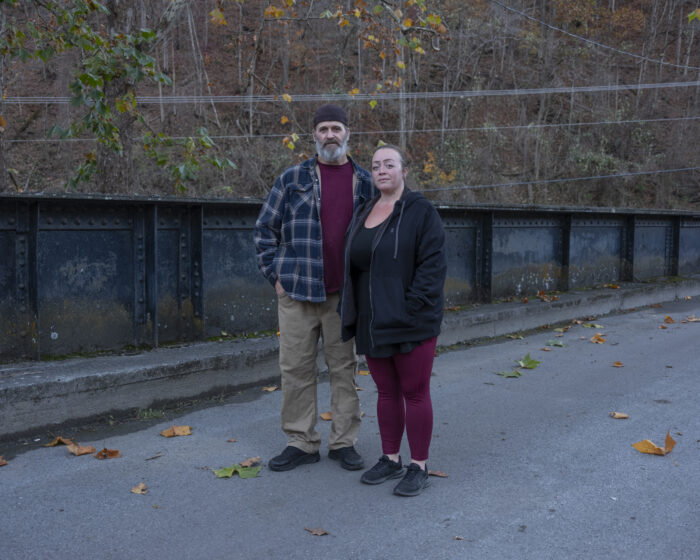
Editor’s Note: West Virginia Public Broadcasting asked photojournalist and West Virginia native Roger May to go back home and take a hard look at how residents are still struggling to find normalcy nine months after flooding hit southern West Virginia. May specializes in turning his camera on the places that shaped him — revealing the humanity behind statistics. He worked primarily in Mingo, Logan, McDowell and Wyoming counties.
Flooding is nothing new to southern West Virginia. My earliest memories are shaped by the 1977 flood — a blur of voices and hurried movement at my grandparents’ house in Chattaroy in Mingo County. They lived at the head of a holler, high enough to stay clear of the worst of it, but many of their neighbors were not so fortunate. That early imprint — of water and worry — has stayed with me my entire life.
Here, small, narrow streams can turn into violent ribbons of runoff in a matter of minutes. A hard rain can become a wall of water downhill and downstream, leaving families with little time to prepare. Roads wash out. Power lines fall. Entire communities — already separated by distance and winding topography — find themselves cut off from the rest of the world. And then, often as suddenly as it arrived, the water recedes, leaving behind the long, exhausting climb of recovery.
From the outside, it’s easy to ask why residents don’t simply move if their homes flood again and again. But for those rooted here — by family, by history, by work, by landscape — the question misses the point. Leaving is not only a financial hurdle; it is a cultural and emotional break that many cannot or do not want to make. If you grow up in these hollers, the land is more than where you live — it’s the place that shaped you, and the place you feel accountable to.
In many parts of southern West Virginia, flat and buildable land is scarce. For generations, people built where they could — most often on the narrow stretches beside creeks and rivers. And building “further uphill” isn’t as simple as it sounds.
Across the four counties I documented for this project — Mingo, Logan, McDowell and Wyoming — more than 53% of land is owned by out-of-state companies and landholding interests. Land that is accessible, affordable and available is nearly as hard to find as predicting the next hundred-year flood.
During this project, I met business owners, retail clerks, teachers, miners and retirees — each touched in some way by the February flooding earlier this year. From Logan to Welch, from Oceana to Kermit, the stories were different, but the through line was the same: people are still rebuilding, long after the news cycle moved on. Porches are being replaced board by board. Furnaces are being coaxed back to life. Panther Mart in Naugatuck only reopened two months ago — seven months after the floodwater tore through it.
Many of the business owners I spoke with didn’t carry flood insurance. The math simply didn’t work. The premiums outweighed what they felt they could risk, so they gambled on staying dry. Others expressed deep frustration with the Federal Emergency Management Agency (FEMA) — feeling overlooked, under-assessed or forgotten entirely.
These photographs don’t aim to document the damage as much, but the people living in the aftermath — their stubbornness, their grief, their humor and their determination to remain rooted in the place they call home.
— Roger May
Q&A With Roger May
The transcript below between WVPB News Director Eric Douglas and photojournalist Roger May has been edited for length and clarity.
Douglas: Let’s talk about the southern West Virginia project. What was it like to go home?
May: Any opportunity I get to go home to those counties in southern West Virginia, it’s great for me. It’s reconnecting with my roots. It’s helping me look at home in a different way, in a more nuanced and subtle way, hopefully, than we see from a lot of folks that are coming in to tell stories.
And I think one of the things that was on my mind was how the passage of time really takes a toll on a place and people. In some regards, I feel like I’m chasing memories of my childhood there when I round a corner and I know what I’m going to see. Sometimes it’s like seeing it for the first time, or I go back to being eight years old and seeing that view for the first time.
Douglas: It’s not like this was the first time you’d ever been back to those areas, but, this was an intentional project to look at how people are doing nine months after a flood.
May: I live in Lincoln County, I’m from Mingo County, but I spend a lot of time in those four counties that I photographed. Maybe Wyoming not as much, but it reminded me of how much I do love Wyoming County, and to be able to get back there was a real treat. I’m a bit of an introvert, and photography helps me access people and places that maybe otherwise I wouldn’t get out of my truck and I’d be to, “Oh, they’re, they’re gonna think I’m up to something or I want something from them,” when, in fact, I really just want to hear their story and share that story with the world.
Working on this really helped me kind of negotiate with myself, like, go talk to this person, see how the flood impacted them. How are they? How are they still dealing with this nine months after the fact, a lot of folks are still very much in the thick of it.
Douglas: I’ve heard that before, that having the camera up, it kind of gives you a little bit of a buffer between somebody and makes them realize that, hey, you’re not just some guy pulling up on the road. You look like a professional photographer.
May: I try to listen to folks and be very clear about what I’m doing. And then even the language that I use is, “Hey, I’m Roger. I’m a photographer. Can I make your picture for this project?” and I’m intentional about the word make, because take just feels like I’m taking something from them. So, in my work and in my relationship with people, that’s how I communicate that, “Hey, could I make a picture of you for this?” And then, of course, offering to share these images, once they’re published, with folks, really helps stay connected to folks and sort of close that loop of the story, right? They can see how their images is used to tell the story,
Douglas: What did you see?
May: I saw small businesses that struggled to reopen. I saw folks that are still rebuilding their homes nine months after the fact, building porches on the front of their homes. I saw a lot of resilience which is a word that gets thrown around a lot and on the one hand I think folks get tired of having to be resilient. But when you’re from our part of the country that’s just what you do, right? You rebuild, you regroup, you do the next thing, right? And so I saw a lot of dignity and pride and humanity and folks that are still recovering from this.
Douglas: In your essay, you got into the lack of usable land, that most of the land, especially in those counties, but southern West Virginia generally, is owned by out-of-state conglomerates and that sort of thing. There’s just no safe places to live.
May: That’s not a new story. That’s a well established fact in West Virginia as a whole, and particularly in southern West Virginia, where you’ve got coal companies and land holding companies that own, I think in McDowell County it’s maybe closer to 65% and maybe over in Mingo it’s 53% or so.
Folks, they can’t go up higher on the hill if it’s owned by somebody else who isn’t willing to sell or lease the land. And so a lot of what we hear sometimes from the outside is, “Why don’t people just move?” “Why don’t they just move to higher ground?” or “Why don’t they move farther away?”
While I understand that question, it completely sidesteps the nuance and the complexity of what home is to people and where home is to people. And so it isn’t just as easy as picking up and moving.
Douglas: What’s your takeaway from this?
May: What I got out of it was connecting to folks on a real conversational level. I think we’re so divided in our country right now that people tend to think that, by default, we’re in one of two camps. And when you really just stop and talk to folks, when you find common ground and commonality, people are just trying to live. They’re trying to make it from one day to the next.
So I learned, I relearned, the power of just plain speak and conversation with folks learning about their lives and how the how the flood impacted them, what they’ve been up to for the last nine months, what they expect from when the next flood is going to hit or the next natural disaster is going to hit. But I think I’ve just learned that everybody is worth listening to and they have something to say, and I need to be listening to it.
Douglas: Is there any special image for you?
May: I was in Wyoming County, and I was in the town of Matheny, which is just a little south, I think maybe southeast of Oceana. And I pulled down this street, this road, and turned around, and as I was coming back out, I was plugging in an address on my phone to try to navigate to maybe talk to some folks about their flood experience, and this older gentleman stepped out of his house and just struck up a conversation with me, asked me if I needed anything, and I said, “No, I’m just looking for this place” and told him what I was doing.
We talked for about 30 minutes. His name was Ralph Hannah. And I never even got out of my truck to photograph him, which you can see my side mirror in the frame, and he just kind of leaned on the mirror. And there’s this American flag in the background. Seventy-eight-year-old man who had lived in this bottom his whole life, saw his childhood home destroyed by a flood years ago, and something about him, I don’t know if he reminded me a little bit of my granddad or what, but he just had this wisdom that he was willing to share. And so I asked him if I could make some photographs of him while we were talking. And he said, “Sure,” and he just kept on, but that’s probably one of my favorite ones.
And then in Naugatuck, there was a guy who was with his brother-in-law, working on rebuilding his porch, and one of his little dogs came out. His name was Irvin Spaulding, and so he’s holding this dog, Little Boy. And I made this photograph of him, and I didn’t want to interrupt their work for too terribly long. But when I saw him over there working, it clicked that maybe this was rebuilding from the flood. And sure enough, it was, even nine months later. So I think those two really, really stood out for me.
Douglas: How do you go nine months without a front porch on your house? How do you get in and out of your house?
May: I don’t know if they had a temporary fix and they were building out the deck a little bit larger, but, yeah, the water was nearly four feet inside their home. And which I just can’t imagine. And a lot of folks I talked to, even though they had been hit really hard, one of the first things that they told me was, we’re lucky because we didn’t lose everything. There were a lot of people that had it a lot worse than we did.
Some folks I talked to in Logan got really emotional about it. Their business was their tire business, but they had the perspective of, “Hey, we were able to regroup and reopen within a few weeks.” And a lot of people didn’t have that opportunity.