Alert (09/10/2026): Our Parkersburg TV transmitter is undergoing maintenance for a few days and will not be operational. We apologize for any inconvenience.
All our programming is available via our TV livestreams on our website and WVPB Passport. Thank you for your patience!
Appalachians have always made use of the region’s wide variety of plants. A new book, called Appalachian Plants: In the Garden, In the Yard, and In the Wild, explores some of the history and lore of regional staples. It’s written by Linda Hager Pack and illustrated by Pat Banks. Inside Appalachia Host Mason Adams spoke with them.
Marshall Memorial Fountain Nominated For National Registry
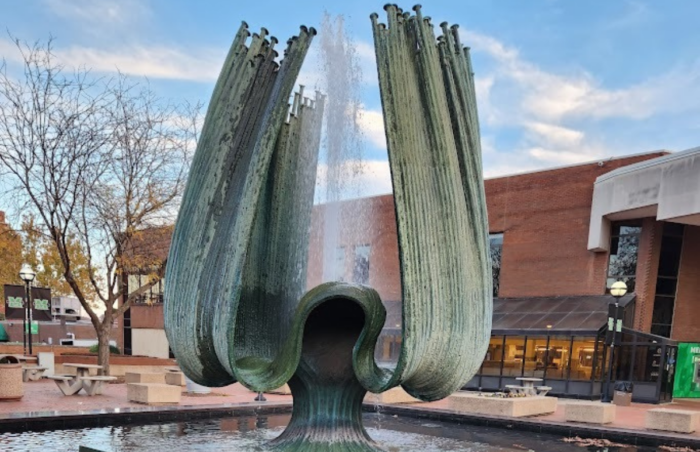
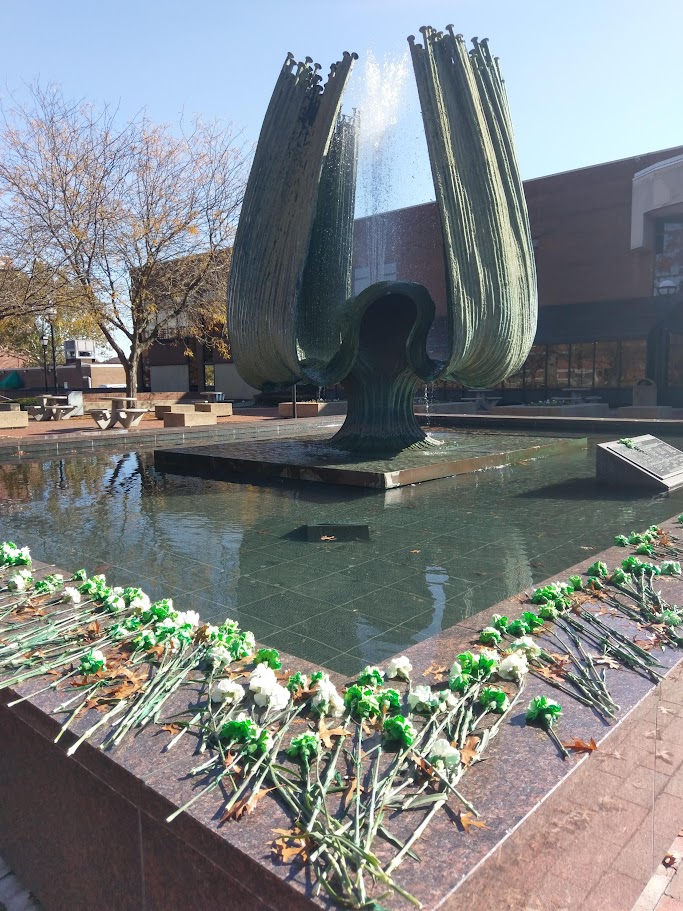
The Marshall Memorial Fountain has been recommended for the National Register of Historic Places. It represents the 75 people who died in a plane crash in November 1970.Eric Douglas/West Virginia Public Broadcasting
Listen
Share this Article
The Marshall Memorial Fountain is now being considered for inclusion on the National Park Service’s National Register of Historic Places. It was created in memory of the 75 people who died in the November 1970 Marshall plane crash and officially dedicated in November 1972.
The West Virginia Archives and History Commission nominated the fountain during a meeting Thursday on Marshall’s Huntington campus. The nomination now goes to the National Park Service for review. It’s anticipated the formal decision will take approximately 45 days.
On Nov. 14, 1970, 75 members of the football team, coaching staff and community died in a plane crash. To remember that day, members of the community lay carnations at the fountain and turn it off for the winter.
Photo Credit: Eric Douglas/West Virginia Public Broadcasting
“The possible inclusion of the Memorial Fountain on the National Register of Historic Places reaffirms its significance as more than just a monument,” Marshall University President Brad Smith said. “Adversity can lead to an excuse, or it can lead to a reason. The Memorial Fountain is a symbol of our reason, a space where we gather to remember, reflect and find strength in our community’s resilience.”
The fountain, designed by Italian sculptor Henry Bertoia, is more than 13 feet high and weighs 6,500 pounds. The fountain received extensive repairs in 2008 including a new granite surface for the foundation, a copper catch tray and a higher water spray like the original output when it was installed in 1972.
Being listed on the national register recognizes the historical, architectural or archaeological significance of a site. It helps ensure the preservation of important cultural resources and can provide benefits such as eligibility for preservation grants and tax incentives.
Randall Reid-Smith, secretary of the West Virginia Department of Arts, Culture and History, said the nomination was written by Marshall two-time history graduate S. Cody Straley, who serves as the national register and architecture survey coordinator for the state Historic Preservation Office.
Straley said writing the official nomination was his small way of paying back the institution that gave him so much.
“We know why this fountain is important, but today the national government will provide federal recognition for the fountain’s importance,” Straley said.
Marshall’s Old Main was placed on the registry in 1973.
Add WVPB as a preferred source on Google to see more from our team
In 2020, the U.S. Navy commissioned a new aircraft carrier, CVN-81, and chose to name it after Doris "Dorie" Miller, but stories have surfaced recently of discussions about renaming it after President Donald Trump.
Appalachians have always made use of the region’s wide variety of plants. A new book, called Appalachian Plants: In the Garden, In the Yard, and In the Wild, explores some of the history and lore of regional staples. It’s written by Linda Hager Pack and illustrated by Pat Banks. Inside Appalachia Host Mason Adams spoke with them.
This week, in author Willie Carver, Jr.’s new book, he reconsiders a negative childhood experience with a neighborhood girl who might have just been looking for a friend. Also, a southwestern Virginia community rang the alarm after more and more of its children were diagnosed with cancer. A local journalist is trying to unravel the cause. And, the city of Asheville has a new crusading reporter. He’s a puppet.
Lydia Hamessley is a professor of music at Hamilton College in New York and the author of "Unlikely Angel, The Songs of Dolly Parton." She spent nearly a decade researching Dolly's music catalog. Inside Appalachia Associate Producer Abby Neff talked with Hamessley.