Alert (09/29/2026): Our Parkersburg TV transmitter is still undergoing maintenance and remains temporarily inoperative. We apologize for the inconvenience.
All our programming is available via our TV livestreams on our website and WVPB Passport. Thank you for your patience!
This week, author Silas House returns with a sweeping new novel. Also, some folks say, you have to fake it 'til you make it, even if you're trying to establish a state park. And, the story of the first Mothman sightings as written by a small town journalist in 1966.
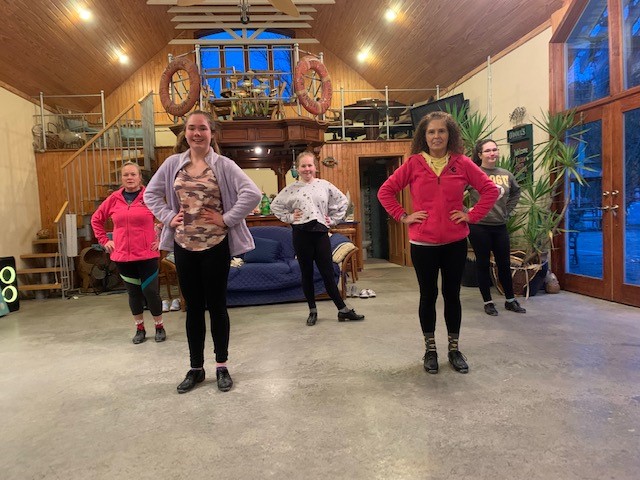
Introducing the Lincoln County Cloggers. (Well, they've been around a long time, actually.)Bill Lynch/West Virginia Public Broadcasting
Share this Article
Over the phone, Tosha Smith explained that the Lincoln County Cloggers had suspended classes for new cloggers for the first half of 2023. They were preparing for the National Cherry Blossom Festival Parade in April and didn’t have time to devote to newbies.
“We’ll offer that class for beginners in the fall,” she said. “But you could still come out for a lesson.”
I balked and tried to explain that I thought I needed a lot more than just one lesson, that I wanted to spend a few weeks with them.
“Maybe I ought to come back and do the class in the fall — the eight-week class,” I said.
She told me I should just come out now, that they could focus more attention on me.
I went along with it and met Tosha in the parking lot of the Lincoln County McDonalds, an easy-to-find, central location. I could follow from there.
It was a bit of a haul from West Hamlin and just far enough for me to be glad that I had someone to follow. I tried to pay attention. So, I could find my way back at least to the McDonalds.
The house we pulled up to wasn’t what I expected to find in Lincoln County or really anywhere in West Virginia, really. It was a large, but unassuming house next to what looked like a garage or guest house separated by a wall and a gate.
Beyond the house, was the river. On the other side, a train shrieked by, probably carrying coal.
“I wish I’d got my recorder out to catch the sound of the train,” I said to Tosha.
Tosha smiled and said, “Just wait around. There’ll be another one.”
The place belonged to Liza Hofmann, one of the members of the Lincoln County Cloggers.
Beyond the gate, just past the statue of David, was a credible beach bar with submerged bar stools in a salt pool, a hot tub and an elaborate looking outdoor fireplace/barbecue feature.
Winter had choked the space with debris. The water had gone dark and murky. The entire patio would need a good cleaning come summer, but what she’d built was remarkable. It was a real oasis.
Liza said there wasn’t an awful lot to do in Lincoln County. She’d built the patio and the clubhouse because she wanted a place for her friends and family to gather.
I wanted to be her neighbor — at least from late May until about the first of September.
I was shown inside the sea shanty-themed clubhouse, where Tosha introduced me to her three daughters. They talked to me a little about the Lincoln County Cloggers, which performed at festivals, fairs and events all over the area, but didn’t compete.
Liza and Tosha led the dance troupe with Tosha organizing the group’s dance routines and handling much of their bookings.
After a dance demonstration, Tosha had me join their line and walked me through the basic steps.
“It’s just kick, one, two, three, kick, one, two, three, kick,” she said — or that’s pretty close to what she said, though I had a little trouble with the counting and remembering where my feet were supposed to be.
“Start with your left foot,” Tosha told me.
And I did. Often, I went back to my left foot, even when I was supposed to be kicking with my right.
But… Tosha and Liza said I did pretty good — good enough that they squeezed a second lesson in with the second. We did a little dance to “Cotton-Eyed Joe” and then a more elaborate set of steps to Bob Seger’s “Old-Time Rock n’ Roll.”
From where I was standing, the dance was cool, but I’m not sure how Bob would feel about it.
Before I left, I recorded the dance steps to take with me and study.
“Homework,” Tosha said.
I promised to do my best and come back next week.
Add WVPB as a preferred source on Google to see more from our team
On this West Virginia Week, our voter's guide is out, and it has all the information you need to know about the upcoming general election in the state. Also, another lawsuit targets the state's public school funding formula. And, a million dollar giant troll is making its way to the woods of West Virginia.
Silas House is a major voice for Appalachia. The Kentucky native has written more than 15 books and served as the state's poet laureate. His latest book is The Tulip Poplars, a sweeping novel about the lives of four people as they navigate friendship and forbidden love throughout the 20th century. Inside Appalachia's Mason Adams spoke with House.
When Hurricane Helene tore through western North Carolina in 2024, it took lives and upended communities. A community of ballad singers lost a place where they could share their tradition, but what was lost could be restored.
Generations ago, kudzu was introduced to Appalachia to help control erosion and provide forage for cattle. But then, it kind of just took over. Kudzu is an invasive plant that chokes out native greenery. Some people are fighting back. Folkways Reporter Eliza Benbow spent time with the kudzu warriors in western North Carolina.