Elk Creek, Virginia, is a small, unincorporated community located in Grayson County, about a half hour from the North Carolina border. Many people in Elk Creek have deep ties to their land, and for one family taking care of their land and honoring their ancestors meant creating a traditional Japanese Shinto Garden. From Elk Creek, Folkways Reporter Wendy Welch brings us the story.
Tallow is rendered animal fat and has been used primarily in traditional food preparation — as an ingredient and as a cooking oil. In addition, tallow can be used in making soap, candles, healing salves, skin moisturizers and perfumes, as well as lubricants for wood, leather and metal working.
Tallow is produced by a stovetop technique known as rendering, which is the melting and clarifying of hard fat from around the kidneys and loins of mostly cattle and sheep. But tallow can be rendered from the fats of other ruminants, including both domestic and wild species such as deer and goats.
Rendering purifies the fat and rids it of “cracklings,” the bits of protein that can spoil the tallow if left unrefrigerated.
Chuck Kleine
/
West Virginia Public Broadcasting
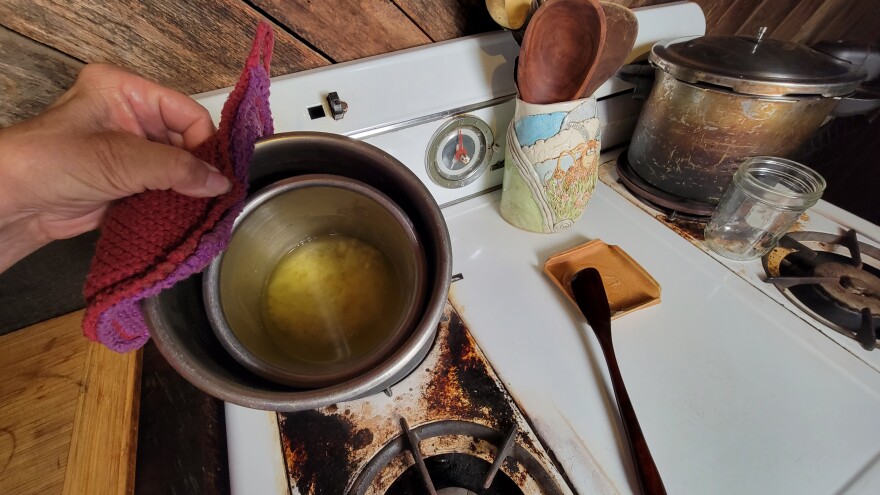
Beef fat being rendered in a double boiler.
Tallow, when rendered clean, can last up to a year at room temperature if stored in a dark place, and for many years when stored in the freezer.
The process begins by taking the hard fat and slowly cooking it in water until the fat chunks have turned cloudy and a yellow liquid, the tallow, rises to the top.
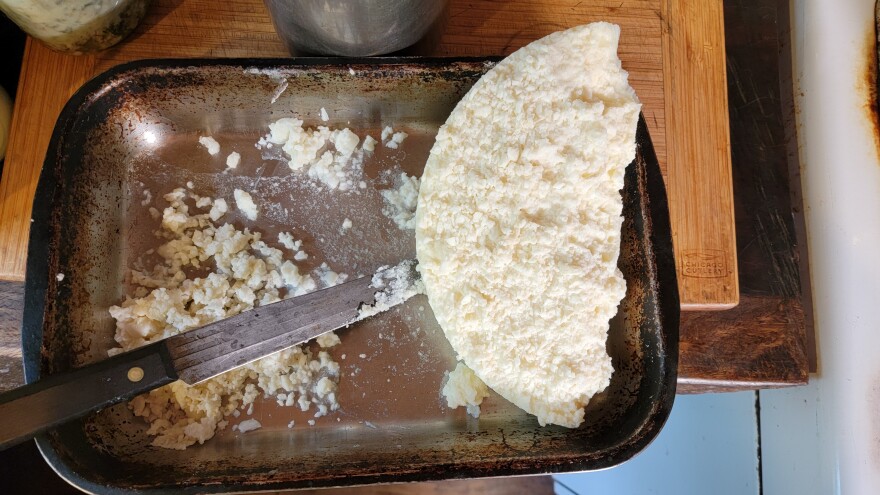
Next, it’s cooled in a refrigerator until a solid whitish substance forms at the top of the pot.
The solid is removed from the pot and any traces of protein bits still attached can be shaved off with a kitchen knife. Then, the entire process is repeated until the water is clear and the tallow is clean of any bits of protein.
The tallow is then strained into a jar and topped with a secure lid. When cooled, the tallow is ready for use.
Chuck kleine
/
West Virginia Public Broadcasting
Cooled tallow.
There have always been several positive reasons to use tallow. Because of its high smoke point of 480 degrees, tallow was often used for deep frying, until the rise of vegetable oil.
While tallow contains saturated fat, it also contains monounsaturated fats, which are considered good for the heart. Beef tallow contains conjugated linoleic acid, which is a natural anti-inflammatory.
It’s also very good for the skin, either applied topically or consumed as an ingredient in any of a multitude of recipes. That’s because it’s high in omega 3’s and is packed with vitamins A, D, K, E and B12.
EDIBLE MOUNTAIN – How To Make Tallow
Add WVPB as a preferred source on Google to see more from our team
The 2026 West Virginia Quilt Festival will bring quilters from across the state and beyond to the Cedar Lakes Conference Center in Ripley Sept. 17 to Sept. 19.
This week, a Japanese Shinto garden took root in southwestern Virginia because of family connections spanning geography and generations. Also, in Whitesburg, Kentucky, a new mosaic uses recovered objects to honor the town’s people after the flood of 2022. And, the young adult novel Verity Vox and the Curse of Foxfire mixes historical fact with spooky Appalachian folklore.
Kentucky Fried Chicken founder Colonel Sanders' iconic items earned big bucks at auction. For the Appalachia + Mid-South Newsroom, reporter Andrew Henderson went to the auction and hung around for the fried chicken.
This week, having a very specific talent can lead to a dream job. It’s how cartoonist John Rose got his foot in the door to draw the comic strip Snuffy Smith. Also, there are dos and don’ts for treating poison ivy. And, a young, old-time musician wants to save her family’s lost ballads.