This week on Inside Appalachia, we talk with East Tennessee’s Amythyst Kiah. Her new album contemplates the cosmos. Also, hair salons are important gathering places where Black women can find community. And, West Virginia poet Torli Bush uses story to tackle tough subjects.
Tallow is rendered animal fat and has been used primarily in traditional food preparation — as an ingredient and as a cooking oil. In addition, tallow can be used in making soap, candles, healing salves, skin moisturizers and perfumes, as well as lubricants for wood, leather and metal working.
Tallow is produced by a stovetop technique known as rendering, which is the melting and clarifying of hard fat from around the kidneys and loins of mostly cattle and sheep. But tallow can be rendered from the fats of other ruminants, including both domestic and wild species such as deer and goats.
Rendering purifies the fat and rids it of “cracklings,” the bits of protein that can spoil the tallow if left unrefrigerated.
Chuck Kleine
/
West Virginia Public Broadcasting
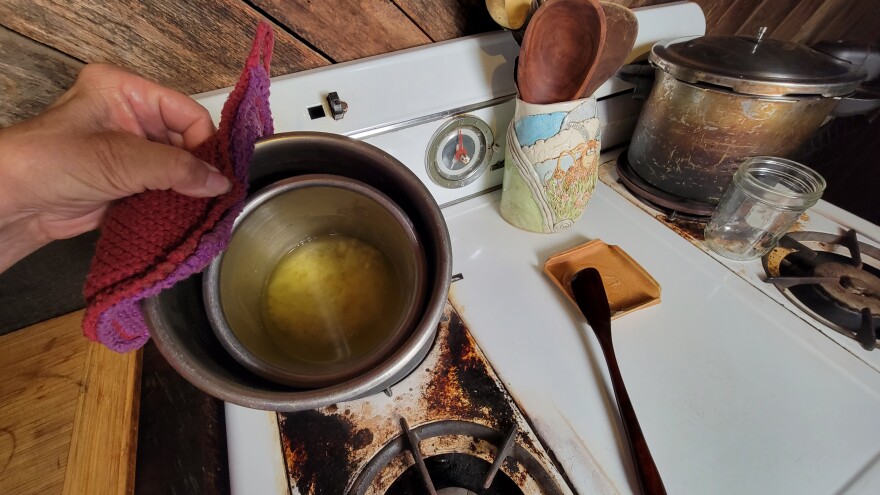
Beef fat being rendered in a double boiler.
Tallow, when rendered clean, can last up to a year at room temperature if stored in a dark place, and for many years when stored in the freezer.
The process begins by taking the hard fat and slowly cooking it in water until the fat chunks have turned cloudy and a yellow liquid, the tallow, rises to the top.
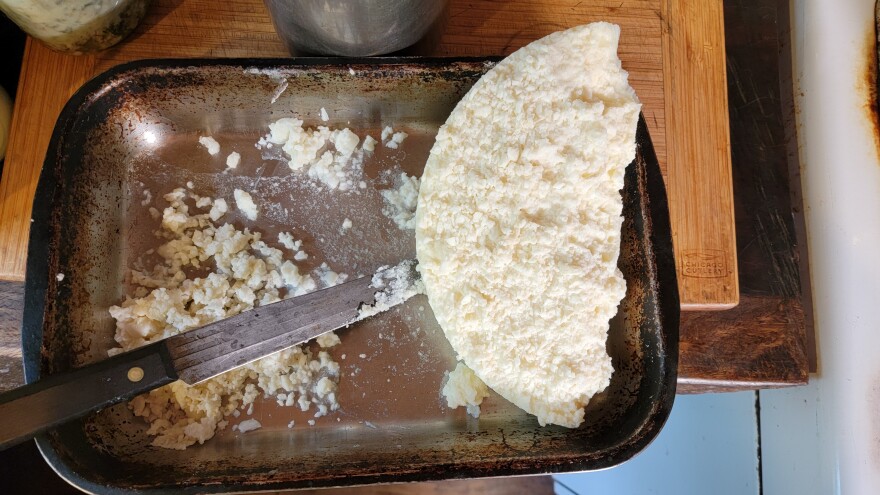
Next, it’s cooled in a refrigerator until a solid whitish substance forms at the top of the pot.
The solid is removed from the pot and any traces of protein bits still attached can be shaved off with a kitchen knife. Then, the entire process is repeated until the water is clear and the tallow is clean of any bits of protein.
The tallow is then strained into a jar and topped with a secure lid. When cooled, the tallow is ready for use.
Chuck kleine
/
West Virginia Public Broadcasting
Cooled tallow.
There have always been several positive reasons to use tallow. Because of its high smoke point of 480 degrees, tallow was often used for deep frying, until the rise of vegetable oil.
While tallow contains saturated fat, it also contains monounsaturated fats, which are considered good for the heart. Beef tallow contains conjugated linoleic acid, which is a natural anti-inflammatory.
It’s also very good for the skin, either applied topically or consumed as an ingredient in any of a multitude of recipes. That’s because it’s high in omega 3’s and is packed with vitamins A, D, K, E and B12.
EDIBLE MOUNTAIN – How To Make Tallow
Add WVPB as a preferred source on Google to see more from our team
On this West Virginia Week, seven mining operations are to close, the state Senate votes to ban abortion medication by mail, and Gov. Patrick Morrisey presses for tax cuts.
This week on Inside Appalachia, we talk with East Tennessee’s Amythyst Kiah. Her new album contemplates the cosmos. Also, hair salons are important gathering places where Black women can find community. And, West Virginia poet Torli Bush uses story to tackle tough subjects.
Acclaimed singer-songwriter Amythyst Kiah released "Still + Bright" last year, which featured guests like S.G. Goodman and Billy Strings. Inside Appalachia host Mason Adams spoke with Kiah from her home in Johnson City, Tennessee at that time. We listen to an encore of that conversation.
America continues to wrestle with racial division, but music has often been a space where those barriers are challenged. In this episode of Us & Them, host Trey Kay revisits a 1960s moment when a band refused to perform unless a mixed-race couple was allowed to dance — and paid the price for taking that stand. It’s a story about courage, consequences and the uneasy intersection of music and race in America.