Alert (09/29/2026): Our Parkersburg TV transmitter is still undergoing maintenance and remains temporarily inoperative. We apologize for the inconvenience.
All our programming is available via our TV livestreams on our website and WVPB Passport. Thank you for your patience!
This week, Barbara Kingsolver’s new novel takes on issues of class and classical music. Also, kudzu warriors band together to fend off invasive plants and take back the land. And, it’s pawpaw season, but a new bug could be harming the trees.
Logan County's Tim Browning: 'Sometimes, You are All You've Got'
Listen
Share this Article
Since the show began almost two years ago, A Change of Tune has highlighted some of the best up-and-coming artists out of these West Virginia hills with podcast-y chats ranging from Tyler Childers to Ona, Bud Carroll to Coyotes in Boxes and beyond.
But those interviews have been a bit infrequent, and since West Virginia Day was this month (and with A Change of Tune’s second birthday on the horizon), we thought we’d do something special: 30 days, 30 brand new #WVmusic interviews that range from Morgantown alt-rockers and Parkersburg singer-songwriters to West Virginia music venues and regional artist management and beyond, all of which contribute to this state’s wild and wonderful music scene.
And today, we are chatting with Tim Browning, a Logan County singer-songwriter who’s been playing music 20 years and a has a number of stories to tell.
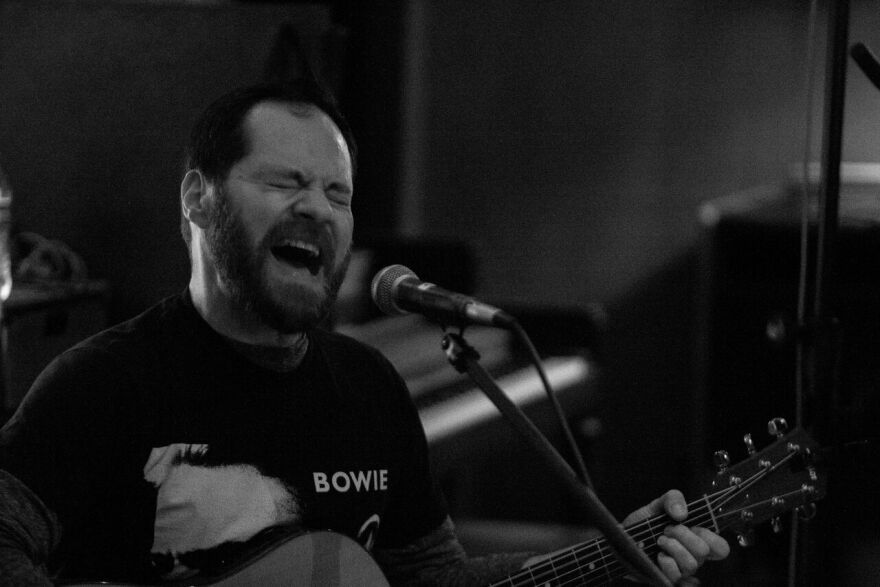
Tim Browning is a resilient singer-songwriter out of Logan County, West Virginia.
Interview Highlights
On getting into music at a young age:
When I was a kid, my parents both played Southern gospel music in church. That’s how they met. So music has always had a strong influence in life. When I was about 8, I got my first bass guitar, and I sat on a stool behind them and plucked away at the bass while they were singing. It’s kind of funny to call it touring, but we went all over the region playing music. So that’s where I got my start.
And then my cousin gave me an old electric Harmony guitar. And I had no amplifier. So I had to wait until it was late at night when everyone was asleep to start learning how to play guitar.
You know, you watch a lot of acts and a lot of bands and a lot of places do cover tunes. But I was just never good at that. I was uncomfortable, maybe a little intimidated, playing other people’s song. So I thought, “Maybe I should write my own.” And that was that.
On his relationship with country music:
[Despite moving to Nashville,] I don’t really sing country music. But it has a lot of the same ingredients [as what I play]: a lot of rough-neck, back alley thoughts and ideas, being in those hills and hollers, taking life as it comes, and trying to get up out of that hole you feel like you were born in.
With the current string of tunes that I’ve been doing with The Widowmakers, I always describe our music as “crimes of passion.”
Credit Most Exalted
/
Catch Tim Browning & the Widowmakers on tour throughout West Virginia.
On moving to Nashville at a young age to make music:
With Nashville, it seemed just as mystical and just as far away as Hollywood. So at 18, I loaded up my little piece of crap car, and I drove to Nashville. At that point [in your life], you have these grandiose ideas of what you can be. And I think that’s where my love and local and independent music comes from: you walk in [to a local bar], and you may open up for a local group, and they’re amazing. And everything they do is just as quality and felt just as important as what you heard on the radio. And a lot of times, the acts that you saw were bits and pieces of what you heard on the radio, but were still doing local acts and shows because that’s where their hearts were. The guy that’s parking your car or the girl getting your coffee is the most amazing songwriter or most brilliant singer that you may never ever hear. I was captured by that. I don’t think I ever fell out of love with it.
On gaining musical inspiration from enlisting in the Army:
It was hard finding a chance to perform, but it was not hard to write. That experience provided me with the most time for reflection. The further I got away from home, the more I fell in love with home. That’s when I came to terms as a young man about where I was from and to be ok about where I was from. That’s been my hardest lot in life: accepting things as they come.
I got away from the grunge-y abstract ideas that were happening in a lot of the music that you would have listened to as a teenager. I really became comfortable with being very blunt, matter-of-fact, and honest with who I was and what I was writing about. I got away from writing what I thought people wanted to hear.
Credit Most Exalted
/
Tim Browning describes his band’s music as “a completely different brand of rock’n’roll.”
Music featured in this #WVmusic chat:
Tim Browning & the Widowmakers- “Gasoline”
Tim Browning & the Widowmakers- “One Horse Town”
Tim Browning & the Widowmakers- “Without You”
Add WVPB as a preferred source on Google to see more from our team
On this West Virginia Week, a mine operation in Kanawha County gets a WARN Notice, three Wyoming County Schools will remain closed until next week, and we learn the origins of the Flatwoods Monster.
This week, Barbara Kingsolver’s new novel takes on issues of class and classical music. Also, kudzu warriors band together to fend off invasive plants and take back the land. And, it’s pawpaw season, but a new bug could be harming the trees.