This week, having a very specific talent can lead to a dream job. It’s how cartoonist John Rose got his foot in the door to draw the comic strip Snuffy Smith. Also, there are dos and don’ts for treating poison ivy. And, a young, old-time musician wants to save her family’s lost ballads.
Home » WVPB Podcasts » Appalachia’s Folkways: Handmade and Passing It On
Published
Appalachia’s Folkways: Handmade and Passing It On
Listen
Share this Article
This week on Inside Appalachia, we’ll hear from Appalachians who have a knack for making things with their hands -- people who make the essentials of life in the old ways.
“And when I sit down at one of those looms and I start creating a piece of cloth, I feel connected to the place of my ancestors, the people who have come before,” said weaver Jane Gilchrist.
Credit Caitlin Tan, WVPB
/
Jane weaving a pot holder. She said she is drawn to weaving because it is a relaxing, repetitive movement that still requires focus.
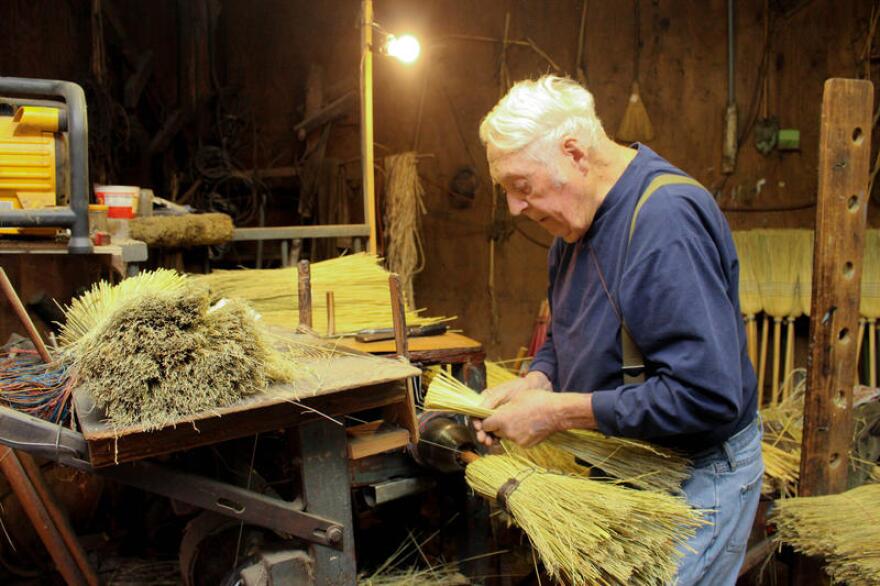
Back in 2017, as part of a partnership between West Virginia Public Broadcasting and the West Virginia Humanities Council’s Folklife program, we aired a story about a West Virginia broommaker Jim Shaffer, who has been practicing his craft since 1946. Since it aired, a video of Jim went viral online, and people from New York to Florida decided to come visit Jim and get one of his special handmade brooms.
Credit EMILY HILLIARD/ WV FOLKLIFE PROGRAM
/
Jim Shaffer
But the broommaking business has changed drastically over the years, and Shaffer says he foresees a day when stores stop stocking straw brooms altogether.
“Walmart, Kmart, and Kroger’s have took all that over now, and you don’t have any mom and pop stores to buy from the wholesale distributors, so they all went out of business,” Shaffer said.
Recently, Shaffer decided to close his shop after seven decades of hard work. But he found a new broommaker, Wanda Hott, who wanted to buy his equipment and learn his craft. Her broommaking business is based in Hampshire County, West Virginia. We’ll hear how she -- and even some of her younger family members -- are pitching in to keep the art of sweeping alive in Appalachia.
Credit Caitlin Tan, WVPB
/
The sponge stage of the salt rising bread starter. Once the starter is in this stage one can mix it with flour to make a dough.
We’ll also hear from a new generation of Appalachian makers dedicated to keeping these traditions going. A few years ago, the West Virginia Humanities Council launched the West Virginia Folklife Apprenticeship Program. Emily Hilliard, the state folklorist, says the program is designed to encourage traditional artists to teach their crafts to a new generation. The master artists each receive a $3,000 dollar stipend to spend a year teaching an apprentice.
Kara Vaneck and Marion Harless focused their study on the craft of making teas, jellies and other value-added products out of herbs and other ingredients you can find right in the woods. Vaneck uses the training she received with Marion to make handmade products through her business, Smoke Camp Crafts.
Another folklife apprentice, Amy Dawson, is learning the art of salt rising bread. The recipe grew out of the distinctive quality of life on the Appalachian frontier.
Making salt rising bread is a labor-intensive proccess, but it’s a tradition Dawson wants to help keep alive. “Growing up I didn’t realize how special it was, and I just thought it was something that people had everywhere, just a type of bread. But it wasn’t until I moved back home in my thirties that I realized that it was really only in this region, and that you really couldn’t get it anymore.” Dawson is a chef at Lost Creek Farm, a farm-to-table traveling restaurant.
Credit Jessica Lilly
/
Mike Sizemore, Athens, W.Va.
Also in this episode, host Jessica Lilly travels to Mountain Artworks, a studio in Mercer County that houses the unique flair, personality, passion and dreams of metal sculptor Mike Sizemore. In his art, Sizemore uses copper in addition to other found materials, even recycled glass ashtrays. Some of his work, which can tower as tall 30 feet, is often inspired by petroglyphs from ancient drawings.
Do you know someone in your community or family who still makes things with their hands? What traditions are still out there? We’d love to tell more of these stories before the knowledge is lost. Send us an email or reach out on Twitter or Instagram. #MyAppalachia.
Inside Appalachia is produced by Roxy Todd. Jesse Wright is our executive producer. Catherine Moore edited our show this week. Our audio mixer is Patrick Stephens. We’d love to hear from you. Send us tweet @InAppalachia.
Add WVPB as a preferred source on Google to see more from our team
On this West Virginia Week, Gov. Patrick Morrisey gets pushback over school clothing vouchers, Huntington residents seek to ban Flock cameras, and black lung is big again.
This week, having a very specific talent can lead to a dream job. It’s how cartoonist John Rose got his foot in the door to draw the comic strip Snuffy Smith. Also, there are dos and don’ts for treating poison ivy. And, a young, old-time musician wants to save her family’s lost ballads.
For nearly 100 years, Snuffy Smith has been a staple of newspaper comic pages, though these days, it’s easier to find him online. Snuffy Smith was brought to life by Artist Fred Lasswell in the 1930s, but now the strip is written and drawn by John Rose, who lives in Virginia’s Shenandoah Valley. We hear from Rose about drawing the famous hillbilly.
Federal health researchers at the CDC have a new report about black lung disease among the most experienced coal miners in Appalachia. They are suffering from the incurable disease at the highest rates in nearly half a century.