This week, some of the stories on our show inspired college student art — including a vivid image of a bear smashing a clarinet. Also, a Hare Krishna community in West Virginia serves vegetarian food made in three sacred kitchens. And, COVID-19 exposed the contempt society has for marginalized people. One author says, these folks are anything but passive.
Marshall Memorial Fountain Nominated For National Registry
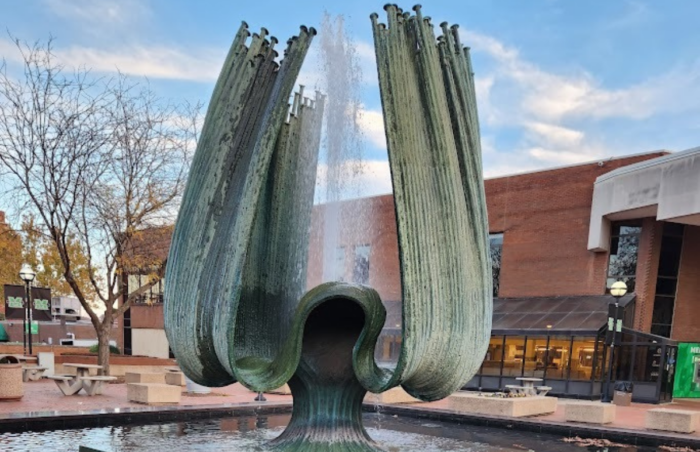
The Marshall Memorial Fountain has been recommended for the National Register of Historic Places. It represents the 75 people who died in a plane crash in November 1970.Eric Douglas/West Virginia Public Broadcasting
Listen
Share this Article
The Marshall Memorial Fountain is now being considered for inclusion on the National Park Service’s National Register of Historic Places. It was created in memory of the 75 people who died in the November 1970 Marshall plane crash and officially dedicated in November 1972.
The West Virginia Archives and History Commission nominated the fountain during a meeting Thursday on Marshall’s Huntington campus. The nomination now goes to the National Park Service for review. It’s anticipated the formal decision will take approximately 45 days.
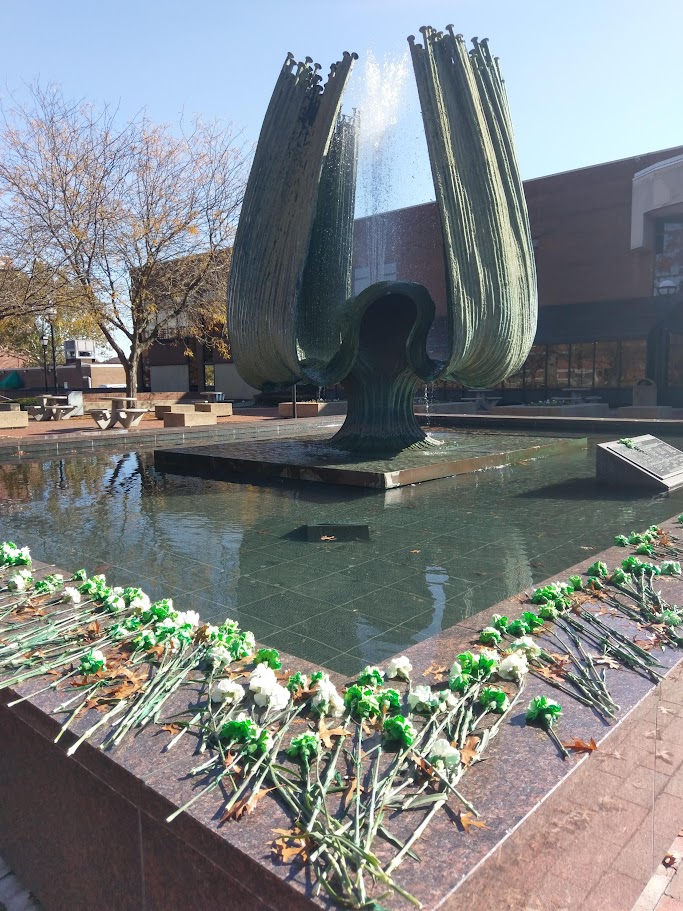
On Nov. 14, 1970, 75 members of the football team, coaching staff and community died in a plane crash. To remember that day, members of the community lay carnations at the fountain and turn it off for the winter.
Photo Credit: Eric Douglas/West Virginia Public Broadcasting
“The possible inclusion of the Memorial Fountain on the National Register of Historic Places reaffirms its significance as more than just a monument,” Marshall University President Brad Smith said. “Adversity can lead to an excuse, or it can lead to a reason. The Memorial Fountain is a symbol of our reason, a space where we gather to remember, reflect and find strength in our community’s resilience.”
The fountain, designed by Italian sculptor Henry Bertoia, is more than 13 feet high and weighs 6,500 pounds. The fountain received extensive repairs in 2008 including a new granite surface for the foundation, a copper catch tray and a higher water spray like the original output when it was installed in 1972.
Being listed on the national register recognizes the historical, architectural or archaeological significance of a site. It helps ensure the preservation of important cultural resources and can provide benefits such as eligibility for preservation grants and tax incentives.
Randall Reid-Smith, secretary of the West Virginia Department of Arts, Culture and History, said the nomination was written by Marshall two-time history graduate S. Cody Straley, who serves as the national register and architecture survey coordinator for the state Historic Preservation Office.
Straley said writing the official nomination was his small way of paying back the institution that gave him so much.
“We know why this fountain is important, but today the national government will provide federal recognition for the fountain’s importance,” Straley said.
Marshall’s Old Main was placed on the registry in 1973.
This week, some of the stories on our show inspired college student art — including a vivid image of a bear smashing a clarinet. Also, a Hare Krishna community in West Virginia serves vegetarian food made in three sacred kitchens. And, COVID-19 exposed the contempt society has for marginalized people. One author says, these folks are anything but passive.
Our program, Inside Appalachia, in December was tagged in an Instagram post by WVU Professor of Art Joseph Lupo. The post showcased four-color reductive relief prints made by WVU students — each one inspired by a story or episode they heard on the show.
For most of us, the cold and ice of the last few weeks have been a struggle, but a group of local rock climbers made the best of it. Also, lawmakers considered bills related to absentee ballot deadlines and medications used to terminate pregnancies.