This week, historian Mills Kelly’s love affair with the Appalachian Trail started when he was a boy scout. Also, the region is known for exporting coal, but it’s losing people, too. And, Cuz’s Uptown Barbeque in southwestern Virginia fuses Asian ideas with Appalachian comfort food.
Last week’s flooding in eastern Kentucky devastated towns and lives. Appalshop, the organization that has documented the lives of the people from the region for more than 50 years is right in the middle of the floods in Whitesburg.
West Virginia Public Broadcasting News Director Eric Douglas spoke with Appalshop Operations Director Roger May about where things stand.
This interview has been lightly edited for clarity.
Douglas: Talk to me about the situation in eastern Kentucky and what’s going on on the ground.
Appalshop staff
/
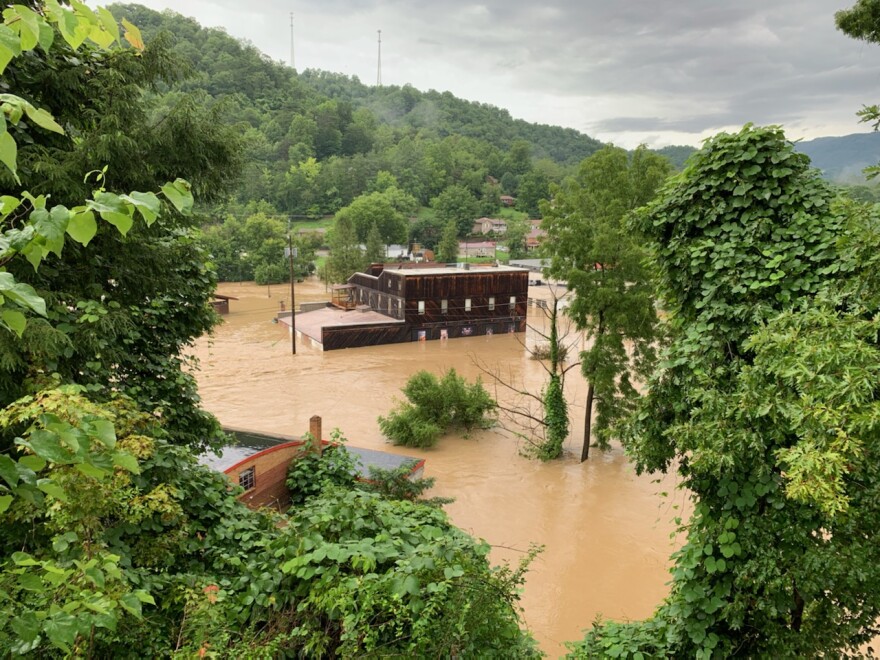
The Appalshop building surrounded by water.
May: We’re focused on immediate community support and recovery efforts. All of our staff are accounted for. We’ve lost people in eastern Kentucky. We haven’t been able to fully access our building yet. We had a couple of staff go in to retrieve some things that we needed from there. We’re not really certain at this point of the total damage to our facilities, but it’s estimated that there are heavy losses to our materials and the buildings.
Douglas: You still have film, you still have video, you’ve got audio recordings, it’s truly an archive of Appalachia. What’s your greatest concern?
May: Our greatest concern is the health and safety of our folks. Everybody is chomping at the bit to pitch in and help. It’s a struggle to capture that energy and keep it at bay, because we have to make sure that they’re safe. We do have emergency plans and procedures in place to protect our archival materials, but many of them are preserved off site, according to best practices. That being said, we do have a lot of stuff in the building that likely suffered severe damage. And we’re just not sure of the full situation yet. We haven’t been able to fully assess it. And probably won’t really be able to for several more days or even weeks.
Douglas: Looking forward, what do you need?
May: Well, we’ve got a full resource list compiled on our website. If you go to Appalshop.org, you’ll see a pop up bar that’ll take you directly to a resource page. And that includes news and updates from local and state officials, as well as links for people who are interested and able to donate.
Douglas: Eastern Kentucky, southern West Virginia, have taken some bad hits over the years. And now this devastation. How do we move forward?
May: I think the same way that we always have. We lean on one another and we don’t wait on anybody else to save us. We’re going to be the ones that get us through this. And while it’s a daunting task, we’ve recovered from other disasters in the past. The thing about this is, the flooding was at historic levels. We’re prepared to deal with regular seasonal flooding, but there was nothing regular about this flooding. The level of the water was considerable. I think that the gauge actually broke somewhere around 21 feet, which is well over the flood stage level. But you know, it’s unfortunately not new to us. We’ll get through it by looking out for each other and taking care of each other.
Douglas: What am I missing, Roger? What do you want to say?
May: Well, I just appreciate the opportunity to share information with listeners. I know that WMMT and Appalshop means a lot to a lot of people, not just in eastern Kentucky and southern West Virginia. We’ve received messages of support from all around the world, and we appreciate you and we hear you and thank you for your support.
Douglas: I saw something, and maybe it’s something you shared on Facebook in the last day or so, but archivists and documentarians from all over the country are reaching out to offer their support and I assume it’s even restoring photographs and that sort of thing.
May: The outpouring of support is overwhelming. And it’s just what people do. They care about Appalshop and they care about the work that we do. They also care about us as human beings and that’s our priority right now.
To support Appalshop, visit their website for more information.
Add WVPB as a preferred source on Google to see more from our team
This week, historian Mills Kelly’s love affair with the Appalachian Trail started when he was a boy scout. Also, the region is known for exporting coal, but it’s losing people, too. And, Cuz’s Uptown Barbeque in southwestern Virginia fuses Asian ideas with Appalachian comfort food.
Mills Kelly is a lifelong hiker and Appalachian Trail scholar. He shares the trail’s history and more on "The Green Tunnel Podcast." He’s also written several books, including his most recent, called "A Hiker’s History of the Appalachian Trail." Inside Appalachia’s Bill Lynch spoke with Kelly to learn more.
The Greenbank Observatory is offering a limited chance to go behind the scenes to check out its Search for Extra Terrestrial Intelligence (SETI). SETI tours are offered to small groups – ages 12 and up – several times a month through October. We caught up with the Observatory’s news manager to find out more about the tours – and what exactly scientists there are looking for.