The Greenbank Observatory is offering a limited chance to go behind the scenes to check out its Search for Extra Terrestrial Intelligence (SETI). SETI tours are offered to small groups – ages 12 and up – several times a month through October. We caught up with the Observatory’s news manager to find out more about the tours – and what exactly scientists there are looking for.
How To: Portable Iron Pour with 'Sputnik' the Iron Furnace
Listen
Share this Article
“Anybody who wants to carve a mold, we have some right here,” WVU sculpture area coordinator Dylan Collins said to a crowd who gathered. “It’s going to be just like a cooking show! You see your ingredients there, art will get made here. So don’t be shy! And, Welcome! Let me know what you need!”
Credit Justin Steiner
/
The inaugural iron pour of ‘Sputnik,’ the portable iron furnace, was both very cool and very hot at the same time…
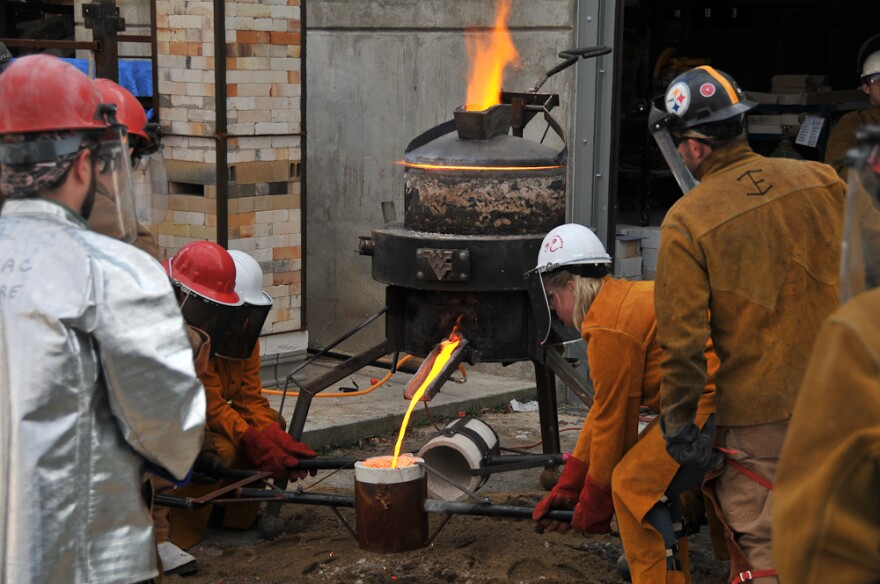
It was a cool day—downright cold in the shade when the wind blew, but the iron furnace, pet-named Sputnik, fired up pretty quickly and was soon melting iron. The event lasted well into the darker hours, with pour teams pouring some 1,500 lbs of iron.
“This kind of started with myself and my friend Jeremy Entwistle, the sculpture program coordinator at Fairmont State University,” Collins explains. “We’ve been working collaboratively for the last year, going to cast iron conferences, getting our students together to work collaboratively together casting in iron, and we thought it would be a great idea to make a furnace where we could get a lot of metal out.”
Entwistle already has a furnace at Fairmont State but it doesn’t have as much capacity as Sputnik. So the idea was to create a larger furnace that would also be portable and go on the road for various iron casting events in the region.
They set to work, and the beauty of getting sculptors to build, well … anything, is that they consider beauty while designing. And Sputnik is certainly a fun thing to look at!
“It looks like a machine that has landed from another planet,” Collins said. Thus the spacecraft-based nickname.
Graduate sculpture student Megan Gainer said many sand molds were in the works for weeks leading up to the iron pour. She said invitations to collaborate were also sent out to other schools and community members.
“And we’ve invited a couple other universities, I believe there’s Shepherdstown, Fairmont, and even Virginia Tech here,” Gainer said, “as well as a couple other people from the community, and later today there will be a couple people from the Tamarak Foundation coming to see what we’re doing.”
Local businesses, including Construction Supply Company (CSC), 3 Rivers Iron and Metal, and Jack’s Recycling, contributed to the WVU Iron Pour event by donating materials and supplies.
The Iron Pouring Process:
Heat furnace with coke to get it up to temperature. (Coke is coal that has been cooked in an anaerobic environment.)
Once up to temperature, begin filling it with charges. (Charges are buckets of premeasured broken up iron, and more coke.)
Repeat. Continue to feed the furnace and the well inside starts to build up molten metal.
Tap out the little bot that keeps the metal held back, and let ‘er flow down a trough into ladles (high temperature cups)
Pour teams distribute hot metal into premade resin-bonded sand molds.
Collins says the sand molds are the handiwork of students, faculty, alumni, and members of the public. He says and that the object of the day is not only to make art, but also to celebrate history. “We’ve kind of merged the past and the present,” Collins said. “We’re bringing together these two different eras and helping people engage with this really rich industrial history which is a real mark of the culture here.”
Collins hopes to be able to take Sputnik around the region, celebrating history and art, beginning with a trip to Fairmont State in the near future.
Add WVPB as a preferred source on Google to see more from our team
The Greenbank Observatory is offering a limited chance to go behind the scenes to check out its Search for Extra Terrestrial Intelligence (SETI). SETI tours are offered to small groups – ages 12 and up – several times a month through October. We caught up with the Observatory’s news manager to find out more about the tours – and what exactly scientists there are looking for.
On this West Virginia Week, the air around the site of a chemical leak near Institute is determined safe, the state reaches a settlement with Roblox, and Charleston photographer Perry Bennett represents Team USA in Iceland.
This week, in author Willie Carver, Jr.’s new book, he reconsiders a negative childhood experience with a neighborhood girl who might have just been looking for a friend. Also, a southwestern Virginia community rang the alarm after more and more of its children were diagnosed with cancer. A local journalist is trying to unravel the cause. And, the city of Asheville has a new crusading reporter. He’s a puppet.
Kentucky writer Willie Edward Taylor Carver Jr’s new book Tore All To Pieces weaves poetry and short stories into a narrative about people and place. Inside Appalachia’s Bill Lynch recently spoke with Carver and brings us this conversation.