This week, we take a look at how the U.S. government built a secret city in East Tennessee during World War II to work on the atomic bomb. Also, almost everybody has a favorite cup or coffee mug, but how far would you go to replace it? And, we hear from a cabinetmaker on the physicality of poetry.
Home » This Guy Loves Crawdads, Snakes, and Teaching
Published
This Guy Loves Crawdads, Snakes, and Teaching
Share this Article
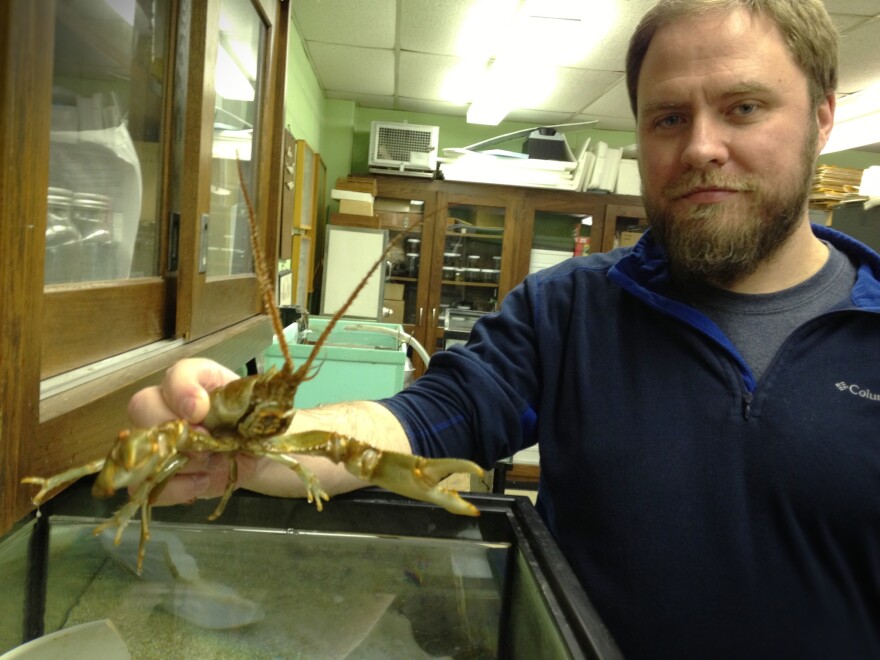
Zachary Loughman has built a career as a naturalist and a scientist by not letting his inner 10-year-old boy grow up.
He has discovered, identified, and named 10 new crayfish species here in North America, and as an Associate Professor of Biology at West Liberty University, he’s shared his fascination for the species with countless students.
“Everyone loves crayfish,” he said. “Anybody who grew up next to a creek knows what a crawdad is, so I basically have the dream job of every ten year old in West Virginia.”
Credit Glynis Board / WVPublic
/
WVPublic
West Liberty student Audrey Sykes said Loughman is “easily one of the most passionate, enthusiastic and memorable professors that I’ve ever had.
“The way he feels about crayfish is inspiring.”
Loughman’s research has been featured in Science Magazine, National Geographic, and in the neuroscience publication Neuron, among others.
While he’s built a name for himself through crayfish research, Loughman said he was more of a snake guy growing up. He still loves them — he even has a bunch in his office. His fascination with crayfish, though, stemmed from a conversation with his adviser while Loughman was workinghis masters degree at Marshall University.
“I was driving home from my thesis site with Dr. Polly and he said, ‘I’ve been watching you, you really like natural history. You don’t have to study snakes for natural history, study something no one has put much effort into.’ Of course there were people who studied crayfish before me, but no one had looked at it from a naturalist perspective. Soon after that, I was focusing less and less on snakes and more on crawdads.”
Loughman said his career as a professor and biologist has stemmed from a lifelong curiosity with the natural world.
“Naturalists, as I like to identify as, we have a very different perspective of the natural world in that when we see animals, we immediately start asking questions,” he said. “When I see a snake or a crayfish, especially one I haven’t seen before, my first thought isn’t, ‘What is my hypothesis going to be?’ It’s: ‘Wow, this is cool!’ Then I immediately follow that up with, ‘What are you?’”
Credit Guenter Schuster
/
The Big Sandy Crayfish is found in Kentucky, Virginia and West Virginia. It’s listed as a threatened species and protected under the Endangered Species Act.
Loughman takes students all over the region, from the Northern Panhandle where he found red crayfish with bright blue features, to the southern coalfields, where he discovered a new kind of crayfish.
He’s even had some fun naming them.
“I described a crayfish thats endemic to the Tug River which is shared between Kentucky and West Virginia and gave it the name Cambarus Hatfieldi after the Hatfields of infamy.”
The Faculty Merit Foundation of West Virginia named Loughman the state’s Professor of the Year in 2014. He’s been teaching graduate and undergraduate students for eleven years at West Liberty, and he said he loves education almost more than he loves looking for crawdads in streams.
“Whenever I get outside and I’m teaching, or I get to do the field work, or I’m bouncing down the road in a van full of college kids that it’s my job to teach and turn into the next generation of conservation biologists.
The roughly 5,700 residents of the town of Wayne are one step closer to being able to use city water, more than two weeks after receiving a do not consume order.
The American Lung Association released its annual report giving West Virginia Ds and Fs. News Director Eric Douglas spoke with Elizabeth Hensil, the director of Advocacy at the American Lung Association, to better understand what the grades mean.
Tobacco use is the leading cause of preventable death in West Virginia, accounting for about 4,200 deaths annually. The American Lung Association released its annual report grading West Virginia with Ds and Fs. We spoke with Elizabeth Hensil, the director of Advocacy at the American Lung Association, to better understand what the grades mean.
Tobacco use is the leading cause of preventable death in West Virginia, accounting for about 4,200 deaths annually. And about 20% of West Virginia adults smoke.