On this week’s encore broadcast of Mountain Stage, you’ll hear live performances by Al Stewart, Livingston Taylor, Sweet Honey In The Rock, The Nighthawks, and Cristina Vane with host Kathy Mattea. We recorded episode 1,054 on the campus of George Mason University at the Hylton Performing Arts Center in Manassas, VA.
Save Women’s Sports Act Challenge Goes To US Supreme Court
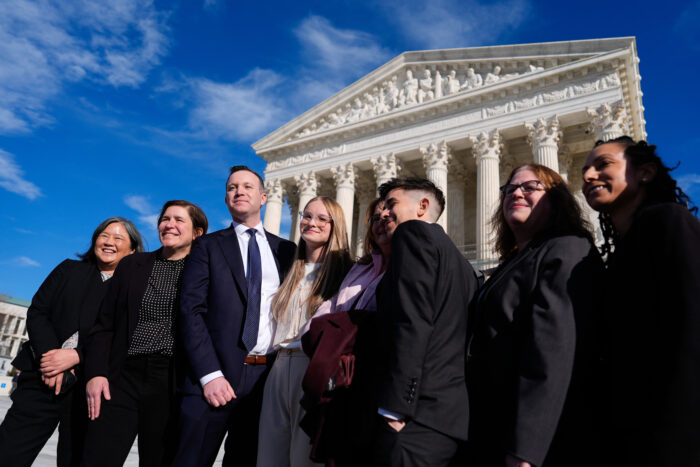
Becky Pepper-Jackson and her mother Heather Jackson pose with members of their legal team outside the Supreme Court after arguments over state laws barring transgender girls and women from playing on school athletic teams, Tuesday, Jan. 13, 2026, in Washington. Julia Demaree Nikhinson/AP Photo
Listen
Share this Article
The U.S. Supreme Court heard oral arguments from two states Tuesday, including West Virginia, regarding laws that restrict transgender athletes from playing in girls sports in high school and college.
In 2021, the West Virginia Legislature passed the Save Women’s Sports Act to keep transgender females out of women’s and girls sports — restricting participation to only biological males.
Becky Pepper-Jackson (B.P.J.) is a 15-year-old 10th grader. She marches in her high school’s marching band and throws discus and shot put for her school’s track and field team on the girls team.
West Virginia v. B.P.J. stems from a challenge to West Virginia’s 2021 Save Women’s Sports Act, which defines “female” as “an individual whose biological sex determined at birth is female.” Pepper-Jackson and her mother sued, arguing that West Virginia’s law violated the U.S. Constitution and Title IX.
In January 2023, a federal district judge upheld the law, ruling that it was constitutionally permissible for the legislature to classify sports participation based on biological sex. The court recognized that biological males generally outperform females athletically and that the law was reasonably related to fairness in competition.
A divided panel of the U.S. Court of Appeals for the 4th Circuit issued an injunction allowing the challenger to compete while the appeal continued, offering no explanation for its decision. That prompted West Virginia, joined by female athletes represented by the Alliance Defending Freedom, to seek Supreme Court intervention.
According to the ACLU-WV, Pepper-Jackson is the only transgender athlete in West Virginia.
Listen to oral arguments and questioning from the Supreme Court justices.
State Solicitor General Michael Williams represented the state in oral arguments in front of the high court. In his opening statement, he said the state’s law is substantially related to the important governmental interest in ensuring fairness and safety in girls sports.
“The law is indifferent to gender identity because sports are indifferent to gender identity,” he said. “Ultimately, West Virginia’s law, like the laws of at least 26 other states, simply preserves the enduring structure on which girls sports depends.”
“This case is monumental not only for West Virginia, but for our entire country. The outcome will impact the future of women’s sports, the promises of Title IX, and the safety of our daughters,” Attorney General JB McCuskey said in a statement last week. “We are hopeful that the Supreme Court will uphold the Save Women’s Sports Act and agree with what West Virginia has been saying for years: biological sex matters in sports, and allowing males to compete against female athletes is unfair and dangerous.”
In a press release, Gov. Patrick Morrisey reaffirmed his long-standing commitment to protecting fairness, safety and equal opportunity for female athletes.
“While serving as attorney general, I led the appeal of West Virginia’s case that brought this issue before the Supreme Court,” Morrisey said. “This has been a years-long effort to uphold common sense and protect the integrity of women’s sports.”
“This is about ensuring that women and girls have the opportunity to compete on a level playing field,” Morrisey said. “West Virginia will continue to stand up for common sense and equal opportunity in all athletics.”
The ACLU, the ACLU of West Virginia, and Lambda Legal represented the plaintiff in West Virginia v. B.P.J.
The court also heard similar arguments in Little V. Hecox from Idaho. It involves two athletes, one transgender and one cisgender.
According to the ScotusBlog, a media company that watches the Supreme Court, “When they filed their lawsuits, Hecox and B.P.J. argued that the Idaho and West Virginia bans, respectively, violate Title IX, a federal civil rights law that prohibits sex discrimination in educational programs and activities that receive federal funding, as well as the Constitution’s equal protection clause under the Fourteenth Amendment.”
The arguments on both sides say that it is a zero-sum decision based on participation on teams, that someone would be excluded if a transgender girl were included, according to Justice Brett Kavanaugh.
One of the major topics of discussion throughout more than three hours of testimony between the two cases was “scientific uncertainty on the biological advantage.”
Joshua Block represented Pepper-Jackson (B.P.J.) in her suit. He is senior counsel with the ACLU’s LGBTQ & HIV Projects.
“B.P.J. signed up for school sports because she was an 11-year-old girl starting a new middle school who wanted to meet people, make new friends and be part of a team,” he said. “West Virginia argues that to protect these opportunities for cisgender girls, it has to deny them to B.P.J. But Title IX and the Equal Protection Clause protect everyone, and if the evidence shows there are no relevant physiological differences between B.P.J. and other girls, then there’s no basis to exclude her in thinking through the Title IX claim in particular.”
The court is expected to issue a decision in the West Virginia case, and a similar one from Idaho by early summer.
Children aged 13 and older would have the right to proper notice of a hearing where the outcome may affect them, the option to attend the hearing and the right to have the outcome explained to them.
Blood is a key part of modern medical care, but keeping a regular supply relies on thousands of volunteers donating regularly. We learn about the importance of blood drives and how technology is making it easier than ever to roll up your sleeve.
The Recharge West Virginia Program would reimburse employers for the costs of training employees, and also requires the trained employees receive a 25% pay raise.