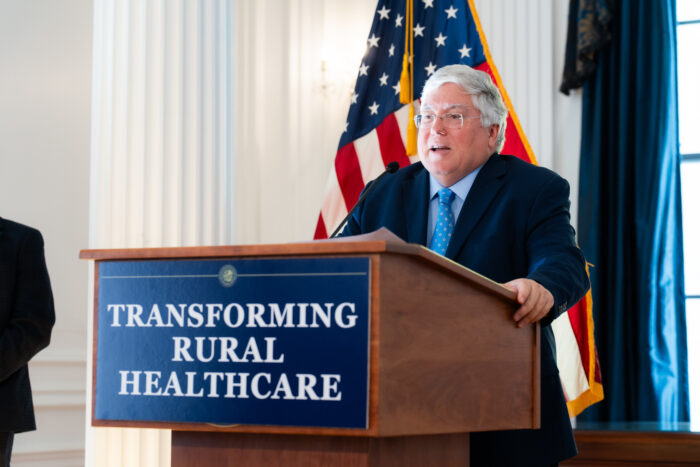
West Virginia is slated to receive $100 million a year for the next five years, thanks to HR1, commonly known as the One Big Beautiful Bill passed by Congress. But there is also an application process for the state to receive even more money.
Gov. Patrick Morrisey announced the application Wednesday as part of the Rural Health Transformation Program (RHTP). He said the plan includes thousands of pages of public input and multiple public meetings.
“We convened three round tables with over three dozen organizations,” he said. “[We] hosted a tele-town hall with more than 17,000 residents attending to speak directly with rural West Virginians about this application.”
The RHTP is designed to lessen the blow of cuts to Medicare and Medicaid. West Virginia may lose as much as $900 million a year from those cuts, putting rural hospitals at risk.
Morrisey said he doesn’t believe those estimates and said he thought improving the health of the state would lower the medical issues in the first place. He also stressed getting people healthy so the state can improve the workforce participation rate.
One initiative is to give Emergency Medical Services (EMS) the ability to provide care directly, allowing some people to get basic care at home. When asked by a reporter if he thought this might mean a need for fewer hospitals, Morrisey said he didn’t want to make a prediction about what would happen other than to say that he thought this was a great opportunity for hospitals.
“It’s a great opportunity for a host of different healthcare providers, but we have to be thinking from a transformative perspective in terms of opportunities we have so patients get better access to care,” he said. “So this is an opportunity to grow access, so there’ll be more opportunities for provider visits, either directly where the patient is going to go to get the care that they need, or to be able to access it through telehealth. That might occur through a hospital, might occur through a clinic. It might occur in a variety of different situations, but it’s putting the consumer first at the equation.”
The Rural Health Transformation plan application focuses on seven key areas, including:
- Connected Care Grid: Build the infrastructure to bring virtual and in-person care access to people on-demand.
- Expanding telehealth, remote monitoring, and mobile-care access points across hospitals, clinics, other healthcare locations, and community hubs.
- Launching a scheduling and referral platform connecting virtual, in-person, and home-based care.
- Supporting EMS community-paramedicine and treatment-in-place programs to reduce unnecessary emergency visits.
- Rural Health Link: Transport West Virginians to care when it’s needed.
- Building a unified, one-stop-shop health-mobility platform connecting NEMT, public transit, and community ride programs.
- Funding vehicle and driver grants to expand local and regional transit capacity.
- Coordinating with EMS and hospitals to create an efficient, data-driven transportation system that lowers costs.
- Mountain State Care Force: Recruit, train, and retain the health care workforce of the future.
- Expanding rural residencies, fellowships, and training sites across key provider types.
- Offering incentives and “return-to-home” scholarships for clinicians serving rural areas.
- Launching apprenticeships and entry-level health care jobs through the Learn & Earn model and community colleges.
- Coordinating workforce recruitment and placement with providers, universities, and state workforce programs.
- Smart Care Catalyst
- Support tech-enabled innovation and regulatory relief.
- Providing technology and productivity grants to modernize small hospitals and rural clinics.
- Creating shared-service collaboratives for group purchasing and administrative efficiency.
- Partnering to reduce administrative burden and improve overall stability.
- Paying for health care value and quality.
- Co-creating and incentivizing standard value-based payment models to align incentives around quality and sustainability across payors.
- Providing support for rural providers to move to value-based payment models.
- Health to Prosperity Pipeline: Help West Virginians rebuild health, rejoin the workforce, and thrive in their communities.
- Expanding health-to-work and recovery-to-work programs connecting care, job coaching, and employment support.
- Partnering with employers and workforce boards to fund on-site wellness and preventive programs.
- Offering incentives to MCOs or employers for transitioning people off Medicaid or into commercial coverage.
- Personal Health Accelerator: Empower healthy living through food as medicine, movement, and local partnerships.
- Scaling Food-as-Medicine, physical-activity, and caregiver-support programs through competitive micro-grants.
- Integrating nutrition, lifestyle, and prevention data into workflows for closed-loop referrals.
- Expanding maternal, infant and youth, and eldercare support and chronic-disease prevention programs statewide.
- Partnering with schools, employers, and local organizations to embed healthy living in everyday life.
- HealthTech Appalachia: Incubate leapfrog technologies that innovate health care delivery and unlock economic growth.
- Establishing innovation funds to seed and scale breakthrough health technologies.
- Operating a statewide accelerator providing funding for AI-enabled, digital-health, and consumer tools, with a particular focus on innovations that improve chronic-disease, SUD, maternal-health and other outcomes specific to rural West Virginia communities.
- Partnering with many groups, such as universities, venture firms, payors, and providers to build a sustainable rural innovation ecosystem.
More information on these seven initiatives can be found here.
See a summary below, provided by the governor’s office, of the application.