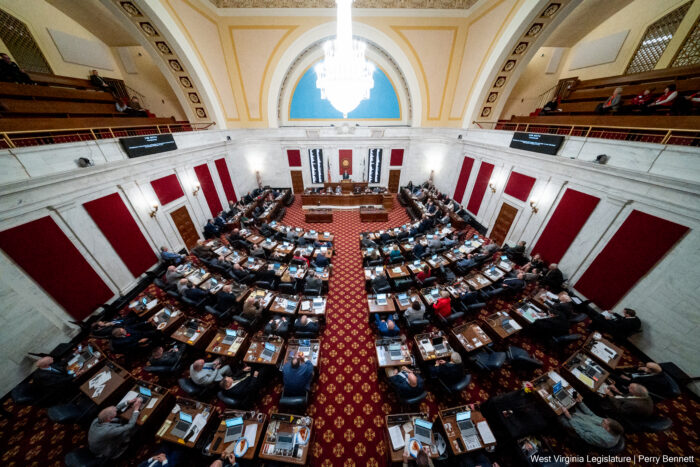
The state’s supreme court heard arguments Tuesday morning in a case about who gets to replace lawmakers removed from the House of Delegates.
The case of Mike Pushkin, Stephen Willingham, and the West Virginia Democratic Party v. Patrick Morrisey and Roger Hanshaw was filed days before Gov. Patrick Morrisey appointed Republican Ian Masters to replace Joseph DeSoto to represent Berkeley County.
De Soto was elected in 2024 but was ousted from the House of Delegates before being sworn in after making threats against multiple lawmakers over text and email. The day before his arrest, De Soto changed his political affiliation from Republican to Democrat, creating confusion and debate over which party would appoint his replacement.
Democrats have argued that a 2018 law requires that DeSoto’s successor hold his political affiliation upon removal, but Republicans maintain the rule would only apply if DeSoto was sworn in.
Robert Bastress for the defense argued that a preference expressed by voters in the form of DeSoto’s election needed to be overturned by consensus.
“The petitioners have never disputed that the House of Delegates didn’t have grounds for expelling him, or didn’t have good reason for taking action against him,” Bastress said. “It was the procedures used, that it proceeded by majority vote on a exclusion as opposed to proceeding to an expulsion procedure where he has to have a two-thirds supermajority.”
Michael R. Williams, solicitor general of West Virginia, argued that swearing in was a constitutional requirement for holding office, and made a distinction between holding office and starting a political term.
“I think the legislature appropriately concluded that the oath was a qualification that needed to be met, and from there we have petitioners today saying they don’t quibble with the notion that the oath was not in fact fulfilled,” he said. “And so I think the court could just rely on the party presentation rule and say, based on that concession, that there’s an acknowledged qualification and an acknowledgement to not meet that qualification, and therefore the House appropriately acted.”
Fundamentally, Williams questioned the court’s authority in the matter.
“Not only do you have a lack of authority empowering this court, you actually have express prohibition barring this court or any other person from interfering with the operations of the sort of essential legislative functions,” he said.
Williams said he believed the petitioners were asking the court to “fundamentally reordering our separation of powers.”
“This is a very aggressive play, and although the facts are unusual, I think the bottom line of what they’re doing is really trying to get this court to position itself as the overseer of very fundamental legislative functions, and I think that really is a very dangerous invitation for everyone involved,” he said.
Bastress argued the court does have the authority because similar issues have happened in the past and are likely to happen again.
It was not immediately clear when the state Supreme Court would release a decision, and the justices questioned whether the issue was not already moot by nature of Masters serving in the seat for close to two years and with another election imminent.
Bastress argued there is still time in the term in question.