More than 3,000 pumpkins decorate the Pumpkin House in Kenova, an event that has turned into a community carnival but started out with five simple carved pumpkins.
The Appalachian Power Mountaineer plant in Mason County, West Virginia, in August 2021.David Adkins / West Virginia Public Broadcasting
Listen
Share this Article
Appalachian Power submitted its plan for the next 10 years to state regulators, and changes could be coming to its coal plants.
Appalachian Power filed its integrated resource plan last week with the West Virginia Public Service Commission.
The company mapped out six scenarios for its Mountaineer, Mitchell and Amos plants.
Only Mountaineer would stay in operation through 2035 in all scenarios, and it may be converted from coal to 100% natural gas.
In some scenarios, Amos would retire completely by 2035 or be partially converted to gas.
The Mitchell plant also would partially retire or partially convert from coal to gas.
The scenarios contemplate a delay in U.S. Environmental Protection Agency power plant rules that are currently under review by the Trump administration.
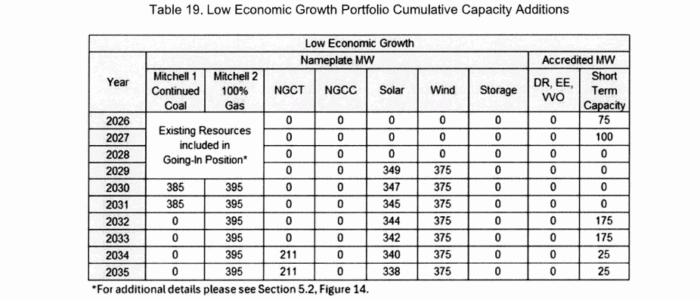
Appalachian Power’s low-growth scenario has Mountaineer and one unit at Amos run with gas and two other units at Amos retire, with the addition of wind, solar and storage.
Credit: Appalachian Power
Karen Wissing, a spokeswoman for Appalachian Power, says if those rules are delayed, “maintaining coal operations at all three plants would be the most cost-effective option for our customers.”
“However,” she added, “if the EPA rules are not modified from their current form, conversion to natural gas generation would become a more cost-effective option.”
The company’s plan also outlines scenarios for both high economic growth or low economic growth.
A low-growth scenario would lead to the retirement of all coal generation by 2032.
The planning document outlined options for replacing the plants with wind, solar and combined-cycle natural gas.
The Amos and Mountaineer plants provide power to Appalachian Power customers in southwest Virginia.
Virginia’s Clean Economy Act sets targets for emissions reductions in electricity generation, something West Virginia lacks.
Appalachian Power’s low-growth scenario for Mitchell has one unit running with gas and the other retiring, with the addition of wind and solar.
Credit: Wheeling Power
Of the three plants, Mountaineer had the highest capacity factor this year through July of 64%.
Amos had a capacity factor of 34% and Mitchell 25%. The average in the PJM region is about 40%. The West Virginia PSC and the legislature would prefer the plants operate closer to 69%.
Inside Appalachia this week explores data centers and artificial intelligence (AI). As part of this special episode, host Mason Adams spoke with Dan Parks, a journalist who writes a Substack called Country Roads News. He's been covering data center development in Tucker County. We listen to an excerpt.
Marshall University and Huntington Tri-State Airport are set to become a premier hub for cutting-edge aerospace training and innovation thanks to a $3 million award from the Economic Development Administration (EDA).
Southern West Virginia has rich but often overlooked musical traditions. Chris Haddox is a WVU professor of sustainable design, but he's also spent years uncovering more information on those overlooked musicians. We spoke with him to learn more about his effort to shine a light on the musical talents of local miners, now with the help of a grant from the Mellon Foundation.
The online system allows businesses to apply for permits, pay fees, and track applications through a single account as part of the governor's Speed to Build initiative.