This week, a new report finds the number of black lung cases is at its highest since the 1970s. The human cost is high. Also, the author of a new book says reintroducing nearly extinct animals back into the wild can boost damaged ecosystems, but they can't repair them. And, roadside attractions pay tribute to our enduring fascination with weird.
WVU Faculty Vote No Confidence In Gee, Freeze Academic Transformation Process
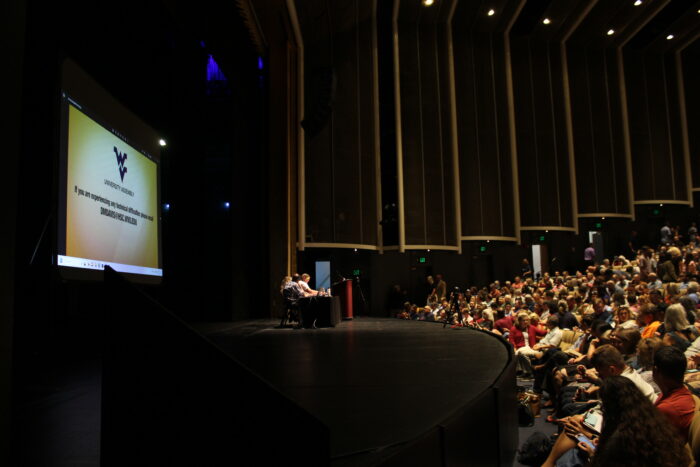
West Virginia University faculty members assemble to vote on two resolutions in the Clay Theatre Sept. 6, 2023.Chris Schulz/West Virginia Public Broadcasting
Listen
Share this Article
With a vote of 797 to 100, the faculty of West Virginia University affirmed that they do not have confidence in President Gordon Gee’s leadership.
Hundreds of faculty members met in person in the Clay Theatre of the Creative Arts Center in Morgantown, with hundreds more from the university’s Beckley and Keyser campuses joining online. They met to vote on the resolution of no confidence in Gee, as well as a resolution to freeze the academic transformation process that has led to proposals to cut dozens of degrees and hundreds of faculty positions from the Morgantown campus. University administration plans to conduct similar program reviews and cuts at Beckley and Keyser next year.
The votes are non-binding, but librarian Jonah McAllister-Erickson says that voicing their concerns to the administration is one of the faculty’s only recourses.
“I think it says something that in a matter of days, we see hundreds, perhaps upwards of over 1000 faculty members in the middle of the day coming together to voice our collective concerns here,” McAllister-Erickson said. “That says that there’s something fundamentally wrong happening at WVU.”
Academic support units like libraries are up for their own review later this year. McAllister-Erickson said unlike academic programs, they do not have the right to appeal.
“We’ve seen several of the initial recommendations for the academic units appealed successfully and make positive changes to the proposals,” he said. “My fear is that in the end, the academic support units will be used to make up the difference between the amount of money the administration thinks they need to save, and what they have been able to cut from the academic units.”
Later in the meeting, the resolution calling for a freeze to the academic transformation process was also approved on similar margins to the vote of no confidence. The final tally was 747 for and 79 against the resolution.
Prior to the vote, Provost Maryanne Reed asked to address the assembly on the resolution. Not being a faculty member she needed to be formally recognized by the assembly, but was voted down 302 in favor to 406 opposed.
Christiaan Abildso, an associate professor in the School of Public Health, was excited by the results but understood that the decision was still in the hands of the Board of Governors. He said he felt proud to see the faculty come together.
“It stinks that it’s against something, but hopefully we keep this feeling of support for one another,” Abildso said. “Showing up every day to work is a traumatic experience right now, it’s brutal. Hopefully people stick together, support one another and get through this with without cutting and harming so many people’s lives as what has been pushed on us.”
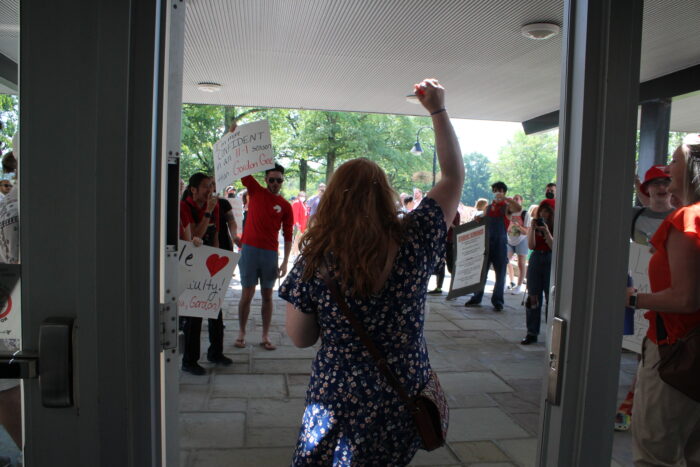
As faculty members streamed out of the building, they were met by chants of “eight to one” from students protesting in support of the votes, a reference to the ratio of votes in favor over against the resolutions.
Jake Hough is a journalism major. He said although his program is not directly impacted, he and other students think it’s important for everyone to pay attention to what is happening.
“These professors are our family,” Hough said. “I look ahead, and we have to ask what’s next? This isn’t just a foreign language issue. This isn’t just an upper level math issue. This isn’t just a mining engineering issue. This is a campus wide issue.”
In a statement released shortly after the conclusion of the university assembly, Board of Governors Chair Taunja Willis-Miller said the board appreciated the faculty members who shared their perspectives and acknowledged the votes.
“The Board of Governors unequivocally supports the leadership of President Gee and the strategic repositioning of WVU and rejects the multiple examples of misinformation that informed these resolutions,” Willis-Miller said in the statement. “The university is transforming to better reflect the needs of today, and we must continue to act boldly. President Gee has shown time and again he is not afraid to do the difficult work required.”
The statement goes on to say the process is critical to ensure a strong future for the University.
As the faculty meeting was underway, Gov. Jim Justice held an administrative briefing. Asked if he had confidence in Gee, Justice said he did.
“Now we can say a whole lot of things about Gordon Gee, but I am telling you wholeheartedly that man is eat up with trying to do good stuff for West Virginia,” Justice said.
The university Board of Governors will meet twice next week: on Sept. 14 to hear public comment on the proposed program cuts and again Sept. 15 to vote on the proposals.
The Faculty Senate meets Monday.
Add WVPB as a preferred source on Google to see more from our team
Marshall University and WVU will provide grant writing and subject expertise with the goal of leveraging $450 million in federal and private funding for water infrastructure projects.
The ACLU-WV said students in Lincoln County receive a worse education than their parents and grandparents did — and that by some measures the schools are worse off than the system a court already found unconstitutional.
It’s thunderstorm season, but not all of them are the same. For the Appalachia + Mid-South Newsroom, Bill Burton and meteorologist Tawana Andrew break down what we know – and what we don't – about the climate and weather in the region. This week, they examine different types of thunderstorms.