Alert (09/29/2026): Our Parkersburg TV transmitter is still undergoing maintenance and remains temporarily inoperative. We apologize for the inconvenience.
All our programming is available via our TV livestreams on our website and WVPB Passport. Thank you for your patience!
This week, author Silas House returns with a sweeping new novel. Also, some folks say, you have to fake it 'til you make it, even if you're trying to establish a state park. And, the story of the first Mothman sightings as written by a small town journalist in 1966.
New Report Ranks State School Spending Below Average
Vectorfusionart/Adobe Stock
Listen
Share this Article
State Board of Education members continue to urge state lawmakers to revisit the school funding formula. A new study looks at state school funding across the country.
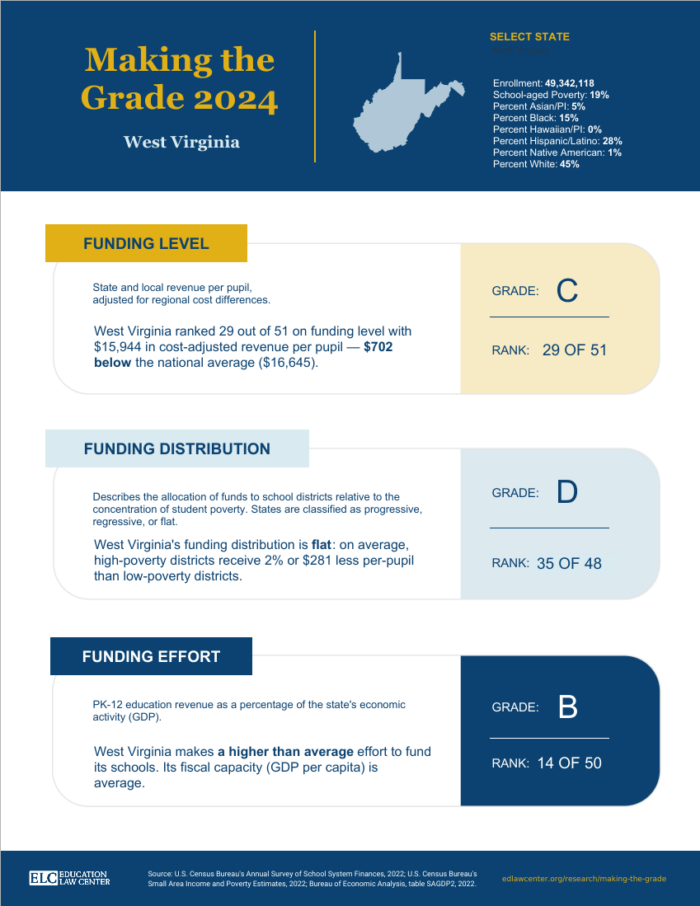
West Virginia’s funding for public schools scores below the national average, according to the Making the Grade report, an annual overview of the condition of school finance in the states.
The report comes from the public education nonprofit Education Law Center, which focuses on school funding equity, non-discrimination for public school students and other issues affecting public school quality.
West Virginia got a B grade for its “funding effort,” defined as spending per student as a percentage of state GDP – the value of goods and services produced by the state. Slightly more than 3 percent percent of the state’s GDP goes towards students, ranking West Virginia 14th in the country.
However, West Virginia’s spending compared to GDP fell by 14 percent year over year, one of the largest drops in the country. The decline follows a national trend that has brought the average effort index among states in 2022 – the most recent year with complete data – to its lowest point in the last decade.
West Virginia’s overall funding level received a C, with overall per pupil spending $700 less than the national average. Nominally, the state spent just 1 percent less per pupil in 2021 than it did in 2020, but adjusted for inflation that number jumps to an 8 percent reduction.
The report acknowledges that “with inflation as high as it was between 2021 and 2022, even significant revenue increases may not actually translate into more purchasing power.”
Only eight states had more per-pupil funding available when inflation is taken into consideration. West Virginia’s reduction in overall spending was enough to drop it four points in the rankings and into the bottom half, from 25th to 29th.
For funding distribution, West Virginia received a D. The report points to distribution, specifically more funding being delivered to educate students in high-poverty districts, as the hallmark of a fair and equitable school finance system.
With similar funding levels in high- and low-poverty districts, West Virginia’s funding was described as having a “flat” distribution system. Analysis shows state spending is 2 percent higher in low-poverty districts, a difference of about $300 per pupil.
The report presents a picture of school funding in the 2021-2022 school year, the most recent data available, and therefore does not capture the full impact of charter schools and vouchers on the educational landscape. In its conclusion, the Making the Grade report highlights the effects of voucher programs like the Hope Scholarship to funding for public education.
Reduced state funding, driven by declining enrollment, has repeatedly come up as a driving factor in the state’s approval of more than 25 school closures this year.
Add WVPB as a preferred source on Google to see more from our team
Ryan Saxe, superintendent of Berkeley County Schools, said the suit is about whether West Virginia school funding system adequately supports what school districts are responsible for providing their students.
In Mason County, West Virginia, new data center developments are changing local landscapes and communities. One of the computing campuses is also threatening a special stand of trees. Reporter Andrea “River” Peterson reports.
West Virginia's state parks, forests, and outdoor recreation areas are about to get an upgrade. Gov. Patrick Morrisey announced Wednesday nearly $20 million in investments to modernize and expand the facilities across the state.












 Vectorfusionart/Adobe Stock