In the North Carolina foothills, a common dessert in the fall is a sonker. Folkways Reporter Amanda Goins first heard that name when she moved to Surry County, North Carolina. She got curious and shares what she learned about this local dessert whose history goes back centuries.
Marshall University To Help Unlock The Secrets Of Water Bears
Listen
Share this Article
The National Science Foundation awarded Marshall University a $366,624 grant to study how protective structures adopted by tardigrades help protect them from their environment. The study will be part of a partnership with the University of North Carolina at Chapel Hill.
Tardigrades, also known as water bears or moss piglets, are micro-animals that are found in almost every place on earth. They are known for being able to survive the harshest environments.
“Tardigrades produce these compounds known as free radicals, which are reactive chemical species, when they’re exposed to stressors,” said Derrick Kolling, chair of the Marshall University Department of Chemistry.
You can see responses to extreme conditions in nature, but the reason why tardigrades are unique is their vast variety of responses to environmental stressors such as vacuums, UV radiation, dehydration, high salt concentration, and freezing temperatures. A common response by tardigrades includes forming into a tun.
“Forming this structure called a tun, they sort-of shrink down; extrude water, and then they can stay in that state for a very long period of time,” Kolling said.
West Virginia Public Broadcasting
When a tardigrade is stressed, it enters a quasi-death state. The animal retracts its head and its eight legs and curls into a dried-up ball.
According to Kolling, looking into these chemical structures could help development in space travel and pharmaceutical storage. They might even help fight against aging.
“Throughout our lives, we develop damage in our bodies,” Kolling said. “Not that we’re necessarily going to form one of these protective states, but these things might give us insight into how humans might protect our DNA.”
In a partnership with Robert C. Byrd Institute, the research team is starting the Tardigrade Trading Post outreach program. The trading post will send scientific kits designed by the research team to be used by citizen researchers. This includes students K-12; what Kolling referred to as little citizen scientists.
The Robert C. Byrd Institute is designing 3D printed microscopes that citizen researchers can use to gather tardigrades from their backyards. On top of providing young students an opportunity to learn about micro-species, Kolling hopes that this will help the team harvest a wide variety of tardigrade species.
“A lot of water bear species are parthenogenic, which means that you only need the female to reproduce so they can reproduce asexually,” Kolling said. “I think the odds of finding a new species are pretty decent, especially if people are willing to go to places like Dolly Sods. We could raise them in the lab. If we find interesting conditions, we would characterize them genetically.”
The grant will support the graduate and undergraduate student research team for the next three years.
Marshall University
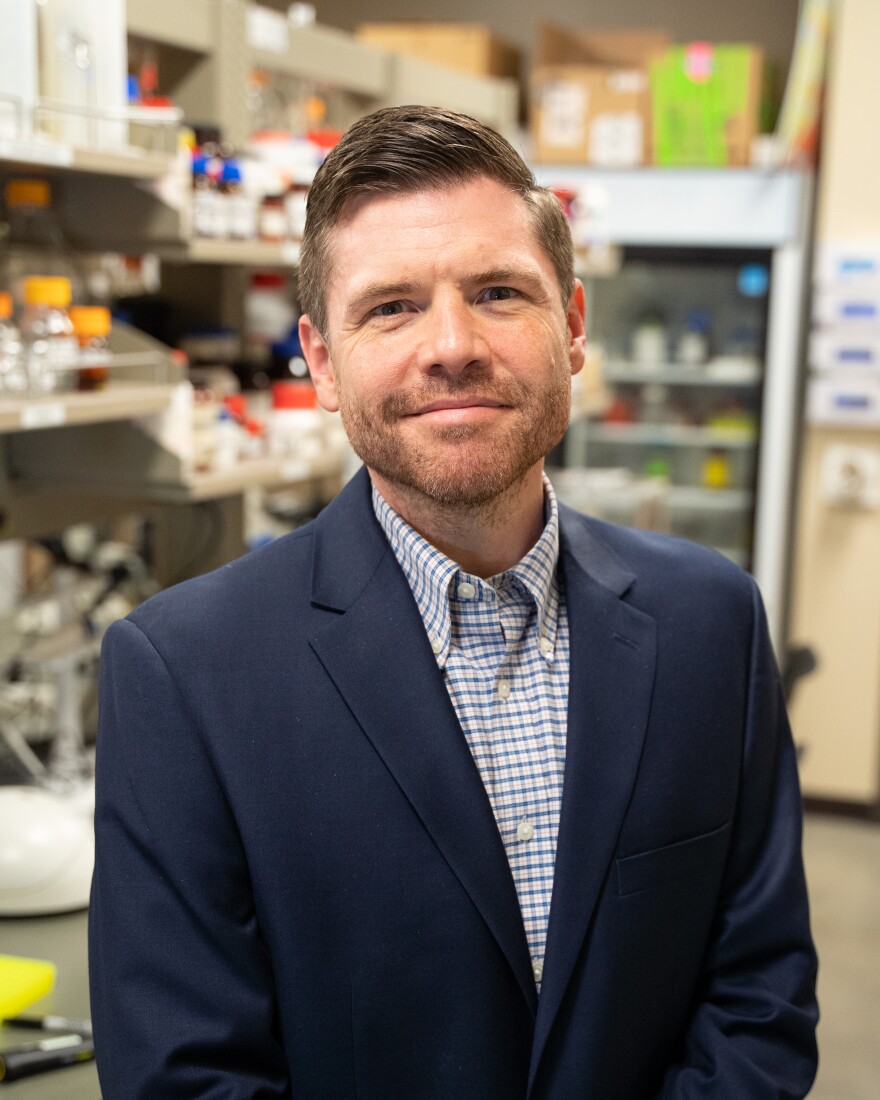
Derrick Kolling, chair of the Marshall University Department of Chemistry
Add WVPB as a preferred source on Google to see more from our team
State treasurer Larry Pack is proposing raising the base pay for all teachers to $50,000, restoring local control over data center tax revenue and term limits for some of the state's highest offices.
On this West Virginia Week, the board of education is in charge of rulemaking for schools according to a ruling from the Court of Appeals of West Virginia, Sen. Jim Justice is admonished and a rule to weaken silica limits in mines is proposed.
The Supreme Court of Appeals of West Virginia ruled Friday that rulemaking by the State Board of Education is within the meaning of 'general supervision' of state schools pursuant to the West Virginia Constitution and that a 2025 law interfering with that rulemaking is unconstitutional.
On this West Virginia Morning, a Marshall University historian discusses documenting previously unknown underground railroad sites throughout the region.