This week, some of the stories on our show inspired college student art — including a vivid image of a bear smashing a clarinet. Also, a Hare Krishna community in West Virginia serves vegetarian food made in three sacred kitchens. And, COVID-19 exposed the contempt society has for marginalized people. One author says, these folks are anything but passive.
Hope Scholarship Bill Nears End Of Legislative Journey
Share this Article
A bill that would establish publicly funded education savings accounts in West Virginia to support private and homeschooling has passed the West Virginia Senate. The legislation passed the House of Delegates two weeks before and could soon be on the governor’s desk for a signature.
HB 2013 would launch the Hope Scholarship Program. The program creates education vouchers for public school students who are interested in changing to home or private school. A student could receive about a $4,600 voucher per year based on the current state School Aid Formula.
These vouchers would be used for things like tuition at a private school, tutoring or an afterschool program.
Also, under the bill, if less than 5 percent of students take part in the program in its first year, then in 2026, the program would open to all current West Virginia private and homeschool students, regardless of whether that student ever attended public school. If all private and homeschooled students took part statewide, the program is estimated to cost about $100 million a year, according to the West Virginia Department of Education.
Will Price
/
WV Legislative Photography
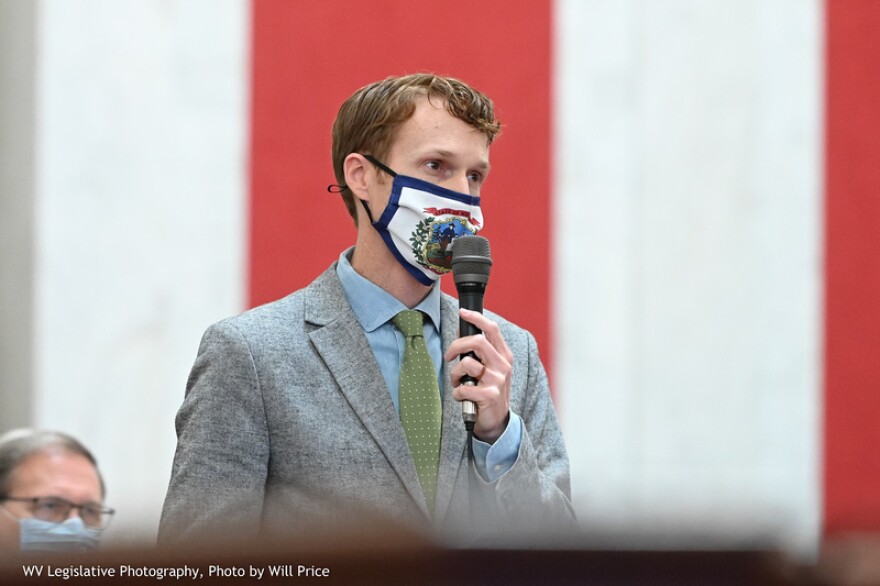
Sen. Amy Grady, R-Mason, speaks to HB 2013 during floor debate on March 17, 2021.
Sen. Amy Grady, R-Mason, who is a public school teacher and who has voted alongside Democrats at times on education-related legislation, spoke in favor of the bill.
Grady said she’d been on the fence about how she would vote but ultimately chose to support the measure, pointing to a student she taught with severe dyslexia.
“I often wonder what happened to him, as he moved on through bigger schools and people didn’t really understand what he needed. I thought about more students that, that could affect,” she said. “That clarity, to me, thinking about that student, and the difference that I made, and the difference that something like [ESAs] could make in his life and the lives of students like him, makes me think twice.”
Most Republicans have argued the program would give families choice and create an even playing field for all West Virginia students.
But Democrats have argued that the bill is costly and would negatively affect funding for public education.
Will Price
/
WV Legislative Photography
Sen. William Ihlenfeld, D-Ohio, speaks to HB 2013 during floor debate on March 18, 2021.
Sen. William Ihlenfeld, D-Ohio, called the bill “financial recklessness.”
“We can’t be lulled into believing that the financial picture in the state of West Virginia is better than it really is. It’s not. It’s flat. Employment is flat. Revenue is flat,” Ihlenfeld said. “I’m not standing up here in opposition to the concept of an ESA, which I know exists in a handful of other states. What I’m saying is that if we’re going to go down this path, we should be careful.”
Democrats have also pointed to concerns over discrimination.
Will Price
/
WV Legislative Photography
Senate Minority Leader Stephen Baldwin, D-Greenbrier, speaks to HB 2013 during floor debate on March 17, 2021.
Senate Minority Leader Stephen Baldwin, D-Greenbrier, spoke against the bill saying its reach is too broad and doesn’t ensure that any student, regardless of background, could receive it.
“This particular bill is not a targeted bill. It’s wide open. So it doesn’t target the aid towards the students who need it the most,” Baldwin said. “A student who needs it the most could be denied admission in the first place, because they are a problem student, because they’re disabled, because they have a ‘lifestyle’ that isn’t agreed to by the folks who were admitting those students.”
But Republicans in support of the bill say private schools are held to the same state and federal laws as public schools and must accept anyone.
Will Price
/
WV Legislative Photography
Senate Education Chair Patricia Rucker, R-Jefferson, speaks to HB 2013 during floor debate on March 17, 2021.
Senate Education Chair Patricia Rucker, R-Jefferson, said the Hope Scholarship Program would be no different.
“This legislation actually is open. It understands and accepts that there is high diversity in our state. It understands that people come from all walks of life. It contemplates that if that child is not being served, and it doesn’t matter how much money the parents make, it doesn’t matter what the child’s particular demographic is, where they are in the state,” Rucker said. “It doesn’t matter their background; doesn’t matter their ability. What matters in this legislation is you are not thriving, and you are looking for help, and we are giving them an option.”
HB 2013 passed the Senate 20-13 with Republican Sens. Bill Hamilton, R-Upshur, and Eric Nelson, R-Kanawha, voting against the measure.
On this West Virginia Week, ICE arrests in West Virginia include 650 people, some lawmakers consider changing how residents vote, and rock climbers embrace the cold to scale a frozen waterfall.
On The Legislature This Week, House Finance leaders provide us with some insight into the state budget process. We also hear about lawmakers’ ideas to change local elections, as well as a bill restricting abortion medication in the Senate.
While the West Virginia Legislature may consider hundreds of bills during the 60-day session, there is only one thing they are required by the state constitution to do and that is to pass a balanced budget. The state is not allowed to operate in a deficit. News Director Eric Douglas spoke with House Finance Committee Chair Vernon Criss, R-Wood, and Minority Chair of House Finance Del. John Williams, D-Monongalia, to discuss the process for creating the state budget.
Thursday’s decision came following a two-day hearing held in December at the DEP headquarters in Charleston where the citizen groups argued for the release of all redacted information in the site’s air quality permit application.