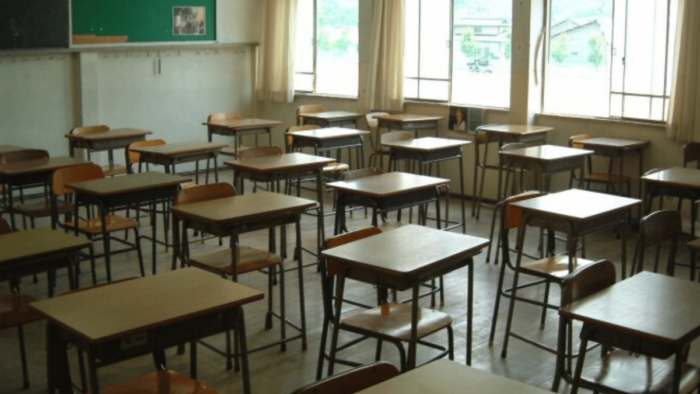
The group “Together for Public Schools WV” is sounding the alarm that schools are being considered for closure next year, not because they are no longer needed, but because school districts don’t have enough money to keep them open. The nonpartisan statewide coalition says the next legislative session isn’t soon enough.
Sarah Duncan, facilitator for the Together for Public Schools Coalition and public education campaign coordinator for the West Virginia Center on Budget and Policy, said lawmakers need to hold a special session during the next interim meetings Sept. 13-15.
“They could utilize surplus funding. We’ve got $125 million available,” she said. “We’d like to see them use that, pause this decline that we are in, and try something different like actually modernizing our school funding formula so that it works.”
West Virginia House Democrats have made similar calls for Gov. Patrick Morrisey to call a special session on school funding this summer
“Together for Public Schools WV” has identified eight schools being considered for closure after the 2026-2027 school year. According to the West Virginia Center on Budget and Policy, 14 school closures were approved during the 2025-2026 school year.
Duncan said September is the last chance to provide supplemental funding before school districts have to make difficult decisions about closures.
“What’s going to happen in the next several months counties are going to look at their budgets, propose school closures,” Duncan said. “We feel like September, in particular, is just our last chance, really, to prevent this. If we wait, then we’re going to be looking at our next interim session in December, and it’ll be too late by then. All those decisions will have been made, and then by next year they’ll go into legislative session in January, and it’ll be just like the previous year.”
Duncan said adequately funding special education services should be a top priority to fix school funding issues. During May interim meetings legislators learned that $560 million dollars were spent on special education in West Virginia in Fiscal Year 2025 alone, almost a quarter of the state’s appropriation for public education that year.
Uriah Cummings, school financial officer for the West Virginia Department of Education, told lawmakers in May that state and federal funds only covered $380 million – about two thirds of that amount – leaving a $180 million shortfall for local districts to cover.
Duncan said that means millions of dollars each county has to find elsewhere.
“When we don’t have funding for required services for students, we have to pull funding from other parts of the budget to cover that,” she said. “So it doesn’t just hurt your students with special needs; it hurts the entire student body. And then when your county runs out of money, you have to look at position cuts and school closures, so it hurts your entire community.”
Among its coalition, “Together for Public Schools WV” counts people who attended public schools in West Virginia but have since moved away. Duncan said that is a testament to both the quality of education provided but also the importance of types of localized, community schools lost to closures.
“Public schools are producing some fantastic students,” she said. “If they weren’t, they wouldn’t be exporting so many of them that are doing such amazing things out in the world.”
She pointed to Roane County native Christina Weiland, now a professor at the University of Michigan, who has created an interactive tool to track school closures across the state.