Alert (09/10/2026): Our Parkersburg TV transmitter is undergoing maintenance for a few days and will not be operational. We apologize for any inconvenience.
All our programming is available via our TV livestreams on our website and WVPB Passport. Thank you for your patience!
This October, the Adaptive Climbers Festival will gather in Kentucky’s Red River Gorge for the fifth year. In 2023, Folkways Reporter Emily Chen-Newton covered the event for Inside Appalachia. Since then, the Adaptive Climbers Festival has grown. Organizers say they’re nearly at capacity, with 300 climbers, caregivers and volunteers. Ahead of the festival, the campground has made accessibility improvements. Volunteers with the ACF have also been sprucing up the trails.
Charter School Expansion Bill Heads Back To House After Senate Makes Changes
Share this Article
A bill expanding West Virginia’s current charter school law is now heading back to the House of Delegates after seeing a handful of changes in the Senate.
HB 2012 allows for up to 10 brick-and-mortar public charter schools to be established in the state by 2023. The bill also allows for the creation of two, statewide virtual public charter schools, as well as one local virtual charter per county.
The two statewide schools would be each permitted to enroll up to 5 percent of the current public school population in the state, while a local county virtual charter would be permitted to enroll up to 10 percent of a county’s headcount enrollment.
Supporters of the legislation have said that by creating several schooling options for families, it enhances school choice and gives students the opportunity to find the right learning model for them.
“The point of providing choice is that you are empowering families, whatever makeup they may be, to have a choice to improve their kids’ lives,” said Senate Education Chair Sen. Patricia Rucker, R-Jefferson, during her closing remarks on the bill Monday. “Charter schools have been found to especially help minorities, low-income and single families.”
The bill adds other new sections, such as an additional authorizer, meaning an entity that can approve a charter school in the state. The new authorizer, called the West Virginia Professional Charter School Board, would be bipartisan and made up of state lawmakers and appointees by the governor. County school boards as well as the state school board may still act as authorizers, according to the bill.
Sen. Richard Lindsay, D-Kanawha, took issue with the new authorizer and its potential power.
“What this bill seeks to do is to add another layer of government called the West Virginia Professional Charter School Board, that will be empowered to authorize our charter schools, potentially over the objection of the county board of education,” Lindsay argued on the Senate floor. “Let that sink in a moment. The folks who’ve been elected to make decisions about education in their respective counties can be overrun and overwhelmed.”
Sen. William Ihlenfeld, D-Ohio, also spoke against the bill saying it doesn’t go far enough to ensure that underperforming districts will be prioritized.
“We have this opportunity to bring those scores up. How do you bring the scores up? You find those who are struggling the most, who have the least opportunity, and you reach out to them,” Ihlenfeld said. “They’re the ones who are pulling us down, not because they want to, but because they don’t have the opportunities that other kids have.”
Sen. Richard Lindsay, D-Kanawha, (right) speaks with Sen. William Ihlenfeld, D-Ohio, (left) on the Senate floor on March 1, 2021.
An amendment was offered last week by Senate Minority Leader Stephen Baldwin, D-Greenbrier, to require charters to set up in underperforming areas, but the amendment was rejected, citing the state’s current charter law, which already encourages this, but does not require it.
Sen. Mike Romano, D-Harrison, has repeatedly voiced his concern on the virtual public charter school model. Under the bill, the virtual public charter schools receive the same level of funding as brick-and-mortar public charters.
“The virtual charter schools cause me the most concern,” said Romano. “Virtual charter schools don’t have any buildings. They don’t have any desks. They don’t have lockers. They don’t have any cooks. They don’t have any janitors. They don’t have any security … Where’s that extra money going to go?”
Democrats overwhelmingly stood to speak against the bill, while Rucker was the only one to speak in favor. She responded to some of the concerns voiced by Democrats, including the financial concern brought up by Romano.
Will Price
/
WV Legislative Photography
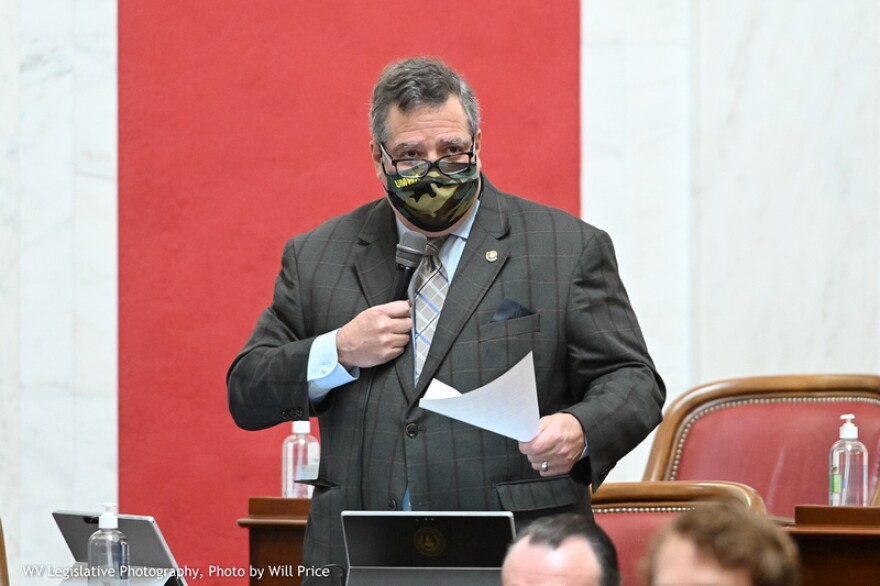
Sen. Mike Romano, D-Harrison, asks questions on HB 2012 during a Senate floor session on March 1, 2021.
“Those virtuals, as my fellow senator pointed out, might not have to heat a building,” Rucker said. “But they do have to worry about the technology. They do have to make certain that their students have what they need in order to be able to go online. In addition to that, they do have buildings. They do have teachers teaching these classes, they still have all of the benefits that, you know, an employee gets. They still have all of those costs.”
The bill also adds some clarification on reasons a charter would be forced to close, such as for misappropriation of funds or for fraud. Under the bill, a charter school can also act as its own Local Education Agency, or LEA, once it has been approved. An LEA, as defined by the U.S. Department of Education, has administrative control and direction.
The bill narrowly passed through the Senate 19-14 with three Republicans voting alongside Democrats to reject the bill.
Since the bill was amended by the Senate, the House now must approve the changes before the bill can head to the governor for a signature.
Add WVPB as a preferred source on Google to see more from our team
At the core of the case is who in government has final authority over policy and rulemaking for the state's public schools: the Board of Education or the Legislature.
In the past 10 to 15 years, schools have seen an increased need to address the social, emotional, and mental health needs of students. The conference will allow support professionals to learn from one another and collaborate.
In recent years, physicians across the country have monitored surges of a condition known as Alpha-Gal Syndrome, which can cause allergic reactions to red meat. Hannah Saad with Appalachia + Mid-South Newsroom member station WKMS reports that, now, farmers, restaurateurs and the afflicted are flocking to a new source of protein.