


'Haunted' Town Already Celebrating Spooky Season
Halloween is still several weeks away, but one West Virginia town is already celebrating the season.
Continue Reading Take Me to More NewsAlert (09/29/2026): Our Parkersburg TV transmitter is still undergoing maintenance and remains temporarily inoperative. We apologize for the inconvenience.
All our programming is available via our TV livestreams on our website and WVPB Passport. Thank you for your patience!




To Educate, Inform, and Inspire by Telling West Virginia's Story

Mountain Readers Week will be held Oct. 5-9, 2026! Celebrate and foster a love of reading in children across West Virginia.
Nominate an exceptional West Virginia K-12 teacher today!

On Demand

On Demand

Stream original productions from WVPB

Watch locally produced documentaries & more.

On Demand

On Demand






West Virginia Morning

Inside Appalachia

West Virginia Week

Mountain Stage

Us & Them

The Legislature Today

The Legislature This Week

Send us your comments and questions.

Stream our board meetings.

Check out the latest WVPB news.

Sign up for our newsletter and get weekly updates.

Meet the WVPB staff.

WV Educational Broadcasting Commission, the WVPB Foundation, and the Friends of WVPB.

Come work with us!

Read our annual report and learn how we educate, inform and inspire with your support.

Sponsor impactful and engaging media and entertainment.

Use your IRA to make a gift to WVPB.

Become a member with your gift of $1,000 or more.

Make WVPB part of your legacy.

Manage your membership account.

Learn how you can Protect and Sustain West Virginia Public Broadcasting.
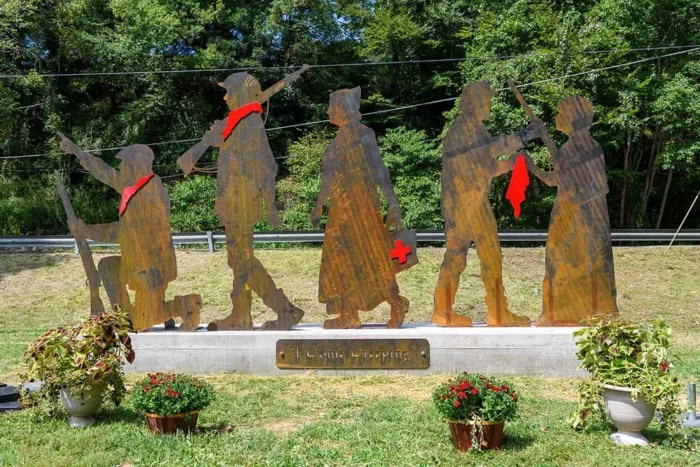
The West Virginia Mine Wars Museum is creating the largest labor history driving trail in the United States, and community members have a chance to shape how it will look.
Started in 2022, the Courage in the Hollers project memorializes the Battle of Blair Mountain and the 50-mile march of militant coal miners.
Kenzie New Walker, the museum’s executive director, said the project originated from museum visitors’ confusion over where to find the actual battle ground.
“They would often say, ‘How do I get to Blair Mountain from here?’ And if you blink, you’d miss it,” New Walker said. “We became really interested in marking the landscape, specifically looking at the nearly 50-mile route that coal miners would have taken in 1921 from Marmet to Blair, where they engaged in battle. We’re interested in creating an experience and an educational one at that for people who drive along the Blair Mountain Memorial Highway.”
With a grant from Monument Lab, a nonprofit public art, history and design studio based in Philadelphia, the museum worked with community members in Marmet in Kanawha County and Clothier in Logan County.
“One of my favorite parts about the project is that the people in these communities became the monuments themselves,” she said. “People participated in a photo shoot, and from these photographs, their bodies traced, cut out of corten steel, and then later installed in the landscape as, as a representation of coal miners who would have been marching in 1921.”
Now, the museum plans to celebrate the collective efforts of the working class with six new permanent monuments where these significant events took place. The expansion is comprehensive, with audio at each site as well as murals and online infrastructure, including a website to plan visits and even a podcast.
New-Walker said getting the communities that will host the new monuments to help create them is central to the project.
“Many people in these communities had family members who participated in these events,” she said. “When you live in West Virginia, you’re hard pressed to find anybody that doesn’t have a coal miner in their family, and specifically UMWA coal miner in their family.”
Opened in 2015 in Matewan New Walker said the museum tells stories about what life and work was like in the coal camps at the turn of the 20th century.
“We talk about coal mining disasters and major strikes and violent clashes like the Paint Creek-Cabin Creek strike, the Battle of Matewan, and of course the culmination of the West Virginia Mine Wars, which was the Battle of Blair Mountain,” she said. “We use this story to explore bigger themes about workers’ rights, civil rights, justice, solidarity, and how the memory and legacy of the mine wars has survived today.”
New Walker said for many years, that legacy was intentionally erased and excluded from history. It’s an oversight the Courage in the Hollers project aims to rectify.
“Putting this story out in the landscape, in the form of museums, as well as monuments and historic markers, helps reverse that erasure,” she said. “When we look at the Battle of Blair Mountain, and we look at the Redneck Army, they were made up of Appalachian-born coal miners, black workers – many of whom were former sharecroppers from the deep south – and immigrants – many of whom recently immigrated from Europe. It brought these folks together across racial and ethnic lines in pursuit of a common cause, which I think has offered this really powerful example of collective action.”
Public meetings are planned for Mingo, Logan, Boone and Kanawha counties starting July 13.
“We’re really interested in hearing people’s stories and their memories,” New Walker said. “It’s not lost on me that we’re doing this during the country’s 250th anniversary. When we think about fighting for democracy, often we think about places like Philadelphia and Washington, D.C. But coal miners in southern West Virginia also led this fight. Coming out of the Battle of Blair Mountain, it led to workers’ rights that we enjoy today, so even if people don’t know about this history, they benefit from this history nationwide.”
Add WVPB as a preferred source on Google to see more from our team

Halloween is still several weeks away, but one West Virginia town is already celebrating the season.
Continue Reading Take Me to More News"Mountain Moves” is a new educational board game designed by the West Virginia Department of Tourism and West Virginia Department of Education to engage eighth-grade students in West Virginia history, tourism and career opportunities.
Continue Reading Take Me to More NewsAluminum plates that helped keep astronauts on the Artemis II rocket safe won the first ever Coolest Thing Made In West Virginia competition.
Continue Reading Take Me to More NewsFor LGBTQ youth in Appalachia, estrangement from their families of origin can be a common and heartbreaking experience. So, some LGBTQ people rely on “chosen family." In Roanoke, Virginia, the culture of ballroom offers the safety and stability of family, along with traditions that are handed down — traditions like vogueing. Mason Adams reported this Folkways story, in collaboration with Brad Kutner and Kelley Libby.
Continue Reading Take Me to More News