Alert (09/29/2026): Our Parkersburg TV transmitter is still undergoing maintenance and remains temporarily inoperative. We apologize for the inconvenience.
All our programming is available via our TV livestreams on our website and WVPB Passport. Thank you for your patience!
This week, ballroom culture offers LBGTQ folks a chance to be as fabulous as they want to be. Also, national media reports on the deaths of notable people, but small, hometown papers add a more personal touch. And, alpha-gal syndrome takes red meat off the menu, but what about ostrich?
Bill Prohibiting Ranked Choice Voting Passes Both Chambers
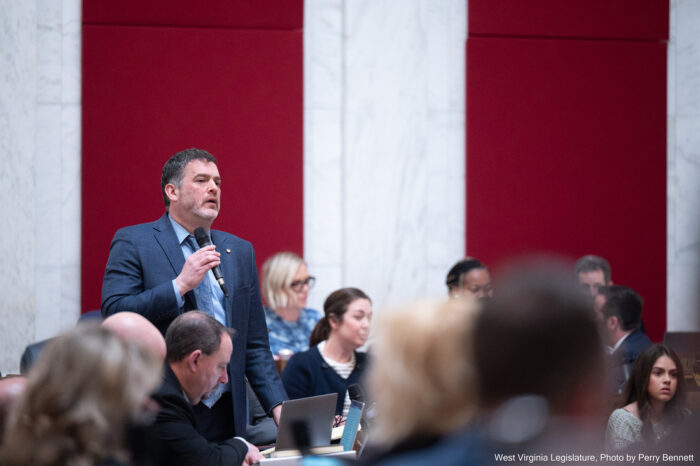
Del. J.B. Akers, R-Kanawha, addresses his fellow lawmakers on the floor of the West Virginia House of Delegates on Friday.Perry Bennett/WV Legislative Photo
Listen
Share this Article
In recent years, some political organizations and public interest groups have pointed to ranked choice voting as a means of improving elections nationwide and better representing the wants of voters. The practice allows voters to rank their candidates by preference, instead of voting for just one.
But the process has become a point of bipartisan contention, with several Republican-led state legislatures advancing bills that would prohibit the process within their jurisdictions. That debate has spilled over into the West Virginia Legislature in the shape of Senate Bill 490.
The West Virginia House of Delegates on Friday passed Senate Bill 490, which would codify in the West Virginia Code that ranked choice voting is prohibited, and that efforts to adopt the process on the state or local level are void.
The bill had already passed the West Virginia Senate on Tuesday, where it was originally proposed by Sen. Jack Woodrum, R-Summers.
Del. Mike Pushkin, D-Kanawha, speaks against the potential prohibition of ranked choice voting in West Virginia on the House floor Friday.
Photo Credit: Perry Bennett/WV Legislative Photo
Ranked choice voting is already not practiced in the state. Proponents of the bill, like Del. J.B. Akers, R-Kanawha, describe it as a “proactive” effort to uphold the integrity of elections in West Virginia.
“We often pass legislation in this body proactively,” Akers said on the House floor Friday. “If we see a problem somewhere else, we try to address it before it’s in West Virginia.”
But opponents of the bill say banning a practice not in place has little effect. Del. Mike Pushkin, D-Kanawha, argued that the bill would prohibit a practice that “promotes civility in politics,” and is already used to select committee chairs in the state legislature itself.
“If you’re running against somebody [and] you think that y’all are pretty close there, you want [to be] their voters’ second choice,” Pushkin said on the House floor Friday. “So you’re not going to attack them, because you want their folks to give you their second choice.”
Despite the pushback from Democratic lawmakers, Senate Bill 490 passed the House by a vote of 87-9 on Friday. It now returns to the state’s Senate for a final review, before heading to the governor’s office for approval to become law.
Add WVPB as a preferred source on Google to see more from our team
On this West Virginia Week, nuclear power in West Virginia takes a step back, Child Protective Services (CPS) settles with five children, and we make a visit to a fire tower.
An autism non-profit says a series of barriers including low Medicaid reimbursement rates have made it all but impossible for the majority of West Virginia children diagnosed with autism to receive the treatment they need.
West Virginia brought in $16 million more than projected for September, 3% ahead of estimate. For the first three months of the fiscal year, collections are up $62 million with increases in most – but not all -- categories.
Five children, abused at the hands of their adoptive parents and now 8-18 years of age, will share $4.4 million following an agreement between their attorneys and the state of West Virginia.