This week, before emancipation, Appalachia provided pathways to freedom for enslaved people trying to escape bondage. A new project identifies more than two dozen previously unknown underground railroad sites. Also, the Fly Around Music & Arts Festival in North Carolina was inspired by the hard work that followed Hurricane Helene. And, a ballad about floods recorded a generation ago still provides solace for people today.
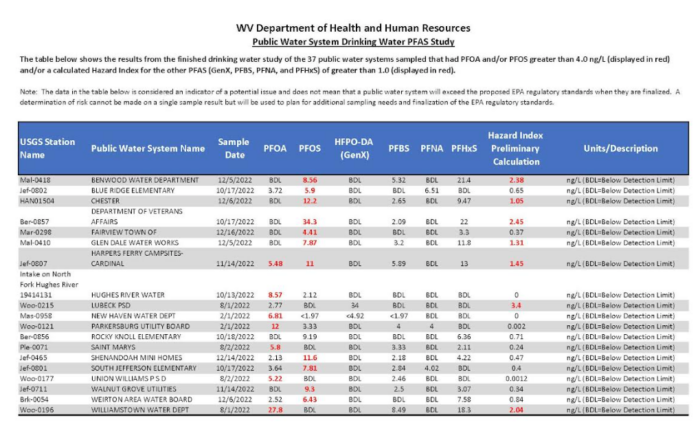
Of those, 19 water systems have levels that are above at least one of the U.S. Environmental Protection Agency’s proposed regulatory standards according to the West Virginia Department of Health and Human Resources and the West Virginia Department of Environmental Protection.
Under the direction of DHHR, USGS sampled the finished drinking water of 37 systems previously identified as having certain PFAS compounds in their raw-water (pre-treated water) source, to determine which systems need additional or upgraded treatment.
Courtesy West Virginia Department of Health and Human Resouces and the Department of Environmental Protection.
A chart depicting West Virginia’s finished water testing results for the 19 systems, Public Water System Drinking Water PFAS Study, may be viewed here.
DHHR’s Bureau for Public Health and DEP are working with these 27 systems through a working group formed in March 2023 to evaluate treatment processes and best approaches to removing these compounds from finished water, as well as identify funding options to minimize the burden on customers.
There is currently no regulatory requirement for states or public water systems to conduct sampling. EPA has proposed to regulate certain PFAS compounds, PFOA and PFOS, at a Maximum Contaminant Level (MCL) of four parts per trillion, require public water systems to monitor for certain PFAS compounds, and notify consumers and reduce PFAS levels if they exceed the regulatory standards. EPA expects to finalize this rule by the end of 2023.
West Virginia has been testing finished water to be proactive. The PFAS Protection Act, or House Bill 3189, requires the DEP to identify and address PFAS sources, develop action plans and improve reporting requirements. Senate Concurrent Resolution 46, which passed during the 2020 legislative session, requested DHHR and DEP propose and initiate a public source water supply study plan.
“While a determination of risk for consumers cannot be made based on the preliminary results of this study, this data helps us plan for when final testing is complete and the EPA rules are finalized,” said Dr. Matthew Christiansen, state health officer and commissioner of DHHR’s Bureau for Public Health.
West Virginia will receive $18.9 million in federal funding over two years to address emerging contaminants like PFAS in drinking water. That funding can be used for a wide-range of activities, including research and testing, treatment, source water activities, restructuring, consolidating, or creating water systems, and technical assistance.
“The quick action to form a working group allowed West Virginia water systems and state partners an opportunity to share knowledge and resources at an early stage,” said Dr. Christiansen. “DHHR and DEP will coordinate with impacted communities to administer the federal funding.”
Additional samples of finished drinking water may be collected from sampling points located at the entry point to the distribution system and analyzed for PFAS compounds of concern.
“This information is another vital step forward in our efforts to address this issue,” said DEP Secretary Harold Ward. “The DEP, DHHR, and our local water systems can make more informed decisions and take appropriate next steps to ensure that safe, clean drinking water is accessible to all communities across West Virginia.”
PFAS are chemicals used in thousands of applications throughout the industrial, food, and textile industries and are an ingredient in some firefighting foams, food packaging, cleaning products, and various other household items. They are classified as possible carcinogens and may create other adverse health effects. Exposure to PFAS over a long period of time may lead to negative health effects.
Add WVPB as a preferred source on Google to see more from our team
The industrial warehouse fire in Parkersburg is completely out and the shelter in place order has been lifted. Now is the time for cleanup and remediation, as well as an investigation into what caused the blaze.
A fire in a Wood County industrial storage facility prompted Gov. Patrick Morrisey Sunday to declare a State of Emergency. Firefighters battled the blaze at the Peoples Cartage warehouse on Camden Avenue in Parkersburg.
The Chemours Company has agreed to pay $450 million for PFAS (per- and polyfluoroalkyl substances) releases at four facilities in three states, including West Virginia.
































 Kozorog/Adobe Stock