Alert (09/29/2026): Our Parkersburg TV transmitter is still undergoing maintenance and remains temporarily inoperative. We apologize for the inconvenience.
All our programming is available via our TV livestreams on our website and WVPB Passport. Thank you for your patience!
Our premiere fall broadcast season of Mountain Stage continues this week when host Kathy Mattea welcomes Tony Trischka’s EarlJam featuring Michael Daves, Buffalo Wabs & The Price Hill Hustle, Jack Barksdale, and Sarah Borges.
Park Service Uses Fire To Fight Fire — Even In W.Va.
Listen
Share this Article
The Western United States is suffering through heatwaves and long-term droughts, raising fears of more out-of-control wildfires burning hundreds of thousands of acres this year. That is on top of record breaking wildfire seasons in recent years.
West Virginia is the third most forested state in the nation, and second in standing hardwoods like maple and oak, according to the National Association of State Foresters. According to a 2016 survey from the U.S. Department of Agriculture Forest Service, approximately 78 percent of the state’s total land area is made up of forest land.
Eric Douglas
/
WVPB
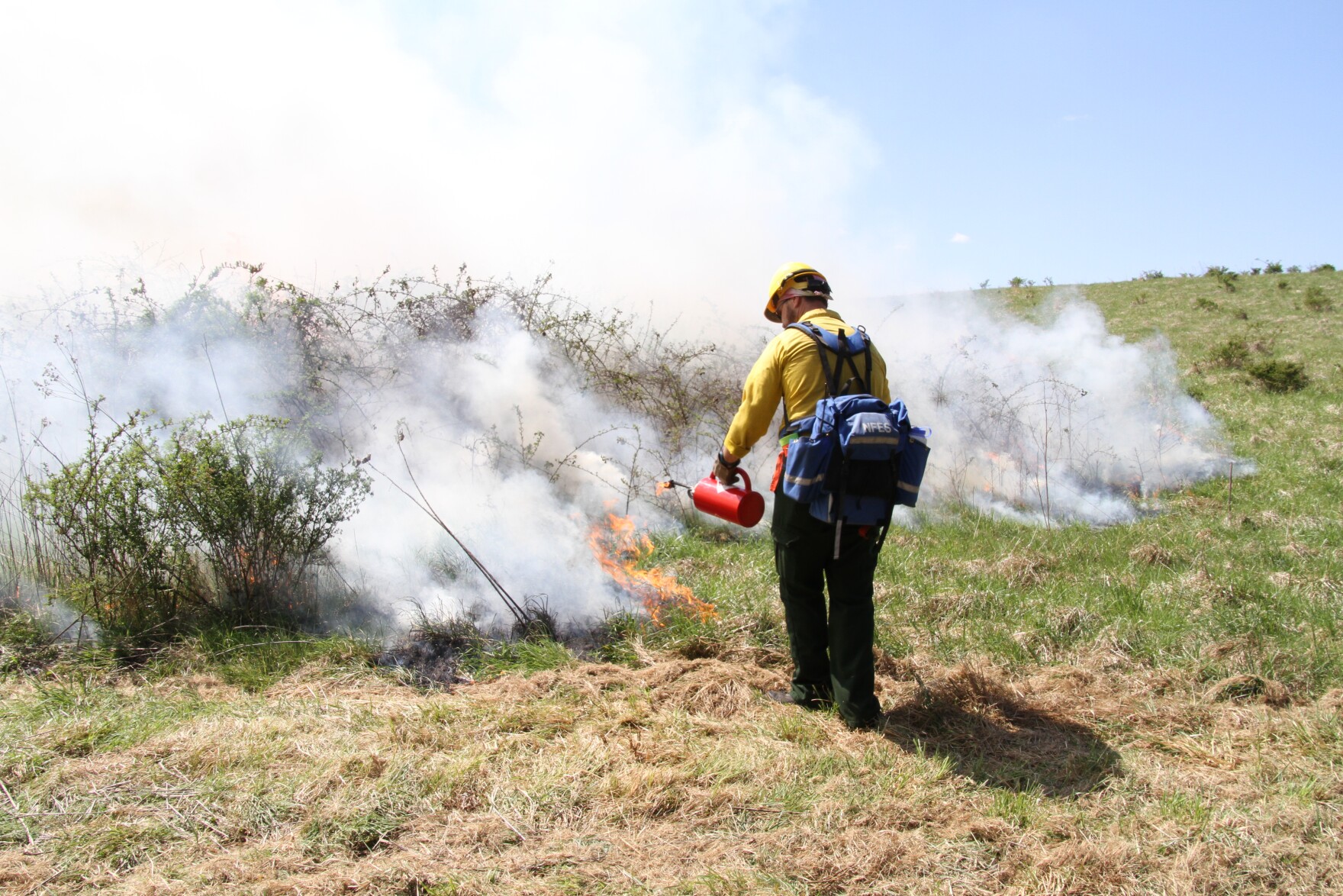
Smoke rolls upward from a prescribed burn in Grandview in Raleigh County.
For years, the National Park Service and the forest service put out every fire in the forests as quickly as they could. But they have since learned there is a better way.
Aaron Kendall is the fire management officer for the Monongahela National Forest. He says the forest service has multiple fire units with different goals in mind, depending on where they work.
“Some of them are more towards wildlife or just the diversity of the forest itself,” he said. “And then some of them are to reduce fuel loading, you know, to hopefully prevent the spread of a catastrophic wildfire. It’s a balance.”
Kendall noted that while forest fire risk in West Virginia is not nearly as high as it is in the West, it varies within the state.
“Here in the Elkins area, we have a lot of rain, and so it’s a little less likely to have some type of wildfire,” he said. “But you go just a little bit to the east of us, on the other side of the ridge over towards Petersburg, or White Sulphur Springs on that side of the forest, and it’s a different story. They don’t get nearly as much precipitation. The fire danger can change more rapidly down there.”
Today, the approach has more to do with fires in proximity to houses and buildings.
“You get more and more people moving into what was more of a wild area,” Bieri said. “If you don’t burn those areas, you’ve got to put fires out when they’re close to people’s homes so it just increases that risk.”
A National Park Service firefighter emerges from the smoke during the prescribed burn at Grandview.
Fires set intentionally are called prescribed fires. The park service has a “prescription” or a plan for the fire. The recent prescribed fire at Carper Fields at Grandview was for habitat protection.
“That’s a burn that we do for habitat maintenance and restoration,” Bieri said. “It’s to basically burn out the woody shrubs and invasive species to help maintain a native grassland habitat for wildlife.”
Both Bieri and Kendall worked in western states for the park service before coming to West Virginia. Bieri says we do have some of the same problems Western states face.
“We definitely have the urban interface in terms of people living in forested areas around the park. But we luckily don’t have the fire danger as extreme as it is in places out west,” he said.
On the other hand, Bieri brought up the fires that hit the Great Smoky Mountains in 2016.
“That was a major urban interface issue that burned down quite a lot of homes and businesses around the Gatlinburg area. It’s not just a Western problem, it can certainly happen in the East,” he said.
The overall fire danger in West Virginia is moderate right now, but it can increase in the dry fall months when leaves are falling and trees are dried out.
Add WVPB as a preferred source on Google to see more from our team
Many of the devices we use in our daily lives run on rechargeable lithium-ion batteries. Be aware that damaged or incorrectly charged batteries can overheat, start a fire, or even explode.
During spooky season, popular attention turns toward ghosts and goblins – or if you live in Appalachia – cryptids. For the Appalachia + Mid-South Newsroom, Bill Lynch, producer of Inside Appalachia, brings us the story of the Flatwoods Monster.
A specific style of ballroom dance is helping disenfranchised young people find community in Appalachia. In our latest episode of Inside Appalachia, we explore LGBTQ ballroom culture and community in Roanoke, Virginia. Mason Adams has this excerpt.