


Your browser doesn't support audio playback.
This story originally aired in the Nov. 22, 2026, episode of Inside Appalachia.
Flipping through the menu at a roadside restaurant in Surry County, North Carolina, you might stumble upon an unfamiliar word: sonker.
But wait — what’s a sonker?
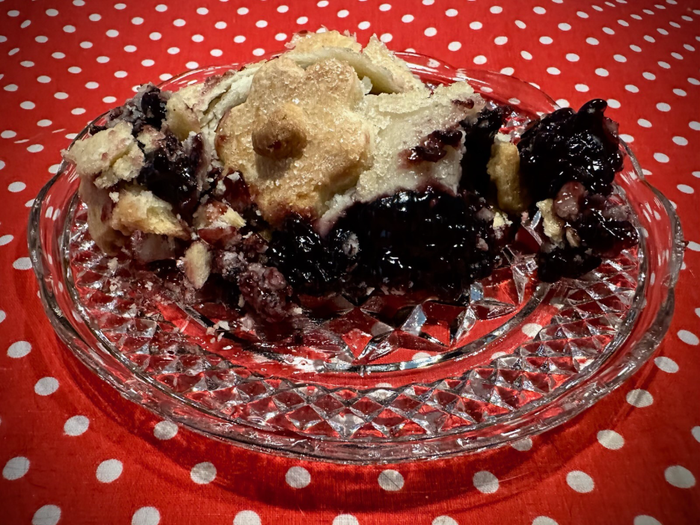
Sonker is a local dessert. Surry County native Mark Goin, whose family has been here since the late 1700s, says it’s like a fruit cobbler, but different.
“It’s a shortcut to a cobbler. Cobbler has a bottom in it. Where your sonker, you just mix up your batter and dump it in with your fruit and all,” Goin said.
Sonker is believed to be unique to Surry County, and it dates back more than a century. Traditionally, locals made the filling from fruit foraged or grown on their own land, and the dough used flour that they milled themselves.
Goin says the dessert was usually made for large gatherings, like the fall harvest, when there was no time to bake a complicated dessert.
“The roots of it was a shortcut because you got a lot to cook, a lot of mouths to feed, you don’t have all the time to be rolling out dough,” he said. “And that’s it, dump it in there, bake it and that’s it.”
Where did the name come from?
Local historian and president of the Surry County Historical Society Annette Ayers says the word has Scotch-Irish origins.
“The first time we heard of that word was in a Martha Washington cookbook,” Ayers said. “Martha Washington referred to the word and said her Scotch-Irish cook used that word. Now in Scotland, sonker means like a swayback hill, and we think the appearance of the pie gave the cook that idea.”
That makes sense. When the dough rises through the sweetened filling, it makes mounds that look a little like low hills.
The society has hosted the annual Sonker Festival since 1980. The festival raises funds to preserve and showcase a home from the 1790s.
Ayers says the abundance of fruit was also important.
“People had berries when they moved into the area. They had apples from the orchards they planted or the native apples. We were what we call subsistence farmers. What you ate is what you produced. And so, you always gleaned from the countryside whatever you could.”
On Oct. 3, the Surry County Historical Society hosted the 45th Annual Sonker Festival in Mount Airy. The day was filled with old time string music, local history and of course a variety of delicious sonker.
A sonker recipe book that was drafted for the original festival in 1980 was available for purchase. It features recipes submitted by Surry County residents in their own words. Some of the recipes are short on details: For example, one starts with “make your biscuit dough” with no further instruction for what to put in the dough — because it was presumed that all locals knew how to make biscuits.
Sonker tradition in the area goes beyond the festival. In 2015, Surry County established the Surry Sonker Trail to encourage year-round interest in the region’s heritage dessert. The trail includes 11 stops that serve sonker, including bakeries, restaurants and general stores in Mount Airy, Elkin, Dobson and Pilot Mountain, North Carolina. One of the original trail stops is Miss Angels Heavenly Pies in Mount Airy.

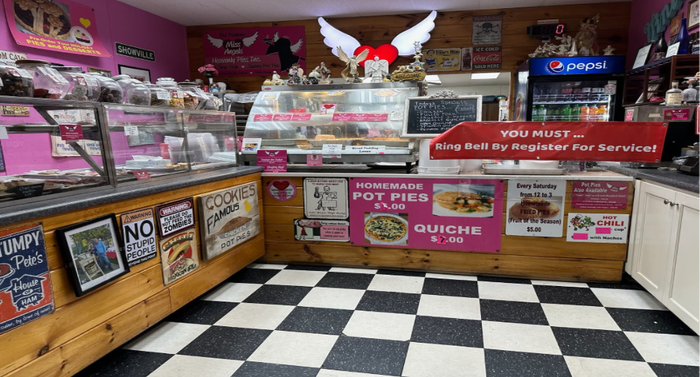
Photo Credit: Amanda Goins/West Virginia Public Broadcasting
The bakery’s walls are lined with vintage signs and displays filled with freshly baked pies, cakes, cookies and other tantalizing sweets. Angela Shur is the owner and baker here. She moved here with her husband from Long Island, New York, in 2006, and says she had her first encounter with sonker soon after.
“It was Thanksgiving. I was doing my Thanksgiving pies, and a woman had come in and asked me for a sweet potato sonker,” Shur said. “And I had no idea what she was talking about. “
It wasn’t just the word that caused confusion.
“The dialect was different anyway, so she couldn’t really understand me. I really couldn’t understand her. So, when she spelled it for me what it was, I started researching it in front of her and I started saying, ‘Oh, a cobbler.’ And she kept saying, ‘No, it’s a sonker.’ And then I finally realized what she was saying.”
Shur soon added sonker to the menu at Miss Angel’s Heavenly pies.
“I started on the weekends right away because we got a lot of tourists during the week,” Shur said. “But a lot of the locals come in here on the weekends because they’re off from work.”
Miss Angel’s sonker is made with fruit from their 65-acre orchard.
“Whatever fruit is coming in is usually the ones I’ll make,” she said. “We also have about 25 bee hives on our farm. So, when we sweeten it, or we sweeten the fruit to go in there, I don’t like using sugar. I strictly use honey as a base.”
There is one other factor that sets Angela’s sonker, or as she calls it ‘zonker’ apart. This region of North Carolina also has a history intertwined with moonshine, so Angela infuses her glaze with the spirit.
“Yes, and we call it ‘bonkers for zonkers,’ because supposedly when we use the alcohol, you go bonkers.”
Shur says she noticed that locals have a sense of pride seeing this traditional treat featured in her bakery. “The older generation, it touches a little bit of home to them. It reminds them of their Papi’s Day or their Mommy’s Day when they did it, you know, or when they were picking fruit for it or carving out the apples. I think culture is too easy to be forgotten. And this is not forgotten.”
So, if you’re ever in Surry County, North Carolina, and see the word sonker pop up on a menu or festival ad, remember that it’s a sweet combination of dough, fruit and Appalachian resourcefulness.