


Your browser doesn't support audio playback.
This story originally aired on the July 26, 2026 episode of Inside Appalachia.
At the corner of a busy intersection in downtown Wytheville, Virginia sits a large garden and a greenhouse. Lexi Reiman spends time each day in this greenhouse, and her hard work is clearly paying off.
She points to several different plants in the greenhouse.
“We have everything from herbs to suyo long cucumbers, loofah squashes, jalapenos, cherry chocolate tomatoes and a huge tray of marigolds,” Reiman said.
To the untrained eye, they all look the same — like little green seedlings. But Reiman, who is now in her thirties, grew up with a family garden. The greenhouse she tends now belongs to Open Door Café. It sits beside the cafe kitchen and dining room.

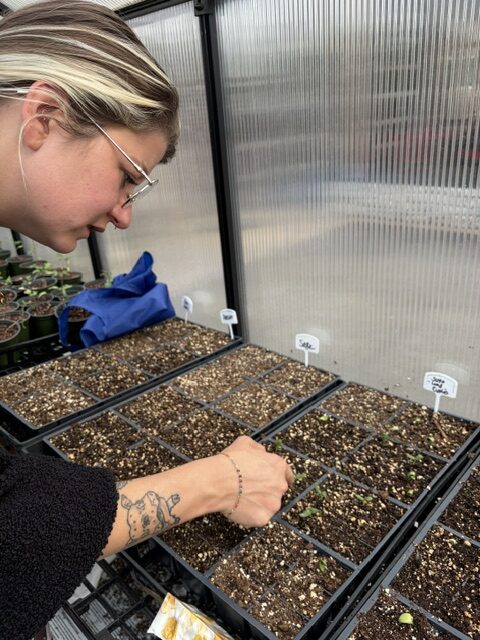
Photo Credit: Wendy Welch/West Virginia Public Broadcasting
The non-profit opened in 2012 as a soup kitchen supported by faith communities. Six years later, the kitchen had morphed into a restaurant where people could buy meals with money or labor. By 2022, Open Door had a garden to help keep costs down for the cafe. Reiman started volunteering the next year on court-ordered community service hours.
Reiman says she got a traffic violation years ago and had to do community service.
“And I started volunteering here at the café, and I never left,” she said.
For those unfamiliar with the court system, people convicted of misdemeanors can do community service in place of a fine or jail time. Offenders get to choose from a group of civic organizations or non-profits. In Wythe County, that list includes Open Door Café.
When her required volunteer hours were over, the directors offered Reiman a job overseeing the garden that supplied food to Open Door and the volunteers who supplied its labor.
Reiman understands the substance use that affects so many of the community service volunteers. She celebrated five years of sobriety at the time of this interview.
“When you quit drinking, you quit doing drugs, learning how to garden, grounding yourself, getting out there, breathing new life into things can help you breathe life into yourself,” she said. “And we’ve actually had quite a few individuals from drug court work in the garden.”
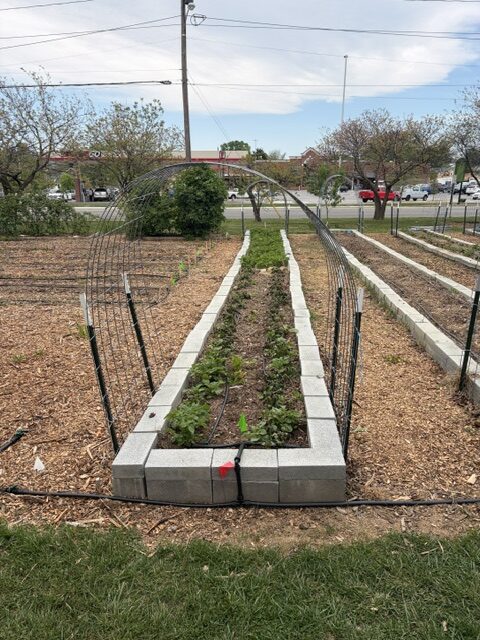
Photo Credit: Wendy Welch/West Virginia Public Broadcasting
Open Door has three types of volunteers. Core volunteers are community members helping out. Community service volunteers work off court-ordered hours. Meal volunteers work 30 minutes in return for a plastic card they hand in at the register. They can then choose any meal from the menu. Many 30-minute-volunteers are in sheltered housing or homeless.
“Every single one of us is closer to being homeless than we are to being the next millionaire. We’re one medical emergency away, and there’s an awful stigma,” Reiman said.
She says people often don’t want to talk to unhoused people or even look at them.
“People don’t touch homeless people for the same reason that back in the ‘80s and the ‘90s people wouldn’t touch individuals with AIDS,” Reiman said. “They think they’re dirty, they think it’s gross, they think it’s gonna rub off on them.”
For Reiman, this is personal. Her brother, eight years her senior, lived on the streets for years.
“I will never forget what it felt like, when me and my friends were leaving Target one afternoon, and we were at the stop sign and one of the girls looks over and she goes ‘Isn’t that your brother?’” she said.
He was holding a sign asking for money and food.
“And I just kinda said ‘no I don’t know who that is,’” Reiman said.
The stigma and shame she felt in that moment guides her interactions with her homeless volunteers every day, she says. She makes sure to greet them by name. And in the dining room, people eating by voucher mixing with customers who paid cash is important to her.
“My district attorney is maybe sitting at the same table as a homeless individual. The individual who oversees the drug court could be sitting there. We want everyone to mesh together to create a community in the café,” Reiman said.
Reiman also says that she hopes mixing those who worked in the garden with those who paid to eat allows conversations that fight stigma toward homeless people.
“Homeless people are no different than you or I and if we sit down with them and listen to them, we might learn something,” she said.
Those town officials might sit by someone like Jeff Hatfield, who volunteers almost daily in return for meals. Hatfield is best known around Open Door by his nickname, the “Compost King.”
“See how this right here, that’s real dry. And then all this up through here, all that’s wet,” he said.
Hatfield says the wet is green compost, the dry is brown. The two mixed together create fermentation, which leads to great garden dirt, all made from scraps people throw away.
Poking the pile with his shovel, Hatfield identifies things that are slowly turning into dirt.
“You got wood chips, potato, I believe that right there might be an onion. Crackers. And that’ll all decay and turn into dirt, then it goes into the garden,” he said. “Kinda makes me proud a little bit because I know I done that. I made that grow. I made that grow.”
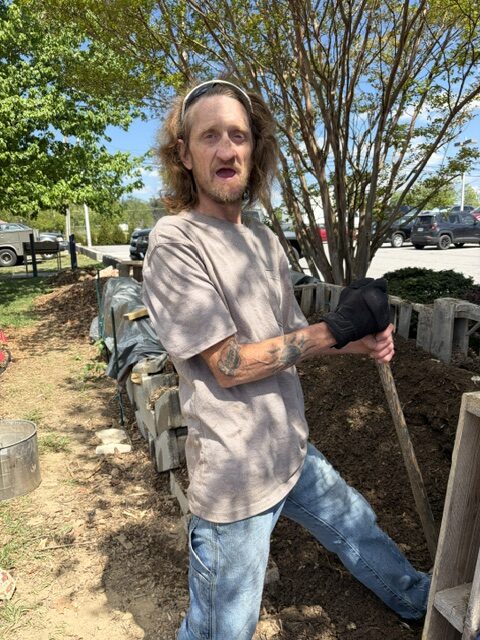
Photo Credit: Wendy Welch/West Virginia Public Broadcasting
Hatfield takes pride in his composting; he also takes pleasure in the meal it provides.
“The chef in there? Great cook. I don’t have to do dishes; I don’t have to cook it. I get out of the house, away from the house,” he said.
Doing dishes is a pain at his place, Hatfield says. He tends a garden on private land in return for the right to pitch his tent there; running water not included.
Melissa Turner also lives in a tent. She became homeless around the same time she turned 50-years-old. Turner describes living a middle-class existence until her husband had a heart attack and lost his job and medical insurance. Within a year, the family went from a brick ranch home to nine people in a single-wide living with Turner’s mother.
Turner is spending this summer in the tent, but over the winter, she slept in the cab of the family truck because space was tight.
Food was tighter. Being homeless is hard, Turner says. But far worse, and the thing she fears most, is being hungry again.
“It’s the worst thing you could ever imagine. It hurts. You wake up of a morning, you hurt, you go to bed at night, it hurts,” she said. “It don’t ever go away. Even after you eat, you still feel hungry.”
In the fall of 2025, Turner started as a community service volunteer, working to pay off court costs and fines. The judge suggested she do her time at Open Door. And like Reiman, once her court-ordered time was over, she stuck around.
Now, two to three days a week, Turner shows up as a core volunteer. At the end of these days, she goes home with cafe meals for her family.
At first, Turner did simple tasks like cleaning in the kitchen or helping unload food donations from the non-profit’s van. She really wanted to volunteer in the garden. But she worried.
“Honestly, my entire life I’ve always wanted to grow something, anything. And I never been able to. Everything I’ve ever put in the ground, it always died,” Turner said.
When spring came, Reiman offered to show Turner how to work in the garden.
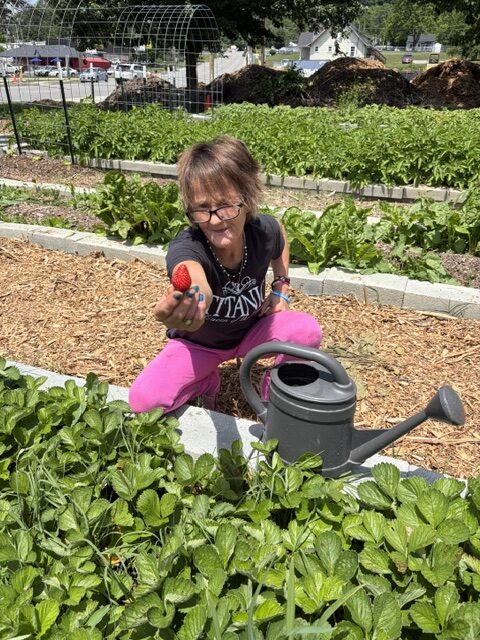
Photo Credit: Wendy Welch/West Virginia Public Broadcasting
They started with recognizing planted rows so she could avoid stepping on them as she watered.
When things began to grow, Reiman showed Turner which plants were weeds to be pulled and which were potatoes and onions. On a sunny June day, Turner had progressed to strawberries.
Reiman kneels in the strawberry patch and moves plants with her hands until she finds what she is looking for. She holds up a small vine coming off a main stem of a strawberry plant.
“This is a daughter. Do you see the vines? So, that vine is coming off the main plant and it’s gonna come over here, and it’s gonna root,” Reiman said. “ And it will start a new plant. You can root these in your yard. And it will grow everywhere.
Turner grins at Reiman
“Oh, I like coming here,” she said.
Next to the daughter plant is a berry, which Reiman picks and pops into her mouth. She grimaces.
“I think a bug ate half this berry,” she said.
Reiman says teaching Turner to garden can help protect her family from being hungry this winter. This is how Open Door Café’s garden grows. And fights hunger. And weeds out stigma.
--
This story is part of the Inside Appalachia Folkways Reporting Project, a partnership with West Virginia Public Broadcasting’s Inside Appalachia. Subscribe to the podcast to hear more stories of Appalachian folklife, arts and culture.