


Your browser doesn't support audio playback.
This conversation originally aired in the Sept. 27, 2026, episode of Inside Appalachia.
The National Hockey League, including the beloved Pittsburgh Penguins, kicks off its new season next week. Minor league and college teams will soon follow suit. But at a grassroots level, hockey still isn’t all that big of a sport in central and southern Appalachia.
That can make it hard for a hockey lover to get her start.
Inside Appalachia Associate Producer Abby Neff met a woman who made it anyway, all the way to the Olympics.

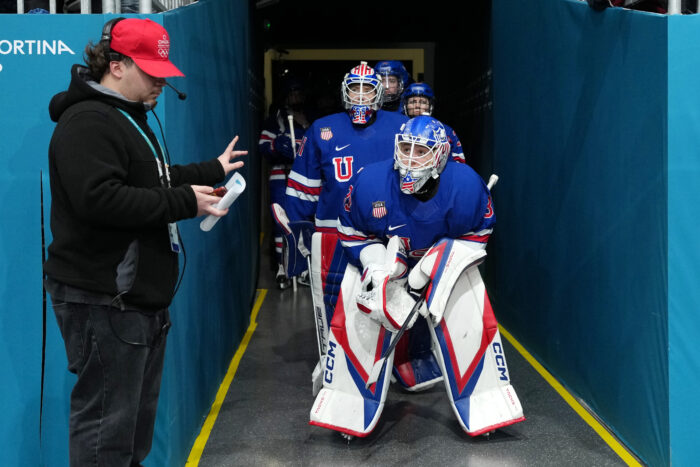
Photo Credit: Carolyn Kaster/AP Photo
The transcript below has been lightly edited for clarity.
Philips: My name’s Gwyneth Philips and I’m an ice hockey goalie. I play for the Ottawa Charge in Canada and for the [Olympic] U.S. Women’s National Team.
Neff: So, Gwyn, what’s your favorite thing about being on the ice?
Philips: Oh, that’s a really good question. I think that I can just kind of be myself. I think if you watch me play and if you know who I am, you can really see my personality come through and I think that’s the most fun. I mean, even in practice, I just have fun having fun.
Neff: And, at the Olympics, you weren’t only representing Athens [Ohio], but also Appalachia. What does that mean to you?
Philips: I think it’s great. I treasure this little part of the world. And you know, hockey’s not a big sport around here, but maybe I’m inspiring a few kids to play hockey or at least get into sports. I have a lot of pride in representing this Appalachian area.
Neff: Can you tell me a little bit about your early days in hockey? I know you played some places other than Athens.
Philips: It’s a lot, and there’s some good stories in there.
I started playing in Athens and I eventually kind of started to grow out of that and I kind of wanted to start challenging myself. So, I started playing in Columbus [Ohio]. So, two, three times a week, my parents would be driving me the 90 minutes to Columbus and back.
But I still wanted to play with my Athens friends, so I started double rostering. And then somewhere in the story, the board said, “Hey, if you keep doing this, your daughter is not allowed on the rink and we’ll call the cops.” And I called them on that bluff. Eight-year-old me showed up to the rink, and I think they called the cops, and I had to run away. So, eventually, we convinced them to not do that, and I got to keep playing with my Athens friends.
And then I even played in Newark for a little bit where I started playing goalie. And then in high school, I kind of made the full move to Pittsburgh and wasn’t really able to play on the Athens team anymore.
But I was a full-time goalie by my senior year of high school, and the Athens team was doing just a random tournament for Thanksgiving, and I was in town and they invited me, and I got to play with a bunch of kids I hadn’t played with in, four or five years. And that was just really fun.
And then, went to Pittsburgh High School and then Boston for five years in college and now in Ottawa.
Neff: Wow.
Philips: Yeah, I mean, it was a lot. My parents made a lot of sacrifices too, right? We’d get home at 1 a.m., three nights a week, from practice in Columbus. And then my dad would have to get up for work in the morning, and my mom would have to wake me up for school.
So, it was a lot, but I think that kind of shaped me into who I am. And then, at a young age, I kind of had to make the commitment to the sport, because I was putting a lot of time into it. And obviously I was having fun, but as I was getting better, I was realizing, I’ve put a lot into this. Let’s see what I can get out of it.
Neff: When did that happen for you? What point did you decide to really commit to it?
Philips: This is silly — they’ve changed the rules now — but when I was in seventh grade, colleges would send out an email … “Would you be interested in our school? Fill this form out.”
That was all it [was]. But in my mind, in my parents’ minds, I’m being recruited to play D1 hockey already. I’m like 12 or something.
So, that was the time when it opened up my eyes to show me like, “Oh, I could leverage this and maybe get a better education with it.” So, that was kind of when I started to really put my time into it, but it never really felt like works. I loved it and I never really considered like, “Oh, I’m doing this just to go to school or something.” I was doing it because I loved doing it.
Neff: Could you tell me a little bit about your experience at the Olympics? Personally, I’ve never been.
Philips: Yeah, I mean, it’s a whole process. You’re just kind of in this bubble or this radar of the national team. They do camps throughout the year and evaluate the team.
There’s a few games that, a rivalry series where you’d play Canada, where they take their players that they think should make the team and maybe they make a cut or two for the main event, which is Worlds or the Olympics.
So, leading up to the Olympics, we had like four or five, 10-day camps in the months leading up where we got back into shape and started to build that team chemistry. And throughout that, they were making cuts slowly. So, each camp, usually one or two less people came to the next one.
But usually, at least for me, I never consider myself on the team until the cuts are made because it’s so competitive and that’s what makes it so successful. But you got to fight for your spot each camp.
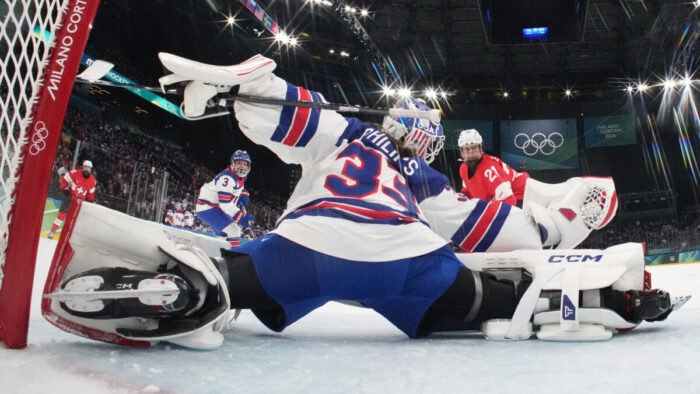
Photo Credit: Mike Segar/Pool Photo via AP
Neff: I just can’t stop thinking about what it felt like to be in Milan and be with your team as someone who grew up here. It’s a pretty small area and it’s pretty secluded. How did you feel your world expand?
Philips: I mean, I connect so much with Athens. I started playing hockey here, but so much of my career took place outside of it. So, when I think of Athens, like I don’t really connect it to my hockey route so much. It’s more the people. So, when I was in Milan, I was expecting the brunt of my support to come from where I played college hockey or where I played hockey in high school.
And honestly, I was wrong. The support I saw in Athens, I was so unprepared for. I had no expectation, and what I saw was insane. The local restaurants were reaching out, and I worked with Avalanche to do a thing and that was so cool.
Neff: The “Gwynzilla” pizza.
Philips: Yeah, which is my favorite pizza. So, I did that. I had teachers from first grade [direct messaging] me, and kids that, maybe they play hockey, maybe they don’t, reaching out.
It was just really cool because again, I don’t connect this place to hockey too much, but to see all that support … I heard there was a banner down Court Street. The cool thing about Athens is, there’s all the college kids, too. So, all these college kids are reaching out and they don’t usually — why do they care? They’re not really from here, but they have a love for the town and they see that support. So, it was really cool to see that.
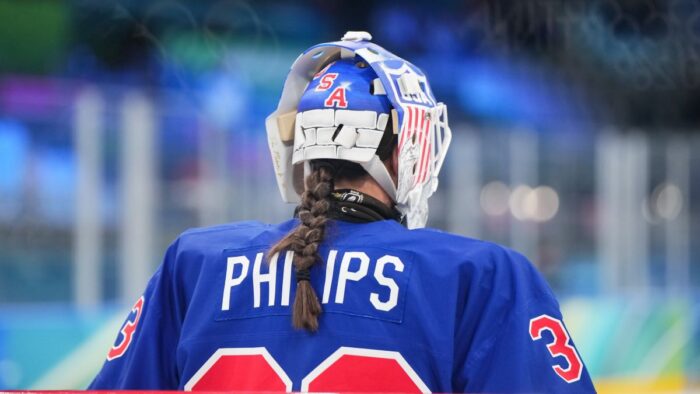
Neff: One thing I did want to mention was in your helmet, the bricks. How did you do that?

Philips: So, goalies paint their helmets. They’re all custom. And typically, you save the back plate for more of a personal design. So, starting in college, when I started painting my helmets because I was not paying for that before college, I would put the bricks on the back, the “Athens Block.”
And so, all my helmets — college, pro and the Olympics — always have some variation of the Athens Block on the back, because I just think that’s super cool. One, goalie brick wall whole thing. And then also just Athens Block is such an iconic piece of Athens. I mean, they’re constantly being stolen from the college green, which I think is hilarious. I know we have some decorating the house.
So yeah, I always add that to my helmet.
Neff: Well, Gwyn, thank you so much for sitting down with me today.
Philips: Yeah, no, thank you for having me. This was fun. It’s always fun to reminisce on Athens and Appalachia.